Freshly Printed - allow 10 days lead
Couldn't load pickup availability
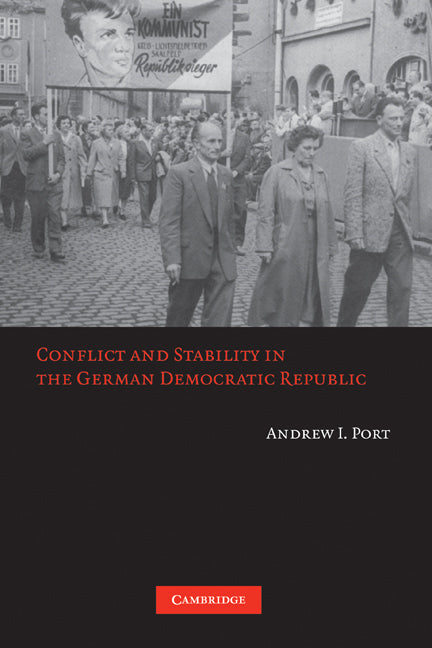
Conflict and Stability in the German Democratic Republic
This book explores the reasons why the post-World War II Communist regime in East Germany outlasted both the Weimar Republic and the Third Reich.
Andrew I. Port (Author)
9780521744171, Cambridge University Press
Paperback / softback, published 6 October 2008
326 pages
23.4 x 15.6 x 1.7 cm, 0.46 kg
'Port provides a compelling and eloquently written argument which brings us closer to understanding the precarious stability of the GDR and the highly nuanced internal workings of the regime. … the detailed notes provide an exhaustive selection of secondary reading, and the broader context is clearly outlined for readers with a less detailed knowledge of the GDR.' The Slavonic and East European Review
Why did the German Democratic Republic last for so long - longer, in fact, than the Weimar Republic and the Third Reich combined? This book looks at various political, social, and economic conflicts at the grass roots of the GDR in an attempt to answer this question and account for regime stability. A local study, it examines opposition and discontent in Saalfeld, an important industrial and agricultural district. Based on previously inaccessible primary sources as well as on interviews with local residents, the book offers a novel explanation for the durability of the regime by looking at how authorities tried to achieve harmony and consensus through negotiation and compromise. At the same time, it shows how official policies created deep-seated social cleavages that promoted stability by hindering East Germans from presenting a united front to authorities when mounting opposition or pressing for change. All of this provides an indirect answer to perhaps the major question of the postwar period: Why did the Cold War last as long as it did?
Part I. Upheaval (1945–53): 1. Creating a 'new order'
2. The GDR's 'first strike'
3. The revolution manqué of June 1953
Part II. The Calm after the Storm (1953–71): 4. The limits of repression
5. Exit, voice, and apathy
6. Power in the people's factories
7. Achieving harmony on the shop floor
8. Divide and rule?
9. 'I comes before we' in the countryside
10. 'Whatever happened to the classless society?'
Subject Areas: Postwar 20th century history, from c 1945 to c 2000 [HBLW3], European history [HBJD]