Freshly Printed - allow 7 days lead
Couldn't load pickup availability
Condition-Based Maintenance and Residual Life Prediction
Chandan Deep Singh (Edited by), Davinder Singh (Edited by), Kanwal Jit Singh (Edited by), Harleen Kaur (Edited by)
9781119933120, Wiley
Hardback, published 21 March 2025
304 pages
22.9 x 15.2 x 2 cm, 0.509 kg
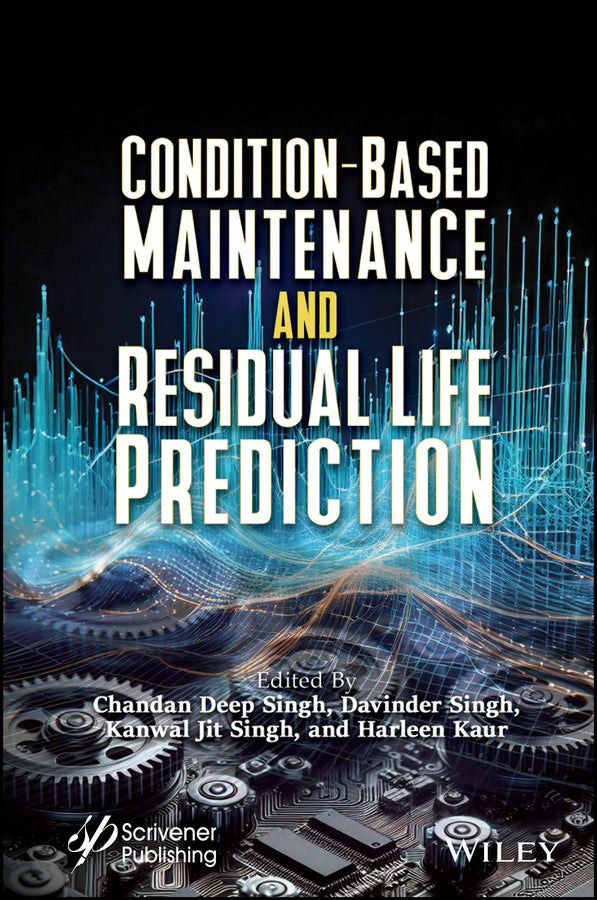
Condition-Based Maintenance and Residual Life Prediction is essential for those looking to effectively implement condition-based maintenance strategies and enhance fault detection through a comprehensive understanding of vibration data analysis and residual life prediction, addressing key challenges in the field. Issues related to condition-based maintenance include its high initial cost, new techniques that can be difficult to implement due to resistance, older equipment that can be difficult to retrofit with sensors and monitoring equipment, and difficult-to-access equipment during production that is difficult to spot-measure. Keeping the above issues in mind, a general handbook for condition-based maintenance and residual life prediction is required to carry out in fault detection. Condition-Based Maintenance and Residual Life Prediction aims to develop, analyze, and model condition-based maintenance and residual life prediction through vibration data. The analysis of vibration responses will aid in developing a fault detection system. The sources of vibration may be due to the presence of different types of defects, such as cracks in the shaft, a bent shaft, or misalignment of shafts. This will give designers a diagnostic tool for predicting the trends of vibration conditions, leading to early fault detection. The devised tool will be capable of quantifying the amplitude of vibration based on the severity of defects. With the features available in the devised diagnostic tool, the proposed model can be used for design, predictive maintenance, and condition-based maintenance.
1 Maintenance 1 1.1 Introduction and Meaning 1 1.2 Need for Maintenance 2 1.3 Importance of Maintenance 3 1.4 Objectives of Maintenance 3 1.5 The Role of the Maintenance Department 4 1.6 Responsibilities of a Maintenance Engineer 5 1.7 Principles of Maintenance 6 1.8 Maintenance Planning 8 1.9 Management Organization and Structures 10 1.10 Types of Maintenance (Figure 1.2) 12 1.10.1 Breakdown (Reactive) Maintenance 12 1.10.2 Preventive Maintenance 13 1.10.3 Predictive Maintenance 14 1.10.4 Corrective Maintenance 16 1.10.5 Condition-Based Maintenance 17 1.11 Economics of Maintenance 18 1.12 Maintenance Scheduling 19 1.13 Conclusion 20 References 21 2 Condition-Based Maintenance 23 Introduction 23 Applications of Condition-Based Maintenance 31 Advantages and Disadvantages of Condition-Based Maintenance 39 Various PdM Techniques 39 References 44 3 Condition Monitoring 47 3.1 Introduction and Meaning 47 3.2 Advantages of Condition Monitoring 51 3.3 Condition Monitoring Applications 53 3.4 Four Pillars of Condition Monitoring 53 3.5 Setting Up a Condition Monitoring (CM) Activity 55 3.6 Condition Monitoring Types 56 3.7 Condition Monitoring Techniques 58 3.8 Condition Monitoring and Predictive Maintenance: Cost-Benefit Tradeoffs 61 3.9 Conclusion 62 References 63 4 Advanced Maintenance Techniques 65 4.1 Introduction 65 4.1.1 Challenge of Maintenance Function 66 4.2 Traditional Maintenance Techniques 67 4.2.1 Preventive Maintenance (PM) 67 4.2.2 Condition-Based Maintenance 69 4.2.3 Total Productive Maintenance (TPM) 70 4.2.4 Computerized Maintenance Management Systems (cmms) 72 4.2.5 Reliability-Centered Maintenance (RCM) 74 4.2.6 Predictive Maintenance 75 4.2.7 Risk-Based Maintenance (RBM) 76 4.2.8 Breakdown Maintenance (BM) 77 4.3 Advanced Maintenance Techniques 78 4.3.1 Intelligent Maintenance System (IMS) 78 4.3.2 Smart Maintenance 80 4.4 Conclusions 83 References 83 5 Unveiling the Future: Residual Life Prediction for Enhanced Asset Management 87 5.1 Introduction 88 5.1.1 Overview of the Key Challenges and Limitations in Accurate Estimation 89 5.1.2 Objectives of the Chapter 91 5.2 Residual Life Prediction Techniques 92 5.2.1 Prognostic Models 92 5.2.2 Statistical Approaches for Residual Life Prediction 93 5.2.3 Machine Learning Techniques for Residual Life Prediction 95 5.3 Applications of Residual Life Prediction 96 5.4 Conclusion 97 References 98 6 Analysis of Vibration 101 Introduction 101 What is Vibration Analysis? 101 Vibration Analysis Methodology 102 Categories of Vibration Measurement 106 Vibration Analysis: Measurement Parameters 108 Vibration Analysis: Tools and Technology 110 Benefits of Continuous Vibration Monitoring 110 References 111 7 Modeling for Vibration 115 7.1 Introduction 115 7.2 Modeling Techniques for Vibration Analysis 116 7.2.1 ANSYS Simulation 117 7.2.2 ABAQUS Simulation 119 7.2.3 HyperMesh OptiStruct Solver Simulation 119 7.2.4 COMSOL Simulation 121 7.2.5 Mathematical Modeling 123 7.2.5.1 MATLAB Simulation 123 7.2.5.2 Miscellaneous Techniques 124 7.3 Conclusions 126 References 127 8 Impact of Condition-Based Maintenance (CBM) and Residual Life Prediction (RLP) on Environmental Issues 131 8.1 Introduction 132 8.2 Goals of Condition-Based Maintenance 134 8.3 Maintenance Strategies 135 8.4 Determination of CBM Failure Point 137 8.4.1 Vibration Monitoring 137 8.4.2 Process-Parameter Monitoring 138 8.4.3 Thermography 138 8.4.4 Tribology 139 8.4.5 Visual Examination 140 8.5 Decision-Making in Condition-Based Maintenance 140 8.6 Decision Models for CBM 141 8.7 Proportional Hazards Modeling 143 8.8 Maintenance Planning and Scheduling 144 8.9 Maintenance Concepts and Strategies 146 8.9.1 Reliability-Centered Maintenance (RCM) 146 8.9.2 Equipment Failure Behavior 148 8.9.3 Condition-Based Maintenance (CBM) 148 8.9.4 Condition-Based Maintenance Plus (CBMp) 149 8.10 Condition-Based Maintenance (CBM) Technology Enablers 150 8.10.1 Diagnostics 150 8.10.2 Prognostics 150 8.10.3 Usage-Based Modeling 151 8.10.4 Data Mining in CBM 152 8.10.5 Artificial Intelligence in CBM 153 8.10.6 Open System Architecture-CBM (OSA-CBM) 153 8.11 Survey of Recent Developments in CBM 154 8.12 Application Areas of CBM 157 8.12.1 Automobiles 157 8.12.2 IT Infrastructure 159 8.12.3 Process/Manufacturing Industry 160 8.13 Open Research Challenges 160 8.13.1 Real-Time Prognostics 161 8.13.2 Data Quality: Preparation and Selection 161 8.14 Residual Life Prediction 162 8.15 Impact of Environmental Policies on Maintenance 162 8.15.1 Impact of Maintenance Practices 163 8.15.2 How to Reduce Maintenance Environmental Footprint Employing Sustainability-Focused Reliability Strategies 164 8.16 Conclusion 164 References 165 9 Sustainability Issues in Condition-Based Maintenance and Residual Life Prediction 171 9.1 Introduction 172 9.2 Definition and Principles of CBM 174 9.2.1 Benefits and Potential of CBM 175 9.2.2 Sustainability Challenges in CBM 177 9.2.2.1 Data Management and Integration 177 9.2.2.2 Technological Advancements and Compatibility 177 9.2.2.3 Human Factors and Organizational Culture 177 9.2.2.4 Economic Viability and Return on Investment 178 9.2.3 Strategies for Enhancing CBM Sustainability 178 9.3 Residual Life Prediction (RLP) 179 9.3.1 Objectives and Applications of RLP 181 9.3.2 Challenges to Sustainability in RLP 182 9.3.2.1 Data Availability and Quality 182 9.3.2.2 Model Development and Validation 182 9.3.2.3 Variable Operating Conditions 182 9.3.2.4 Uncertainty and Confidence Estimation 182 9.3.3 Approaches for Ensuring RLP Sustainability 183 9.3.3.1 Data Collection and Management 183 9.3.3.2 Model Development and Validation 183 9.3.3.3 Integration with Maintenance Systems 183 9.3.3.4 Continuous Improvement and Adaptation 183 9.4 Synergies Between CBM and RLP 183 9.4.1 Challenges and Opportunities of Integration 184 9.4.2 Best Practices for Integration 185 9.4.2.1 Establish Data Integration Framework 185 9.4.2.2 Align Maintenance Strategies 185 9.4.2.3 Develop Advanced Analytical Models 185 9.4.2.4 Enhance Data Quality and Availability 185 9.4.2.5 Foster Collaboration and Knowledge Sharing 186 9.4.2.6 Continuous Monitoring and Improvement 186 9.4.2.7 Change Management and Stakeholder Engagement 186 9.4.2.8 Scalability and Flexibility 186 9.5 Conclusion and Recommendations 187 9.5.1 Key Findings 187 9.5.2 Recommendations for Policy and Practice 187 9.5.3 Future Research Directions 188 References 189 Bibliography 190 10 Role of CBM and RLP in the Performance of the Manufacturing Industry 191 10.1 Introduction 192 10.2 What is Condition-Based Maintenance (CBM)? 194 10.2.1 Definition:– What Does Condition-Based Maintenance (CBM) Mean? 194 10.2.2 CBM Typically Involves the Following Steps 194 10.3 Types of Condition-Based Maintenance 195 10.4 When to Use Condition-Based Maintenance 197 10.5 Steps to Take Before Implementing Condition-Based Maintenance 198 10.6 Challenges of Condition-Based Maintenance 199 10.7 Benefits of Condition-Based Maintenance 200 10.8 Role of Condition-Based Maintenance (CBM) on the Performance of the Manufacturing Industry 201 10.9 Residual Life Prediction 202 10.10 Role of Residual Life Prediction on the Performance of the Manufacturing Industry 203 10.11 Conclusion 205 References 205 11 Impact of Competencies on Condition-Based Maintenance and Residual Life Prediction 207 11.1 Introduction 207 11.1.1 Concept of Condition-Based Maintenance 208 11.1.2 Decision-Making in CBM 210 11.1.2.1 CBM Decision Models 211 11.1.2.2 Proportional Hazards Modelling 212 11.2 Application Areas of CBM 212 11.2.1 Automobile Sector 213 11.2.2 IT Infrastructure 213 11.2.3 Process/Manufacturing Industry 213 11.3 Residual Life Prediction 214 11.3.1 Technical Approach 216 11.3.2 Future Needs and Critical Issues 218 11.4 Competency Framework 220 11.4.1 Competency Work Areas 221 11.4.2 Competency Effect on CMB and RLP 223 11.5 Conclusions 228 References 229 12 Sustainability Issues in CBM and RLP: Case Studies 233 12.1 Medium Industry Case Study 234 12.2 Objectives of Implementing Maintenance Improvement Initiatives 235 12.3 Need for Maintenance 236 12.4 Phase–Wise Implementation of Maintenance Practices 237 12.4.1 Phase 1: Transition 237 12.4.2 Phase 2: Intermediate 243 12.4.3 Phase 3: Maturity 248 12.5 Small Industry Case Study 252 12.6 Research Methodology 253 12.7 Steps to Improve the Weaknesses Identified Through SWOT Analysis 255 12.8 Appropriate Measures Implemented for the Hydraulic Bending Machine 259 12.9 Results and Discussion 262 12.10 Conclusions 267 References 268 Index 273
Harpreet Sharma, Chandan Deep Singh and Kanwal Jit Singh
Rajdeep Singh and Chandan Deep Singh
Harpreet Sharma, Chandan Deep Singh and Kanwal Jit Singh
Davinder Singh and Talwinder Singh
Maninder Singh, Mukhtiar Singh, Jasvinder Singh, Mandeep Singh and Harjit Singh
Rajdeep Singh and Chandan Deep Singh
Rajdeep Singh and Chandan Deep Singh
Jasvinder Singh, Chandan Deep Singh and Dharmpal Deepak
Simranjit Singh Sidhu and Gurpreet Singh Sidhu
Harpreet Sharma, Chandan Deep Singh and Kanwal Jit Singh
Rajdeep Singh, Chandan Deep Singh and Talwinder Singh
Simranjit Singh Sidhu and Gurpreet Singh Sidhu
Subject Areas: Mechanical engineering & materials [TG]