Freshly Printed - allow 8 days lead
Couldn't load pickup availability
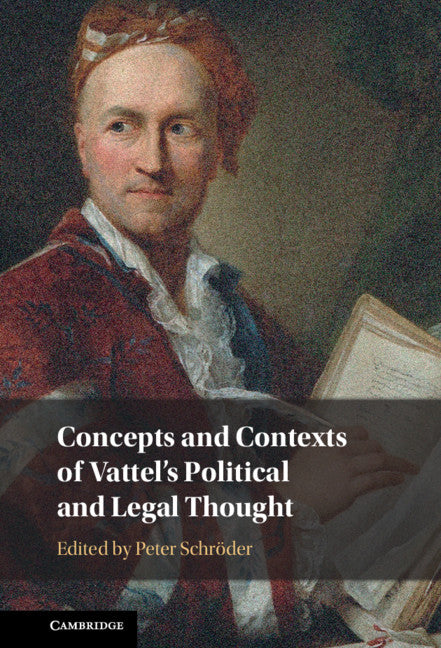
Concepts and Contexts of Vattel's Political and Legal Thought
Explores how Vattel used the natural law tradition to frame a pragmatic and treaty-oriented model of the law of nations.
Peter Schröder (Edited by)
9781108489447, Cambridge University Press
Hardback, published 24 June 2021
400 pages
23.6 x 15.8 x 2.4 cm, 0.641 kg
Concepts and Contexts of Vattel's Political and Legal Thought brings together a collection of highly original and penetrating studies of one of the founders of international law whose Law of Nations remained a classic up until the twentieth-century. This is an excellent place to start thinking about why sovereign states should help one another and under which conditions they could do so. Béla Kapossy, Professor of Modern History, Université de Lausanne
Swiss-born Emer de Vattel (1714–1767) was one of the last eminent thinkers of natural law. He shaped the later part of early-modern natural jurisprudence. At the time, the subject had become a fashionable academic sub-discipline in both jurisprudence and philosophy. Vattel's considerable impact on statesmen, political thinkers, diplomats and lawyers during his lifetime and after rested primarily on the fact that his The Law of Nations (1758) transformed natural law into the basis of a more comprehensive and practicable theory of interstate relations. His ideas served to promote reform programmes whose comprehensive natures spanned the domains of economic reform, constitutionalism and international diplomacy and foreign trade policy. Vattel's conception centred round the principle that defined all sovereign states as nations composed of societies of free men and profoundly influenced legal and political debates in the eighteenth and nineteenth centuries.
Concepts and contexts of Vattel's political and legal thought – an introduction Peter Schröder
Part I. Historical and Intellectual Contexts: 1. In search of a nation: Vattel, Neuchâtel and the Swiss confederacy Nadir Weber
2. Sovereignty contested: Vattel's use of Leibniz, Hobbes and Pufendorf Ben Holland
3. The development of the law of nations: Wolff and Vattel Ere Nokkala
4. Vattel and the Abbe de Choisy: French historiography, piety and law of nations Francesca Iurlaro
5. Vattel and the seven years' war Koen Stapelbroek
Part II. Concepts: 6. Vattel, the balance of power, and the moral justification of war Camilla Boisen
7. Regular war, irregulars, and savages Pablo Kalmanovitz
8. Constitutionalism Antonio Trampus
9. Vattel's theory of the social contract Gabriella Silvestrini
Part III. Receptions: 10. Vattel's reception in British America, 1761–1775 Mark Somos
11. Tradition and revolution: eighteenth century German and French contexts and Vattel's law of nations Nathaniel Boyd
12. Vattel's law of nations in late eighteenth- and early nineteenth-century Greece and Italy Elisabetta Fiocchi Malaspina
13. Reception of Vattel in 18th and early 19th century England and Scotland Marco Barducci
14. Receptions of Vattel in 19th- and 20th-century international law Theodore Christov
15. Vattel's reception in international relations Richard Devetak.
Subject Areas: International organisations & institutions [LBBU], Public international law [LBB], International law [LB], International relations [JPS], Politics & government [JP], History of ideas [JFCX], Social & political philosophy [HPS], Political / legal thriller [FHP]