Freshly Printed - allow 7 days lead
Couldn't load pickup availability
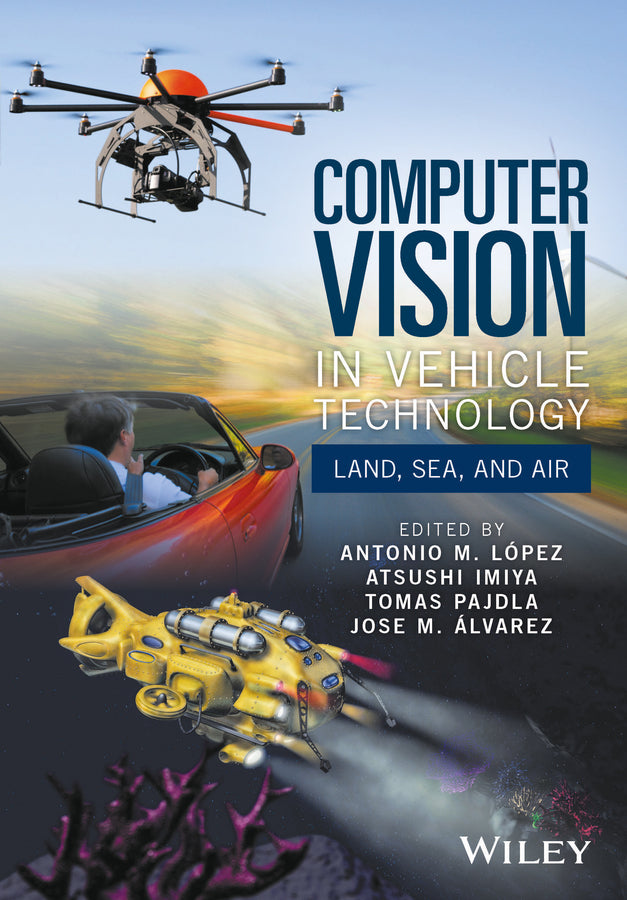
Computer Vision in Vehicle Technology
Land, Sea, and Air
Antonio M. López (Edited by), Atsushi Imiya (Edited by), Tomas Pajdla (Edited by), Jose M. Álvarez (Edited by)
9781118868072, Wiley
Hardback, published 31 March 2017
216 pages
24.6 x 16.8 x 1.8 cm, 0.544 kg
A unified view of the use of computer vision technology for different types of vehicles Computer Vision in Vehicle Technology focuses on computer vision as on-board technology, bringing together fields of research where computer vision is progressively penetrating: the automotive sector, unmanned aerial and underwater vehicles. It also serves as a reference for researchers of current developments and challenges in areas of the application of computer vision, involving vehicles such as advanced driver assistance (pedestrian detection, lane departure warning, traffic sign recognition), autonomous driving and robot navigation (with visual simultaneous localization and mapping) or unmanned aerial vehicles (obstacle avoidance, landscape classification and mapping, fire risk assessment). The overall role of computer vision for the navigation of different vehicles, as well as technology to address on-board applications, is analysed. Key features: This is essential reading for computer vision researchers, as well as engineers working in vehicle technologies, and students of computer vision.
List of Contributors ix Preface xi Abbreviations and Acronyms xiii 1 Computer Vision in Vehicles 1 1.1 Adaptive Computer Vision for Vehicles 1 1.1.1 Applications 1 1.1.2 Traffic Safety and Comfort 2 1.1.3 Strengths of (Computer) Vision 2 1.1.4 Generic and Specific Tasks 3 1.1.5 Multi-module Solutions 4 1.1.6 Accuracy, Precision, and Robustness 5 1.1.7 Comparative Performance Evaluation 5 1.1.8 There Are Many Winners 6 1.2 Notation and Basic Definitions 6 1.2.1 Images and Videos 6 1.2.2 Cameras 8 1.2.3 Optimization 10 1.3 Visual Tasks 12 1.3.1 Distance 12 1.3.2 Motion 16 1.3.3 Object Detection and Tracking 18 1.3.4 Semantic Segmentation 21 1.4 Concluding Remarks 23 Acknowledgments 23 2 Autonomous Driving 24 2.1 Introduction 24 2.1.1 The Dream 24 2.1.2 Applications 25 2.1.3 Level of Automation 26 2.1.4 Important Research Projects 27 2.1.5 Outdoor Vision Challenges 30 2.2 Autonomous Driving in Cities 31 2.2.1 Localization 33 2.2.2 Stereo Vision-Based Perception in 3D 36 2.2.3 Object Recognition 43 2.3 Challenges 49 2.3.1 Increasing Robustness 49 2.3.2 Scene Labeling 50 2.3.3 Intention Recognition 52 2.4 Summary 52 Acknowledgments 54 3 Computer Vision for MAVs 55 3.1 Introduction 55 3.2 System and Sensors 57 3.3 Ego-Motion Estimation 58 3.3.1 State Estimation Using Inertial and Vision Measurements 58 3.3.2 MAV Pose from Monocular Vision 62 3.3.3 MAV Pose from Stereo Vision 63 3.3.4 MAV Pose from Optical Flow Measurements 65 3.4 3D Mapping 67 3.5 Autonomous Navigation 71 3.6 Scene Interpretation 72 3.7 Concluding Remarks 73 4 Exploring the Seafloor with Underwater Robots 75 4.1 Introduction 75 4.2 Challenges of Underwater Imaging 77 4.3 Online Computer Vision Techniques 79 4.3.1 Dehazing 79 4.3.2 Visual Odometry 84 4.3.3 SLAM 87 4.3.4 Laser Scanning 91 4.4 Acoustic Imaging Techniques 92 4.4.1 Image Formation 92 4.4.2 Online Techniques for Acoustic Processing 95 4.5 Concluding Remarks 98 Acknowledgments 99 5 Vision-Based Advanced Driver Assistance Systems 100 5.1 Introduction 100 5.2 Forward Assistance 101 5.2.1 Adaptive Cruise Control (ACC) and Forward Collision Avoidance (FCA) 101 5.2.2 Traffic Sign Recognition (TSR) 103 5.2.3 Traffic Jam Assist (TJA) 105 5.2.4 Vulnerable Road User Protection 106 5.2.5 Intelligent Headlamp Control 109 5.2.6 Enhanced Night Vision (Dynamic Light Spot) 110 5.2.7 Intelligent Active Suspension 111 5.3 Lateral Assistance 112 5.3.1 Lane Departure Warning (LDW) and Lane Keeping System (LKS) 112 5.3.2 Lane Change Assistance (LCA) 115 5.3.3 Parking Assistance 116 5.4 Inside Assistance 117 5.4.1 Driver Monitoring and Drowsiness Detection 117 5.5 Conclusions and Future Challenges 119 5.5.1 Robustness 119 5.5.2 Cost 121 Acknowledgments 121 6 Application Challenges from a Bird’s-Eye View 122 6.1 Introduction to Micro Aerial Vehicles (MAVs) 122 6.1.1 Micro Aerial Vehicles (MAVs) 122 6.1.2 Rotorcraft MAVs 123 6.2 GPS-Denied Navigation 124 6.2.1 Autonomous Navigation with Range Sensors 124 6.2.2 Autonomous Navigation with Vision Sensors 125 6.2.3 SFLY: Swarm of Micro Flying Robots 126 6.2.4 SVO, a Visual-Odometry Algorithm for MAVs 126 6.3 Applications and Challenges 127 6.3.1 Applications 127 6.3.2 Safety and Robustness 128 6.4 Conclusions 132 7 Application Challenges of Underwater Vision 133 7.1 Introduction 133 7.2 Offline Computer Vision Techniques for Underwater Mapping and Inspection 134 7.2.1 2D Mosaicing 134 7.2.2 2.5D Mapping 144 7.2.3 3D Mapping 146 7.2.4 Machine Learning for Seafloor Classification 154 7.3 Acoustic Mapping Techniques 157 7.4 Concluding Remarks 159 8 Closing Notes 161 References 164 Index 195
Reinhard Klette
Uwe Franke
Friedrich Fraundorfer
Rafael Garcia, Nuno Gracias, Tudor Nicosevici, Ricard Prados, Natalia Hurtos, Ricard Campos, Javier Escartin, Armagan Elibol, Ramon Hegedus and Laszlo Neumann
David Gerónimo, David Vázquez and Arturo de la Escalera
Davide Scaramuzza
Nuno Gracias, Rafael Garcia, Ricard Campos, Natalia Hurtos, Ricard Prados, ASM Shihavuddin, Tudor Nicosevici, Armagan Elibol, Laszlo Neumann and Javier Escartin
Antonio M. López
Subject Areas: Electronics & communications engineering [TJ]