Freshly Printed - allow 7 days lead
Couldn't load pickup availability
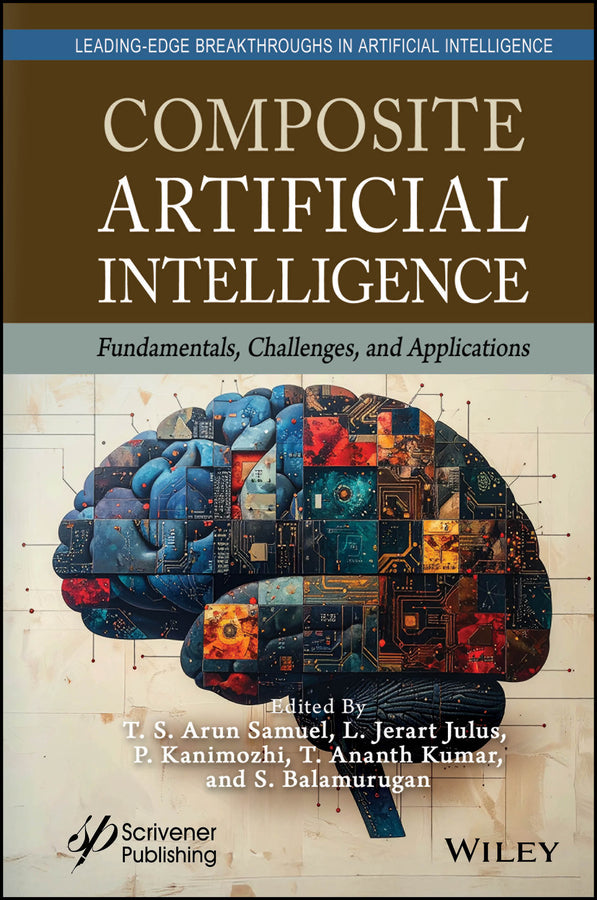
Composite Artificial Intelligence
Fundamentals, Challenges, and Applications
T. S. Arun Samuel (Edited by), L. Jerart Julus (Edited by), P. Kanimozhi (Edited by), T. Ananth Kumar (Edited by), S. Balamurugan (Edited by)
9781394393039, Wiley
Hardback, published 29 June 2026
400 pages
22.9 x 15.2 x 2.5 cm, 0.671 kg
Unlock the full potential of context-aware AI while navigating critical hurdles like bias mitigation and ethical governance with this definitive resource on the future of composite artificial intelligence. In the rapidly evolving landscape of artificial intelligence, the demand for more adaptive, intelligent, and context-aware systems has led to the emergence of composite artificial intelligence: a paradigm that integrates multiple AI techniques to solve complex real-world problems with higher efficiency and intelligence. This book is a groundbreaking exploration of the next evolution in AI, where diverse methodologies like machine learning, symbolic reasoning, and cognitive computing converge to solve complex, real-world problems with unprecedented intelligence and adaptability. Unlike traditional AI approaches that rely on singular techniques, composite AI harnesses the strengths of multiple paradigms, enabling systems that are more robust, interpretable, and capable of human-like decision-making. This book provides a comprehensive roadmap for understanding and implementing these advanced systems, from foundational theories to cutting-edge applications across industries such as healthcare, finance, and smart manufacturing. It delves into critical challenges, including bias mitigation, integration hurdles, and ethical governance, while showcasing real-world case studies that demonstrate the transformative potential of composite AI. With its balanced blend of theory, technical depth, and actionable insights, this book is a definitive resource for unlocking the full potential of AI in an increasingly complex world. Readers will find the volume: Audience Academics, policymakers, AI researchers, data scientists, AI and machine learning engineers and developers, and??industry professionals working in healthcare, finance, manufacturing, and cybersecurity who need robust, explainable, and adaptive AI solutions.
Series Preface xv Part I: Foundational Concepts and Emerging Trends in Composite AI 1 1 Data Fusion Techniques in Composite AI 3 1.1 Introduction 1 2 Composite AI in Natural Language Processing: A Paradigm Shift in Understanding and Generating Human Language 33 2.1 Introduction to Composite Artificial Intelligence (AI) 34 3 A Composite Artificial Intelligence Framework for Enhanced and Intelligent Word Recognition of Handwritten Hindi 65 3.1 Introduction 66 4 Machine Learning-Driven Optimization for Composite AI in Wireless Body Area Networks (WBAN) 85 4.1 Prelude 86 Part II: Advanced Methods and Technical Challenges in Composite AI 101 5 AI-Driven Hybrid Ant Colony and Golden Jackal Optimization Algorithm for Lung Disease Prediction and Classification 103 5.1 Introduction 104 6 Removing Bias in Maritime Imagery: Advancing Gender Equality through Data-Driven Methods 125 6.1 Introduction 126 7 Text-Based Analysis of Twitter Data with Machine Learning Models 151 7.1 Introduction 152 8 Fingerprint Registration and Matching Based on Improved Convolutional Neural Network 181 8.1 Introduction 182 Part III: Real-World Applications of Composite AI in Healthcare and Beyond 199 9 A Novel Transfer Learning-Based Composite AI Model for Skin Disease Classification 201 9.1 Introduction 202 10 Composite AI-Driven Music Recommendation: Integrating Emotion, Aural Analysis and Song Similarity 223 10.1 Introduction 224 11 A Composite Artificial Intelligence Based Framework for Heart Disease Prediction 249 11.1 Introduction 250 12 Composite AI for Predictive Analysis of Autism Spectrum Disorder Using Facial Features 279 12.1 Introduction 280 13 Integrating Imaging and Genomic Data with Composite AI to Enhance Breast Cancer Diagnosis and Early Detection 303 13.1 Introduction 304 14 Cognitive Analytics AI for Predictive Diagnostics and Neurological Forecasting in Brain Tumor Management 325 14.1 Introduction 326 15 Applications for Composite AI in Healthcare 345 15.1 Introduction 346 References 364
Preface xvii
Acknowledgement xix
S. Sowmyayani, D. Dhanya, J. Kavitha and R. Roselinkiruba
1.2 Data Fusion Techniques in Composite AI 3
1.4 Proposed Methodology Using Composite AI 12
1.5 Experimental Results 17
1.6 Conclusion 26
Narendran M., M. Beema Meharaj, D. Diana Julie, Sowmya Banala, G. Umadevi and A. Devi
2.2 Role of Composite AI in NLP 37
2.3 Fundamental Elements of NLP Composite AI 42
2.4 Case Studies and Use Cases of Composite AI in NLP 49
2.5 Challenges and Future Directions 60
2.6 Conclusion 62
R. S. Rampriya, Sabarinathan, SahayaBeni Prathiba, C. Renit, R. Arumuga Arun and S. Bhuvana
3.2 Related Work 68
3.3 Proposed Methodology 69
3.4 Experimental Result and Analysis 75
3.5 Conclusion 81
Krishna Kumar M., Pricilla Mary S., James Nesaratnam R. and Sharon Geege A.
4.2 Architectural Framework of WBAN Integrated with Composite AI 87
4.3 Machine Learning Models for WBAN Optimization 89
4.4 Deep Learning for Signal Processing in WBAN 91
4.5 Security Challenges and AI-Based Solutions in WBAN 92
4.6 AI-Driven Antenna Optimization in WBANs 94
4.7 Conclusion and Research Trajectories 97
Karthikeyan A., Pradeep S., Boorneush M. and Dhivya P.
5.2 Literature Survey 106
5.3 System Design 109
5.4 Results and Discussion 114
5.5 Conclusion 120
5.6 Future Scope 121
Jordan Taylor and J. Padmapriya
6.2 Literature Review 129
6.3 Methodology 134
6.4 Results and Discussion 143
6.5 Conclusion 146
N. Malathy, G. Sharmila, R. Yuvarshini and R. Lavanya
7.2 Objective 157
7.3 Classification of Tweets 158
7.4 Evaluation Metrics 172
7.5 Conclusion and Future Work 175
Lakshmanan B., Selvakumar B., Kasthuri K., Nivashini S. and Swetha R.
8.2 Related Works 182
8.3 Dataset Description 185
8.4 Proposed Work 185
8.5 Results and Discussion 191
8.6 Conclusion 195
R. Karthick Manoj and S. Aasha Nandhini
9.2 Literature Survey 203
9.3 Proposed Methodology 208
9.4 Result and Discussion 213
9.5 Conclusion 218
Ayushmaan Das and Rajalakshmi Shenbaga Moorthy
10.2 Literature Survey 228
10.3 Proposed Composite AI-Driven Music Recommendation Engine 232
10.4 Results and Discussions 239
10.5 Conclusion 244
M. Suresh, M. S. Anbarasi, R. Rajmohan and A. Anbarasi
11.2 Smart Health Monitoring Systems 254
11.3 Materials and Methods 257
11.4 Results and Discussions 270
11.5 Conclusions 275
S. Usharani, A. Ganesh, N. Muralidharan and G. Glorindal
12.2 Related Work 280
12.3 Overview of Composite AI in Predictive Analysis 284
12.4 Proposed Methodology 285
12.5 Experimental Setup 291
12.6 Results and Outputs 295
12.7 Conclusion 296
P. Manju Bala, S. Usharani, A. Balachandar, Sunday Adeola Ajagbe and Matthew Olusegun Adigun
13.2 Materials and Methods 307
13.3 Model Training and Evaluation 313
13.4 Evaluation Results 314
13.5 Conclusion 319
S. Usharani, P. Manju Bala, A. Balachandar and Olukayode A.
14.2 Related Works 327
14.3 Proposed Predictive Analytics Framework for Predicting Brain Tumors and Neurological Disorders 331
14.4 Experimental Setup for Predictive Analytics in Prediction of Brain Tumor and Neurological Disorder 334
14.5 Results and Analysis 340
14.6 Conclusion 341
R. Vijayarajeswari, David Samuel Azariya S., Anto Lourdu Xavier Raj Arockia Selvarathinam, Priyabrata Thatoi, Abhinaya Saravanan and Nisha Soms
15.2 Fundamentals of Composite AI 347
15.3 Applications for Composite AI in Healthcare 351
15.4 Case Studies in Composite AI Applications in Healthcare 356
15.5 Challenges and Future Directions 357
15.6 Conclusion 362
Index 367
Subject Areas: Computer science [UY]