Freshly Printed - allow 8 days lead
Couldn't load pickup availability
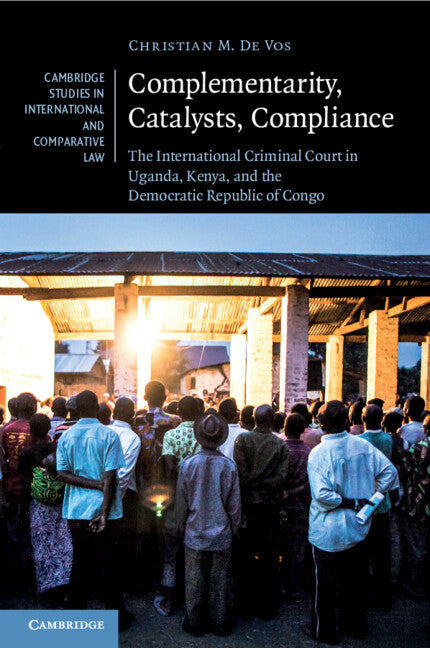
Complementarity, Catalysts, Compliance
The International Criminal Court in Uganda, Kenya, and the Democratic Republic of Congo
Critically explores the International Criminal Court's evolution and the domestic effects of its interventions in three African countries.
Christian M. De Vos (Author)
9781108459723, Cambridge University Press
Paperback / softback, published 16 June 2022
387 pages
22.8 x 15.2 x 2.1 cm, 0.574 kg
'… this beautifully written book offers its readers a very rich analysis of the socio-political context of complementarity and implementation of the Rome Statute. It is highly recommended to any person interested in how international and local actors interact in the repression of mass atrocity crimes.' Bernard Ntahiraja, Nordic Journal of Human Rights
Since its establishment at the turn of the century, a central preoccupation of the International Criminal Court (ICC) has been to catalyse the pursuit of criminal accountability at the domestic level. Drawing on ten years of research, this book theorizes the ICC's principle of complementarity as a transnational site and adaptive strategy for realizing an array of ambitious governance goals. Through a grounded, inter-disciplinary approach, it illustrates how complementarity came to be framed as a 'catalyst for compliance' and its unexpected effects on the legal frameworks and institutions of three different ICC 'situation countries' in Africa: Uganda, Kenya, and the Democratic Republic of Congo. Linking complementarity's law and practice to contemporary debates in international law and relations, the book unsettles international law's dominant progressive narrative. It urges a critical rethinking of the ICC's politics and a reorientation towards international criminal justice as a project of global legal pluralism.
1. Introduction
Part I. The ICC and Complementarity: Evolutions, Interpretations, Implementation: 2. Tracing an idea, constructing a norm: complementarity as a catalyst
3. Mirror images? Complementarity in the courtroom
4. Leveraging the Hague: complementarity and the Office of the Prosecutor
Part II. The ICC in Uganda, Kenya, and the Democratic Republic of Congo: 5. Compliance and performance: implementation as domestic politics
6. Competing, complementing, copying: domestic courts and complementarity
7. Catalysing opportunity: complementarity and domestic proceedings
8. Conclusions and recommendations.
Subject Areas: Public international law [LBB]