Freshly Printed - allow 7 days lead
Couldn't load pickup availability
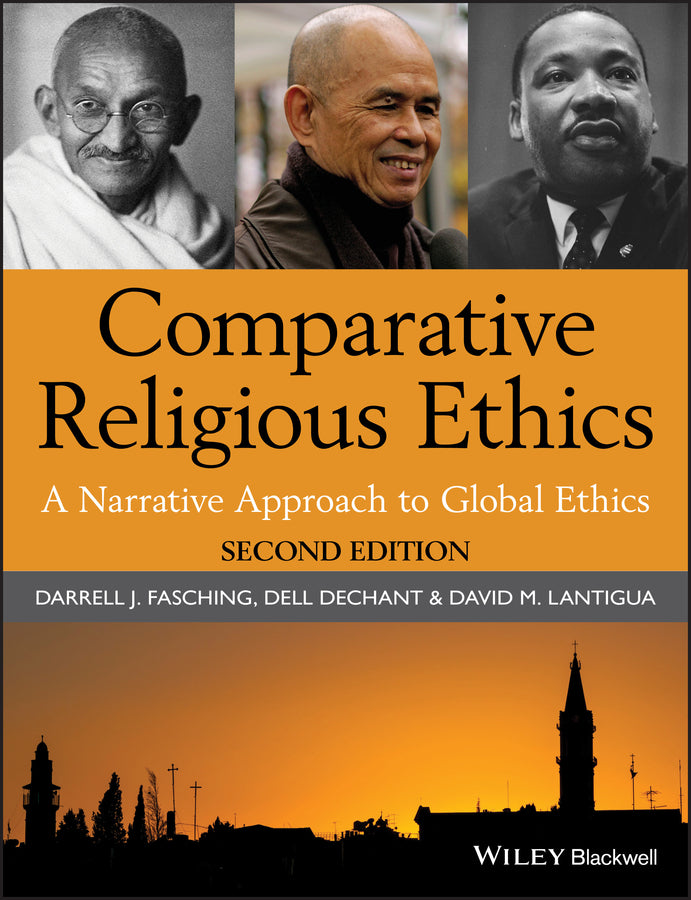
Comparative Religious Ethics
A Narrative Approach to Global Ethics
"It is indeed a very rare thing to have the opportunity and privilege to work with a book that engages, challenges and provokes the student to wrestle with the fundamental ethical questions of our time. Comparative Religious Ethics is such a book. Intellectually rigorous, profoundly insightful and beautifully written, it is an invaluable resource for the instructor and student alike." "Comparative Religious Ethics invites the reader to comprehend the ethical teachings of the world's religions by means of narratives drawn from those traditions and from human historical experience. The stories range from Gilgamesh to Gandhi and from Hiroshima to globalization. Beneath the engaging narratives lies an approach rich in theoretical insights from the study of comparative religion and ethical theory."
—Louise M. Doire, College of Charleston
—Ronald M. Green, Dartmouth College
Darrell J. Fasching (Author), Dell deChant (Author), David M. Lantigua (Author)
9781444331332, Wiley
Paperback / softback, published 8 April 2011
384 pages
24.6 x 19.1 x 2 cm, 0.735 kg
This popular textbook has been thoroughly revised and updated to reflect recent global developments, whilst retaining its unique and compelling narrative-style approach. Using ancient stories from diverse religions, it explores a broad range of important and complex moral issues, resulting in a truly reader-friendly and comparative introduction to religious ethics.
Preface xi Acknowledgments xiii Part I Religion, Ethics, and Stories of War and Peace 1 1 Religion, Ethics, and Storytelling 3 Storytelling: from Comparative Ethics to Global Ethics 4 Religion: the Sacred and the Holy 9 The Deep Structures of the Sacred and the Holy and Their Mediations 19 The Awakening of Ethical Consciousness: the Power of Religious Stories, East and West 20 The Great Religious Stories of the World – an Overview 30 A Postscript on Religious Language 36 Questions for Discussion 39 Sources 40 2 Stories of War and Peace in an Age of Globalization 41 Tales of Madness: from Auschwitz to Hiroshima 42 Auschwitz and Hiroshima: the Formative Religious Events of the Postmodern World 45 Techno-Bureaucratic Rationality and the Demise of Ethical Consciousness 51 Doubling and the Myth of Life through Death: the Spiritual Logic of Mass Death in the Twentieth Century 56 The Way of All the Earth: Global Ethics and Tales of Divine Madness 63 Questions for Discussion 72 Sources 73 Part II War and Peace: Ancient Stories and Postmodern Life Stories 75 Introduction: Ethics after Auschwitz and Hiroshima 77 3 Gilgamesh and the Religious Quest 85 The Story of Gilgamesh 86 Urbanization, Doubling, Death, and the Possibility of Ethical Reflection 91 The Quest – the Way of the Virtues 94 Questions for Discussion 99 Sources 99 4 The Socratic Religious Experience: from the Birth of Ethics to the Quest for Cosmopolis 100 The Story of the Trial of Socrates 101 The Socratic Invention of Ethics – the Way of Doubt 105 The Polis and the Quest for Cosmopolis: the Classical Era 109 The Story of Augustine’ s Confessions – Faith as a Surrender to Doubt 116 The Augustinian-Kantian Quest for a Global Ethic 126 Questions for Discussion 135 Sources 136 5 Hindu Stories – Ancient and Postmodern 137 Cosmic Story: the Myth of Liberation 138 Formative Story: Arjuna and Krishna 143 Life Story: Mohandas K. Gandhi and the Way of Brahmacharya 148 Comparative Reflections: the Paradoxes of War and Peace 159 Questions for Discussion 163 Sources 164 6 Buddhist Stories – Ancient and Postmodern 165 Formative Story: Siddhartha 166 The Cosmic Story Revised: the Myth of Liberation 173 Life Story: Thich Nhat Hanh, the Way of Mindfulness and the Dao of Zen 181 Comparative Reflections: Gandhi and Thich Nhat Hanh 196 Postscript: the Virtues of the Quest in Gilgamesh, Augustine, and Siddhartha 199 Questions for Discussion 203 Sources 203 7 Jewish Stories – Ancient and Postmodern 205 Cosmic Story: the Myth of History 206 Formative Story: the Audacity of Job 213 Life Story: Abraham Joshua Heschel and the Way of Audacity 223 Comparative Reflections: Heschel, Gandhi, and Thich Nhat Hanh 229 Questions for Discussion 232 Sources 233 8 Christian Stories – Ancient and Postmodern 234 Formative Story: Jesus of Nazareth 235 The Cosmic Story Revised: the Incarnation of the Word 242 Life Story: Martin Luther King, Jr. and the Way of the Cross 247 Comparative Reflections: King, Heschel, Gandhi, and Thich Nhat Hanh 257 Questions for Discussion 260 Sources 260 9 Islamic Stories – Ancient and Postmodern 262 Formative Story: Muhammad 263 Cosmic Story: Further Revisions of the Myth of History 269 Life Story: Malcolm X and the Way of Pilgrimage 275 Comparative Reflections: Just War or Non-Violence? – Malcolm X’s Argument with the Gandhian Tradition 286 Questions for Discussion 295 Sources 296 Part III The Path to Global Ethics – the Way of All the Earth 297 Introduction 299 10 Feminist Audacity and the Ethics of Interdependence 300 The Feminist Challenge to the Myths of Life through Death 301 The Feminist Alternative: Interdependence and the Ethics of Care 305 Life Story: Joanna Macy and Buddhist Ecofeminism 311 Life Story: Rosemary Ruether and Christian Ecofeminism 316 Conclusion 324 Questions for Discussion 325 Sources 326 11 Cosmopolis: the Way of All the Earth 327 Globalization and the Story of Babel: from Ethnocentrism to Interdependence 327 Ecofeminism: from the Social Ecology of Conscience to the Social Ecology of Justice 330 The Way of All the Earth 343 Questions for Discussion 347 Sources 348 Index of Names and Terms 349 Index of Subjects 355
Subject Areas: Religion & beliefs [HR]