Freshly Printed - allow 7 days lead
Couldn't load pickup availability
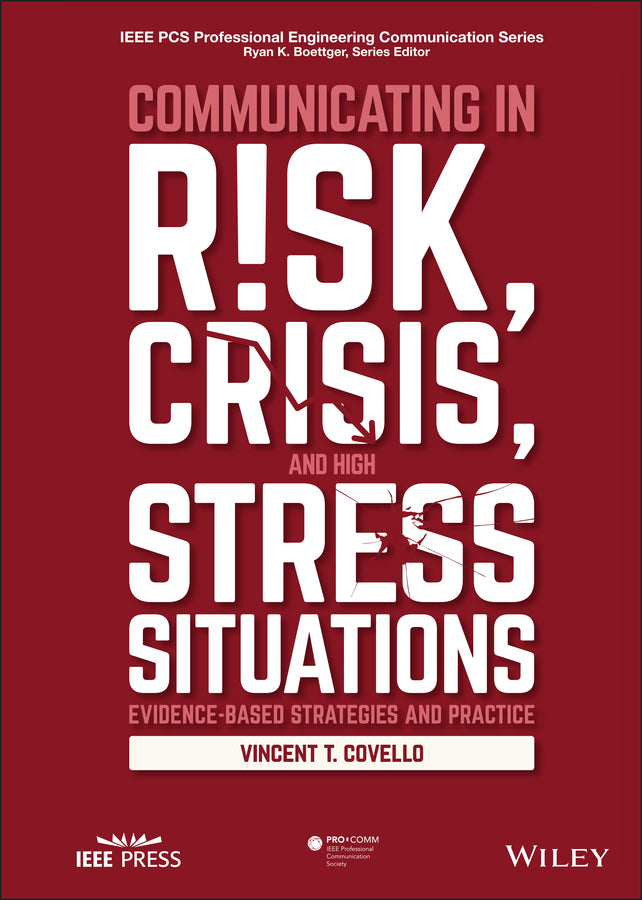
Communicating in Risk, Crisis, and High Stress Situations: Evidence-Based Strategies and Practice
Vincent T. Covello (Author)
9781119027430, Wiley
Hardback, published 25 January 2022
448 pages
25.9 x 18.5 x 2.5 cm, 1.021 kg
COMMUNICATING IN R!SK, CRISIS, AND HIGH STRESS SITUATIONS LEARN THE UNIFYING PRINCIPLES BEHIND RISK, CRISIS, AND HIGH STRESS COMMUNICATION WITH THIS STATE-OF-THE-ART REFERENCE WRITTEN BY A MAJOR LEADER IN THE FIELD Communicating in Risk, Crisis, and High Stress Situations: Evidence-Based Strategies and Practice is about communicating with people in the most challenging circumstances: high stress situations characterized by high risks and high stakes. The ability to communicate effectively in a high stress situation is an essential communication competency for managers, engineers, scientists, and professionals in every field who can be thrust into demanding situations complicated by stress. Whether you are confronting an external crisis, an internal emergency, or leading organizational change, this book was written for you. Communicating in Risk, Crisis, and High Stress Situations brings together in one resource proven scientific research with practical, hands-on guidance from a world leader in the field. The book covers such critical topics as trust, stakeholder engagement, misinformation, messaging, and audience perceptions in the context of stress. This book is uniquely readable, thorough, and useful, thanks to features that include: The book is a necessity for managers, engineers, scientists, and others who must communicate difficult technical concepts to a concerned public. It also belongs on the bookshelves of leaders and communicators in public and private sector organizations looking for a one-stop reference and evidence-based practical guide for communicating effectively in emotionally charged situations. Written by a highly successful academic, consultant, and trainer, the book is also designed as a resource for training and education.
A Note from the Series Editor xiii Acknowledgments xv Author Biography xvii 1 The Critical Role of Risk, High Concern, and Crisis Communication 1 1.1 Case Diary: A Collision of Facts and Perceptions 2 1.2 What Will Readers Find in This Book? 3 1.3 Why You Will Use This Book 4 1.4 The Need for This Book – Now 5 1.4.1 New Literature, New Research 5 1.4.2 Changes in the Communications Landscape 6 1.4.3 Changes in Journalism and the Perception of Facts 7 1.4.4 Changes in Laws, Regulations, and Societal Expectations 7 1.4.5 Changes in Concerns about Health, Safety, and the Environment 7 1.4.6 Changes in Levels of Trust 7 1.4.7 Changes in the Global Political Environment 8 1.4.8 The COVID- 19 Pandemic and the Changed Communication Landscape 8 2 Core Concepts 11 2.1 Case Diary: Recognizing Change as a High Concern Issue 11 2.2 Defining the Concept and Term Risk 13 2.3 Defining the Concept and Term Risk Communication 14 2.4 Risk Communication and Its Relationship to Risk Analysis 17 2.5 Defining the Concepts and Terms High Concern and High Concern Communication 19 2.6 Defining the Concept and Term Crisis 22 2.7 Defining the Concept and Term Crisis Communication 24 2.8 Chapter Resources 25 Endnotes 31 3 An Overview of Risk Communication 33 3.1 Case Diary: Complex Issues Destroy Homes 33 3.2 Challenges and Difficulties Faced in Communicating Risk Information 35 3.2.1 Characteristics and Limitations of Scientific and Technical Data about Risks 35 3.2.2 Characteristics and Limitations of Spokespersons in Communicating Information about Risks 35 3.2.2.1 Case Study: “Go Hard, Go Early”: Risk Communication Lessons from New Zealand’s Response to COVID-19 37 3.2.3 Characteristics and Limitations of Risk Management Regulations and Standards 41 3.2.3.1 Debates and Disagreements 41 3.2.3.2 Limited Resources for Risk Assessment and Management 41 3.2.3.3 Underestimating the Difficulty of and Need for Risk Communication 42 3.2.3.4 Lack of Coordination and Collaboration 42 3.2.4 Characteristics and Limitations of Traditional Media Channels in Communicating Information about Risks 42 3.2.5 Characteristics and Limitations of Social Media Channels in Communicating Information about Risks 43 3.2.6 Characteristics and Limitations of People in their Ability to Evaluate and Interpret Risk Information 44 3.3 Changes in How the Brain Processes Information Under Conditions of High Stress 48 3.4 Risk Communication Theory 49 3.4.1 Trust Determination Theory 49 3.4.2 Negative Dominance Theory 50 3.4.3 Mental Noise Theory 50 3.4.4 Risk Perception Theory 50 3.5 Risk Communication Principles and Guidelines 55 3.5.1 Principle 1. Accept and Involve All Interested and Affected Persons as Legitimate Partners 55 3.5.2 Principle 2. Plan Carefully and Evaluate Performance 55 3.5.3 Principle 3. Listen to Your Audience 57 3.5.4 Principle 4. Be Honest, Frank, and Open 57 3.5.5 Principle 5. Coordinate and Collaborate with Other Credible Sources 58 3.5.6 Principle 6. Meet the Needs of Traditional and Social Media 58 3.5.7 Principle 7. Speak Clearly and with Compassion 58 3.6 Key Takeaway Concepts and Conclusions from this Overview Chapter 59 3.7 Chapter Resources 59 Endnotes 66 4 Development of Risk Communication Theory and Practice 69 4.1 Case Diary: Origin Story 69 4.2 Introduction 70 4.2.1 Historical Phase 1: Presenting Risk Numbers 71 4.2.2 Historical Phase 2: Listening and Planning 71 4.2.3 Historical Phase 3: Stakeholder Engagement 72 4.2.4 Covello and Sandman’s Four Stages of Risk Communication 72 4.2.4.1 Stage 1: Ignore the Public 73 4.2.4.2 Stage 2: Explaining Risk Data Better 73 4.2.4.3 Stage 3: Stakeholder Engagement 77 4.2.4.4 Stage 4: Empowerment 78 4.3 Summary 79 4.4 Chapter Resources 79 Endnotes 83 5 Stakeholder Engagement and Empowerment 87 5.1 Case Diary: A Town Hall Public Meeting Goes Very Wrong 87 5.2 Introduction 89 5.3 Levels of Stakeholder Engagement 91 5.3.1 Types of Stakeholder Engagement 93 5.4 Benefits of Stakeholder Engagement 95 5.5 Limitations and Challenges of Stakeholder Engagement 96 5.6 Techniques and Approaches for Effective Stakeholder Engagement 97 5.7 Meetings with Stakeholders 100 5.7.1 Town Hall Meetings 101 5.7.2 Open House Meetings/Information Workshops 102 5.7.3 Tips for Meetings with Stakeholders 102 5.8 Chapter Resources 104 Endnotes 107 6 Communicating in a Crisis 111 6.1 Case Diary: The Challenge of Partnership in a Crisis 112 6.2 The Three Phases of a Crisis 113 6.3 Communication in the Precrisis Preparedness Phase 115 6.3.1 Precrisis Communication Activity: Identifying Potential Crises 117 6.3.2 Case Study: The 2010 BP Deepwater Horizon Oil Spill 118 6.3.3 Precrisis Communication Activity: Identify Goals and Objectives 120 6.3.4 Precrisis Communication Activity: Develop a Crisis Communication Plan 121 6.3.5 Precrisis Communication Activity: Identify, Train, and Test Crisis Communication Spokespersons 124 6.3.6 Precrisis Communication Activity: Engaging Stakeholders 124 6.3.7 Precrisis Communication Activity: Identifying Stakeholders’ Questions and Concerns 126 6.3.8 Drafting Messages for Anticipated Stakeholder Questions and Concerns 126 6.3.9 Precrisis Communication Activity: Conducting Exercises to Test the Crisis Communication Plan 128 6.3.10 Precrisis Communication Activity: Incident Command System (ICS) and the Joint Information Center (JIC) 129 6.4 Communications in the Crisis Response Phase 130 6.4.1 Case Study: Lac-Mégantic Rail Tragedy 134 6.4.2 Disaster and Emergency Warnings 136 6.4.2.1 Designing Effective Warnings 137 6.4.2.2 Steps in the Disaster and Emergency Warning Process 137 6.5 Communicating Effectively about Blame, Accountability, and Responsibility 139 6.6 Communicating an Apology 140 6.6.1 Case Study: Maple Leaf Foods and the Listeria Food Contamination Crisis 141 6.6.2 Case Study: Southwest Airlines Apology 144 6.7 Communications in the Postcrisis Recovery Phase 145 6.7.1 Case Study and Case Diary: New York City’s Communication Trials by Fire, from West Nile to 9/11 146 6.7.2 Case Study: Johnson & Johnson and the Tylenol Tampering Case 147 6.7.3 Case Study: Flint, Michigan and Contaminated Drinking Water 149 6.8 Chapter Resources 151 Endnotes 159 7 Foundational Principles: Perceptions, Biases, and Information Filters 165 7.1 Case Diary: “A” Is for “Apples” 165 7.2 Message Perception and Reception in High Concern Situations 168 7.3 Message Filter Theory: A Set of Principles Drawn from the Behavioral and Neuroscience Literature 169 7.4 Case Study: COVID- 19 and Risk Perception Factors 171 7.4.1 Social Amplification Filters 173 7.4.2 Mental Shortcut Filters 174 7.4.3 Knowledge and Belief Filters 176 7.4.4 Personality Filters 177 7.4.5 Negative Dominance/Loss Aversion Filters 177 7.5 Message Filters and the Brain 179 7.6 Message Filters, Perceptions, and Models of Human Behavior 179 7.7 Message Filters, Perceptions, and Persuasion 180 7.8 Message Filters, Perceptions, and Ethics 181 7.9 Message Filters and the Issue of Acceptable Risk 182 7.9.1 Factors in Determining Acceptable Risk 183 7.9.2 Strategies for Addressing Acceptable Risk 184 7.10 The Message is in the Mind of the Receiver 186 7.11 Chapter Resources 186 Endnotes 192 8 Foundational Principles: Trust, Culture, and Worldviews 197 8.1 Case Diary: A Disease Outbreak in Africa 198 8.2 Trust Determination 200 8.3 Characteristics and Attributes of Trust 201 8.3.1 Trust and First Impressions 203 8.3.2 Loss of Trust 204 8.3.3 Gaining Trust 206 8.3.3.1 Gaining Trust through Stakeholder Engagement 206 8.3.3.2 Gaining Trust through Trust Transference 206 8.3.3.3 Gaining Trust through Actions and Behavior 207 8.4 Case Study: Trust and the Chernobyl Nuclear Power Plant Accident 207 8.5 Case Diary: The Fukushima Japan Nuclear Power Plant Accident 208 8.6 Gaining Trust in High- Stakes Negotiations 210 8.7 Case Diary: Gaining Trust and the SARS Outbreak in Hong Kong 211 8.8 Trust and Culture 212 8.9 Cultural Competency 212 8.9.1 Different Communication Styles 213 8.9.2 Different Attitudes and Approaches toward Conflict 214 8.9.3 Different Nonverbal Communication 214 8.9.4 Different Attitudes and Approaches to Decision Making 214 8.9.5 Different Attitudes and Approaches toward Information Disclosure 215 8.9.6 Different Attitudes and Approaches to Knowing 215 8.9.7 Different Attitudes and Approaches toward Conversation and Discourse 215 8.9.8 Different Attitudes and Approaches toward the Use of Humor 215 8.10 Risk Perceptions, Trust, and Cultural Theory 215 8.11 Risk Perceptions, Trust, and Worldviews 217 8.12 Case Diary: Fame, Family, and Fear in Public Health Communications 218 8.13 Chapter Resources 221 Endnotes 227 9 Best Practices for Message Development in High Concern Situations 231 9.1 Case Diary: Mapping Through a Maze of COVID Confusion 231 9.2 Introduction 232 9.3 Crafting Messages in the Context of Stress and High Concern Decision- Making 233 9.3.1 Trust Determination and Messaging in High-Stress Situations 233 9.3.1.1 The CCO Best Practice 233 9.3.2 Impaired Comprehension and Messaging in High-Stress Situations 234 9.3.3 Negative Dominance and Messaging in High-Stress Situations 234 9.3.4 Emotional Impact and Messaging in High-Stress Situations 235 9.3.4.1 Case Study: Hoarding Toilet Paper at the Outset of the 2020 COVID-19 Pandemic 236 9.4 Message Mapping 238 9.4.1 Benefits of Message Maps 238 9.4.2 Message Maps and the Brain 241 9.4.3 The Development of Message Mapping 243 9.4.4 Case Study: Message Maps and Asbestos 244 9.4.5 Steps in Developing a Message Map 245 9.4.5.1 Step 1: Identify, Profile, and Prioritize Key Stakeholders 245 9.4.5.2 Step 2: Develop Lists of Stakeholder Questions and Concerns 248 9.4.5.3 Case Study: Stakeholder Questions, Terrorism, and Disasters 249 9.4.5.4 Step 3: Develop Key Messages 249 9.4.5.5 Step 4: Develop Supporting Information 252 9.4.5.6 Step 5: Testing the Message Map 253 9.4.5.7 Step 6: Repurpose Maps through Appropriate Information Channels 254 9.5 Summary 254 9.6 Chapter Resources 255 Endnotes 263 Appendices 265 Appendix 9.1 265 Appendix 9.2 267 Appendix 9.3 277 Appendix 9.4 280 10 Communicating Numbers, Statistics, and Technical Information about a Risk or Threat 285 10.1 Case Diary: A Civil Action 285 10.2 Introduction 288 10.3 Case Study: Numbers, Statistics, and COVID-19 289 10.4 Brain Processes That Filter How Technical Information about Risk or Threat Is Received and Understood 292 10.4.1 Risk and Threat Perception Filters 293 10.4.2 Thought Processing Filters 294 10.4.3 Mental Model Filters 294 10.4.4 Emotional Filters 295 10.4.5 Motivational Filters 295 10.5 Challenges in Explaining Technical Information About a Risk or Threat 296 10.6 Framing 297 10.7 Technical Jargon 298 10.8 Information Clarity 299 10.9 Units of Measurement 300 10.10 Case Study: Risk Numbers, Risk Statistics, and the Challenger Accident 303 10.11 Comparisons 304 10.12 Lessons Learned 308 10.13 Chapter Resources 308 Endnotes 315 11 Evaluating Risk, High Concern, and Crisis Communications 321 11.1 Case Diary: Finding the Road to Rio 321 11.1.1 The Mosquito Front 322 11.1.2 The Citizen Front 322 11.1.3 The Olympic Athlete and Visitor Front 323 11.1.4 Communication Strategy: The Citizen Front 323 11.1.5 Communication Strategy: Olympic Athlete and Visitor Front 323 11.2 Introduction 324 11.3 Benefits of Evaluation 326 11.4 Evaluation Practices for Risk, High Concern, and Crisis Communication 327 11.5 Case Studies of Evaluation Comparison to Best Practice: Hurricane Katrina, COVID-19 and Vaccination Hesitancy, and Outbreak of COVID-19 in Wuhan, China 329 11.5.1 Hurricane Katrina 329 11.5.2 COVID-19 and Vaccination Hesitancy 330 11.5.3 Outbreak of COVID-19 in Wuhan, China 330 11.6 Barriers and Challenges to Evaluation 332 11.6.1 Differences in Values 332 11.6.2 Differences in Goals 332 11.6.3 Competition for Resources 332 11.6.4 Ability to Learn from Results 333 11.7 Evaluation Measures 338 11.7.1 Process/Implementation Evaluation Measures 338 11.7.2 Outcome/Impact Evaluation Measures 339 11.7.3 Formative Evaluation Measures 340 11.8 An Integrated Approach to Evaluation 341 11.9 Resource: Case Study of Focus Group Testing of Mosquito-Control Messages, Florida, 2018–2019 342 11.10 Evaluation Tools 347 11.11 Chapter Resources 348 Endnotes 353 12 Communicating with Mainstream News Media 357 12.1 Case Diary: A High Stakes Chess Game with a News Media Outlet 357 12.2 Introduction 359 12.3 Characteristics of the Mainstream News Media 361 12.3.1 Content 361 12.3.2 Clarity 362 12.3.3 Avoiding Prejudice 362 12.3.4 Topicality 362 12.3.5 Diversity 363 12.3.6 Subject Matter Expertise 363 12.3.7 Resources 363 12.3.8 Career Advancement 364 12.3.9 Watchdogs 364 12.3.10 Amplifiers 364 12.3.11 Skepticism 364 12.3.12 Source Dependency 365 12.3.13 Professionalism and Independence 365 12.3.14 Covering Uncertainty 366 12.3.15 Legal Constraints 366 12.3.16 Special Populations 366 12.3.17 Competition 366 12.3.18 Confidentiality and Protection of Sources 367 12.3.19 Deadlines 367 12.3.20 Trust 367 12.3.21 Storytelling 368 12.3.22 Balance and Controversy 368 12.4 Guidelines and Best Practices for Interacting with Mainstream News Media 368 12.5 The Media Interview 370 12.6 Lessons and Trends 375 12.7 Case Diary: A Ten-Round Exercise 377 12.8 Chapter Resources 378 Endnotes 381 13 Social Media and the Changing Landscape for Risk, High Concern, and Crisis Communication 385 13.1 Case Diary: Myth-Busting: Mission Impossible? 385 13.2 Introduction 387 13.3 Benefits of Social Media Outlets for Risk, High Concern, and Crisis Communication 389 13.3.1 Speed 389 13.3.2 Access 390 13.3.3 Reach 390 13.3.4 Amplification 390 13.3.5 Transparency 390 13.3.6 Understanding 390 13.3.7 Changes in Behaviors 391 13.3.8 Relationship Building 391 13.3.9 Timeliness 391 13.3.10 Hyperlocal Specificity 391 13.3.11 Listening and Feedback 392 13.3.12 Taking Advantage of the Benefits of Social Media 392 13.4 Challenges of Social Media for Risk, High Concern, and Crisis Communication 393 13.4.1 Rising Expectations 393 13.4.2 Repostings/Redistribution 393 13.4.3 Permanent Storage 394 13.4.4 Hacking/Security 394 13.4.5 Rise and Fall of Social Media Platforms 394 13.4.6 Resources 394 13.4.7 Privacy and Confidentiality 394 13.4.8 Cognitive Overload 395 13.4.9 Players on the Field 395 13.4.10 Misinformation, Disinformation, and Rumors 395 13.5 Case Study: Social Media and the 2007 and 2011 Shooter Incidents at Virginia Polytechnic Institute and State University (Virginia Tech) 397 13.6 Case Study: Social Media and the 2013 Southern Alberta/Calgary Flood 398 13.7 Best Practices for Using Social Media in Risk, High Concern, and Crisis Situations 400 13.7.1 Create a Social Media Plan 400 13.7.2 Staff Appropriately for Social Media Communication 400 13.7.3 Ensure Continuous Updating 401 13.7.4 Identify Your Partners 401 13.7.5 Assess and Reassess Your Selection of Platforms 401 13.7.6 Create and Maintain as Many Social Media Accounts as You and Your Stakeholders Need 401 13.7.7 Be Prepared for the Special Social Media Requirements and Pressures in a Crisis 401 13.7.8 Provide Guidance for Employees and Engage Them in the Process 402 13.7.9 Don’t Skip Evaluation 403 13.8 Case Diary: Social Media and the Negative Power of“Junk”Information about Risks and Threats 403 13.9 Lessons Learned and Trends 404 13.10 Chapter Resources 404 Endnotes 408 Index 411
Subject Areas: Computer networking & communications [UT]