Freshly Printed - allow 10 days lead
Couldn't load pickup availability
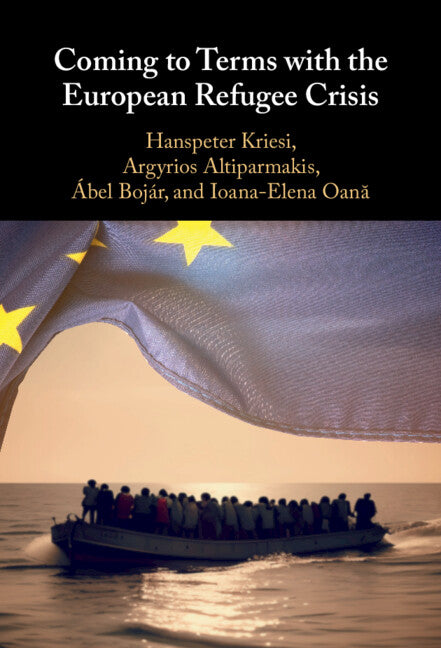
Coming to Terms with the European Refugee Crisis
A study of the policymaking process and its dysfunctional outcome in the EU polity during the refugee crisis.
Hanspeter Kriesi (Author), Argyrios Altiparmakis (Author), Ábel Bojár (Author), Ioana-Elena Oană (Author)
9781009456531, Cambridge University Press
Hardback, published 8 February 2024
428 pages
23.5 x 16 x 2.7 cm, 0.761 kg
'Using an innovative method, Kriesi et al. provide one of the most comprehensive and insightful studies of the 2015–16 refugee crisis. A must-read for those interested in EU crisis politics and migration politics alike.' Natascha Zaun, Professor in Public Policy and Law, Leuphana University Lüneburg, Germany
The refugee crisis which hit the European Union and its member states during 2015–16 was just one in a series of recent crises, but perhaps the most critical for the EU's resilience. This book shows how policymakers in the EU polity have tried to come to terms with it. To explain how they reacted to the crisis domestically and jointly at the EU-level, the study relies on an original method to analyze political processes. It argues that the policy-specific institutional context and the specific crisis situation, defined in terms of asymmetrical problem and political pressure, largely shaped the crisis response. The authors suggest that the way in which the refugee crisis was managed has resulted in conflicts between member states, which have been further exacerbated in subsequent crises and will continue to haunt the EU in times to come. This title is also available as Open Access on Cambridge Core.
Part I. The Refugee Crisis in the EU and its Member States: Our Approach in Context: 1. Introduction
2. Theoretical framework
3. Design of the study
4. Crisis situation – policy heritage, problem pressure and political pressure
5. The variety of policy responses at the EU- and national level
Part II. Policy-Making: Actors and Conflict Structures: 6: Conflict lines in the member states
7. Actors and conflicts at the EU level
8. Government composition and domestic conflicts
9. Framing the refugee crisis on the right
Part III. The Dynamics of Policy-Making: 10. The drivers of elite support in the refugee crisis
11. Dynamics of politicization of policy-making between polity levels
12. Dynamics of policy-making in the EU-Turkey agreement
Part IV. Outcomes and Conclusion: 13. Policy-specific conflict configurations on the demand side
14. The electoral consequences of the refugee crisis
15. Conclusion
References.
Subject Areas: Constitution: government & the state [JPHC]