Freshly Printed - allow 7 days lead
Couldn't load pickup availability
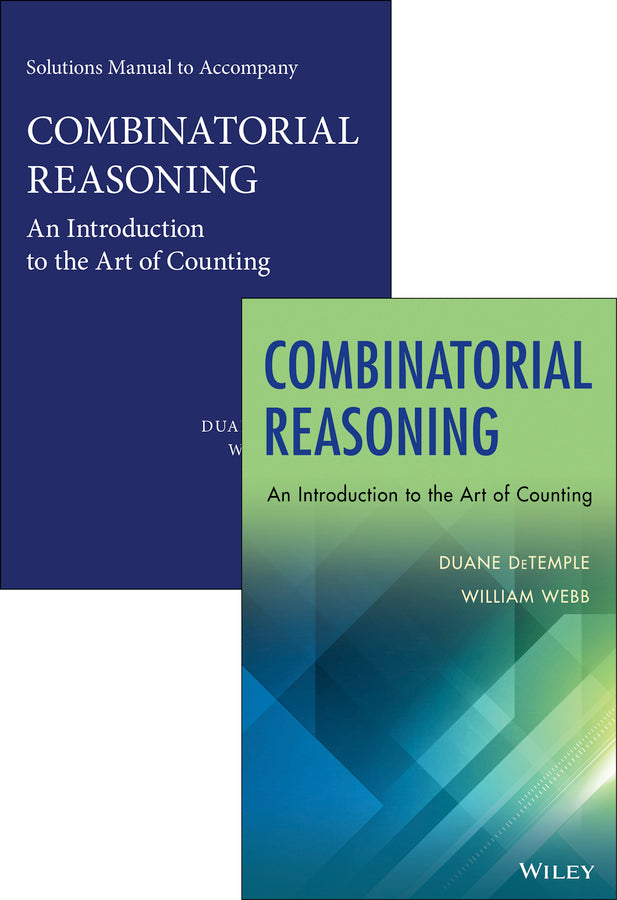
Combinatorial Reasoning
An Introduction to the Art of Counting Set
Duane DeTemple (Author)
9781118830833, Wiley
Hardback, published 4 November 2014
682 pages
24.3 x 16.1 x 3.2 cm, 0.798 kg
Combinatorial Reasoning: An Introduction to the Art of Counting and Solutions Manual Written by two well-known scholars in the field, Combinatorial Reasoning: An Introduction to the Art of Counting presents a clear and comprehensive introduction to the concepts and methodology of beginning combinatorics. Focusing on modern techniques and applications, the book develops a variety of effective approaches to solving counting problems. Balancing abstract ideas with specific topical coverage, the book utilizes real world examples with problems ranging from basic calculations that are designed to develop fundamental concepts to more challenging exercises that allow for a deeper exploration of complex combinatorial situations. Simple cases are treated first before moving on to general and more advanced cases. Additional features of the book include: • Approximately 700 carefully structured problems designed for readers at multiple levels, many with hints and/or short answers Combinatorial Reasoning: An Introduction to the Art of Counting is an excellent textbook for upper-undergraduate and beginning graduate-level courses on introductory combinatorics and discrete mathematics Solutions manual to accompany Combinatorial Reasoning: An Introduction to the Art of Counting
• Numerous examples that illustrate problem solving using both combinatorial reasoning and sophisticated algorithmic methods
• A novel approach to the study of recurrence sequences, which simplifies many proofs and calculations
• Concrete examples and diagrams interspersed throughout to further aid comprehension of abstract concepts
• A chapter-by-chapter review to clarify the most crucial concepts covered
Written by well-known scholars in the field, Combinatorial Reasoning: An Introduction to the Art of Counting introduces combinatorics alongside modern techniques, showcases the interdisciplinary aspects of the topic, and illustrates how to problem solve with a multitude of exercises throughout. The authors' approach is very reader-friendly and avoids the "scholarly tone" found in many books on this topic.
PREFACE ix PART I THE BASICS OF ENUMERATIVE COMBINATORICS 1 Initial EnCOUNTers with Combinatorial Reasoning 3 1.1 Introduction 3 1.2 The Pigeonhole Principle 3 1.3 Tiling Chessboards with Dominoes 13 1.4 Figurate Numbers 18 1.5 Counting Tilings of Rectangles 24 1.6 Addition and Multiplication Principles 33 1.7 Summary and Additional Problems 46 References 50 2 Selections, Arrangements, and Distributions 51 2.1 Introduction 51 2.2 Permutations and Combinations 52 2.3 Combinatorial Models 64 2.4 Permutations and Combinations with Repetitions 77 2.5 Distributions to Distinct Recipients 86 2.6 Circular Permutations and Derangements 100 2.7 Summary and Additional Problems 109 Reference 112 3 Binomial Series and Generating Functions 113 3.1 Introduction 113 3.2 The Binomial and Multinomial Theorems 114 3.3 Newton’s Binomial Series 122 3.4 Ordinary Generating Functions 131 3.5 Exponential Generating Functions 147 3.6 Summary and Additional Problems 163 References 166 4 Alternating Sums, Inclusion-Exclusion Principle, Rook Polynomials, and Fibonacci Nim 167 4.1 Introduction 167 4.2 Evaluating Alternating Sums with the DIE Method 168 4.3 The Principle of Inclusion–Exclusion (PIE) 179 4.4 Rook Polynomials 191 4.5 (Optional) Zeckendorf Representations and Fibonacci Nim 202 4.6 Summary and Additional Problems 207 References 210 5 Recurrence Relations 211 5.1 Introduction 211 5.2 The Fibonacci Recurrence Relation 212 5.3 Second-Order Recurrence Relations 222 5.4 Higher-Order Linear Homogeneous Recurrence Relations 233 5.5 Nonhomogeneous Recurrence Relations 247 5.6 Recurrence Relations and Generating Functions 257 5.7 Summary and Additional Problems 268 References 273 6 Special Numbers 275 6.1 Introduction 275 6.2 Stirling Numbers 275 6.3 Harmonic Numbers 296 6.4 Bernoulli Numbers 306 6.5 Eulerian Numbers 315 6.6 Partition Numbers 323 6.7 Catalan Numbers 335 6.8 Summary and Additional Problems 345 References 352 PART II TWO ADDITIONAL TOPICS IN ENUMERATION 7 Linear Spaces and Recurrence Sequences 355 7.1 Introduction 355 7.2 Vector Spaces of Sequences 356 7.3 Nonhomogeneous Recurrences and Systems of Recurrences 367 7.4 Identities for Recurrence Sequences 378 7.5 Summary and Additional Problems 390 8 Counting with Symmetries 393 8.1 Introduction 393 8.2 Algebraic Discoveries 394 8.3 Burnside’s Lemma 407 8.4 The Cycle Index and Pólya’s Method of Enumeration 417 8.5 Summary and Additional Problems 430 References 432 PART III NOTATIONS INDEX, APPENDICES, AND SOLUTIONS TO SELECTED ODD PROBLEMS Index of Notations 435 Appendix A Mathematical Induction 439 A.1 Principle of Mathematical Induction 439 A.2 Principle of Strong Induction 441 A.3 Well Ordering Principle 442 Appendix B Searching the Online Encyclopedia of Integer Sequences (OEIS) 443 B.1 Searching a Sequence 443 B.2 Searching an Array 444 B.3 Other Searches 444 B.4 Beginnings of OEIS 444 Appendix C Generalized Vandermonde Determinants 445 Hints, Short Answers, and Complete Solutions to Selected Odd Problems 449 INDEX 467
Subject Areas: Mathematics [PB]