Freshly Printed - allow 10 days lead
Couldn't load pickup availability
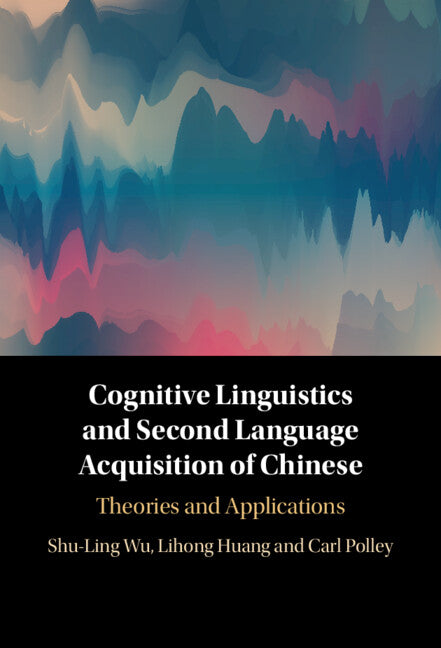
Cognitive Linguistics and Second Language Acquisition of Chinese
Theories and Applications
An introduction to the key cognitive linguistics concepts that aid analysis of Chinese and inform L2 Chinese teaching and learning.
Shu-Ling Wu (Author), Lihong Huang (Author), Carl Polley (Author)
9781009186728, Cambridge University Press
Hardback, published 8 February 2024
248 pages
23.5 x 15.9 x 1.9 cm, 0.5 kg
'This book represents a comprehensive and systematic application of cognitive linguistic research to the teaching and learning of the Chinese language, revealing how language and thought are related in embodied experience and cultural environment. Its publication is of great benefit to those who learn, teach, or study Chinese as a second language.' Ning Yu, Professor of Applied Linguistics and Asian Studies, The Pennsylvania State University
Although cognitive processes are fundamental in shaping the language that we speak, they are often overlooked in language teaching and learning. This groundbreaking book addresses how to use key cognitive linguistic (CL) concepts to analyze the Chinese language and to advance L2 Chinese teaching and learning. It presents an overview of the most prominent CL research published in both Chinese and English and explores how it applies to L1 and L2 Chinese studies. Including sample lesson plans and classroom activities, it demonstrates to language teachers how to use CL-based approaches to explain and teach a wide range of linguistic phenomena to their students. Researchers will also gain new insights from the summaries of recent advances and contrastive analyses between English and Chinese. Covering up-to-date research, yet written in a clear and engaging style, it will foster a new understanding of teaching and learning Chinese.
Preface
1. Cognitive linguistics and second language acquisition
2. Construal in language
3. Concepts and categorization
4. Iconicity and image schemas
5. Metaphor and metonymy
6. Polysemy
7. Embodied cognition and mental simulation
8. Teaching Chinese modal verbs
9. The future of cognitive linguistics in Chinese studies.
Subject Areas: Linguistics [CF]