Freshly Printed - allow 7 days lead
Couldn't load pickup availability
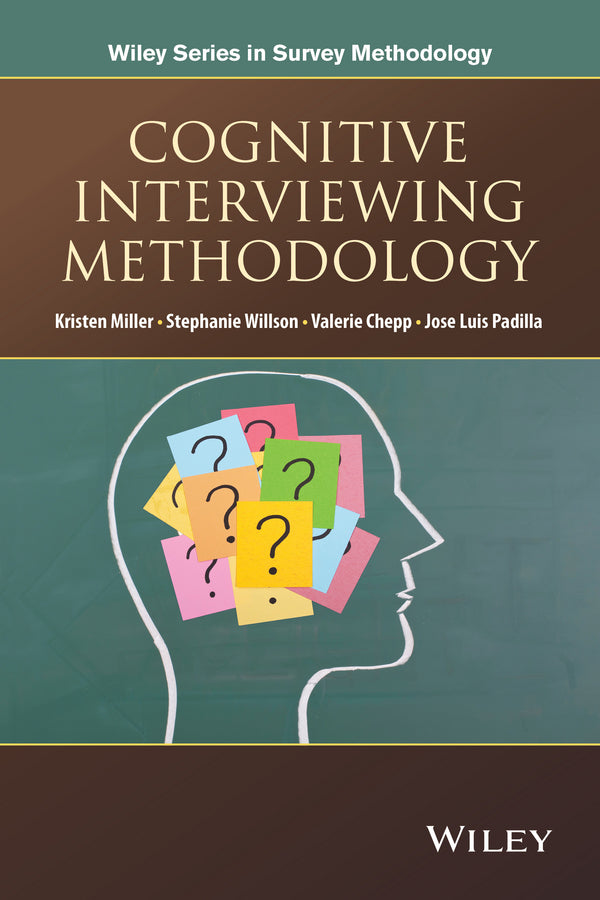
Cognitive Interviewing Methodology
Kristen Miller (Edited by), Valerie Chepp (Edited by), Stephanie Willson (Edited by), Jose-Luis Padilla (Edited by)
9781118383544, Wiley
Paperback / softback, published 12 August 2014
206 pages
23.6 x 15.8 x 1.1 cm, 0.322 kg
AN INTERDISCIPLINARY PERSPECTIVE TO THE EVOLUTION OF THEORY AND METHODOLOGY WITHIN COGNITIVE INTERVIEW PROCESSES
Providing a comprehensive approach to cognitive interviewing in the field of survey methodology, Cognitive Interviewing Methodology delivers a clear guide that draws upon modern, cutting-edge research from a variety of fields.
Each chapter begins by summarizing the prevailing paradigms that currently dominate the field of cognitive interviewing. Then underlying theoretical foundations are presented, which supplies readers with the necessary background to understand newly-evolving techniques in the field. The theories lead into developed and practiced methods by leading practitioners, researchers, and/or academics. Finally, the edited guide lays out the limitations of cognitive interviewing studies and explores the benefits of cognitive interviewing with other methodological approaches. With a primary focus on question evaluation, Cognitive Interviewing Methodology also includes:
An excellent reference for survey researchers and practitioners in the social sciences who utilize cognitive interviewing techniques in their everyday work, Cognitive Interviewing Methodology is also a useful supplement for courses on survey methods at the upper-undergraduate and graduate-level.
Foreword xiii Gordon Willis Acknowledgments xv Contributors xvii 1 Introduction 1 1.1 Cognitive Interviewing Methodology, 2 2 Foundations and New Directions 7 2.1 Introduction, 7 2.2 Sociology and the Interpretivist Tradition, 8 2.3 New Directions: Interpretation and Cognition, 9 2.4 Methodological Implications for Cognitive Interviewing, 11 2.5 Conclusion, 14 3 Data Collection 15 3.1 Introduction, 15 3.2 Cognitive Interviewing Study Sample, 15 3.2.1 Considerations of Sample Design, 16 3.3 The Cognitive Interview, 20 3.3.1 Differing Approaches to Cognitive Interviewing, 20 3.3.2 Different Kinds of Data: Respondent as Evaluator versus Respondent as Story Teller, 22 3.4 The Role of Interviewer, 28 3.4.1 Interviewer as Data Collector, 29 3.4.2 Interviewer as Researcher, 30 3.5 Conclusion, 33 4 Analysis 35 4.1 Introduction, 35 4.2 Analysis of Cognitive Interviews: Overview, 36 4.3 Analytic Steps for Cognitive Interviews, 38 4.3.1 Step 1: Conducting the Interview, 39 4.3.2 Step Two: Producing Interview Summaries, 40 4.3.3 Step Three: Developing a Thematic Schema, 42 4.3.4 Step Four: Developing an Advanced Schema, 44 4.3.5 Step Five: Making Conclusions, 47 4.4 The Benefits of a Complete Analysis, 49 4.5 Conclusion, 50 5 Assessing Translated Questions via Cognitive Interviewing 51 5.1 Introduction, 51 5.2 Why Use Cognitive Testing in Multilingual Survey Research, 51 5.2.1 Multilingual Research Settings, 52 5.2.2 Instrument Production in Multilingual Settings, 53 5.3 Translation and Translation Assessment Procedures, 54 5.3.1 Team Translation Approaches, 54 5.3.2 Translation Assessment Procedures, 54 5.3.3 Pretesting as Part of Translation Assessment, 55 5.4 Cognitively Testing Translations of Survey Questions, 57 5.4.1 Cognitive Interviewers, 58 5.4.2 Respondent Selection, 58 5.4.3 Introduction, Protocol, and Implementation, 59 5.4.4 Analysis, 59 5.5 Problems Uncovered by Cognitive Testing of Translations, 60 5.5.1 Uncovering Translation Problems, 61 5.5.2 Uncovering Problems with the Source Question, 64 5.5.3 Uncovering Problems Related to Cultural Differences – Need for Adaptation, 65 5.6 Conclusion, 66 6 Conveying Results 69 6.1 Introduction, 69 6.2 Contents of a Cognitive Interviewing Report, 70 6.2.1 Introduction, 70 6.2.2 Summary of Findings, 71 6.2.3 Methods, 73 6.2.4 Question-by-Question Review, 77 6.2.5 Appendix, 80 6.3 Characteristics of a Cognitive Interviewing Report, 80 6.3.1 Transparency, 81 6.3.2 Reflexivity, 82 6.4 Conclusion, 84 7 Case Study: Evaluation of a Sexual Identity Question 85 7.1 Introduction, 85 7.2 Background, 86 7.2.1 Intended Construct for the National Health Interview Survey Sexual Identity Question, 86 7.2.2 Review of Data Quality Problems, 87 7.2.3 Development of an Improved Sexual Identity Question, 89 7.3 Case Study: Cognitive Interviewing Evaluation of the National Health Interview Survey Revised Sexual Identity Question, 93 7.3.1 Recruitment and Respondent Demographics, 93 7.3.2 Interviewing Procedures, 93 7.3.3 Data Analysis, 95 7.4 Case Study Findings, 96 7.4.1 Summary of Question Performance, 96 7.4.2 Basis of Respondents’ Answers, 97 7.4.3 Cases of Response Problems, 99 7.4.4 Interpretation of Categories, 100 7.4.5 Study Conclusions, 105 7.5 Conclusion, 106 8 Analysis Software for Cognitive Interviewing Studies: Q-Notes and Q-Bank 107 8.1 Introduction, 107 8.2 Q-Notes Analysis Features, 108 8.2.1 Level 1: Conducting Interviews, 108 8.2.2 Level 2: Summarizing Interview Notes, 110 8.2.3 Level 3: Comparing Across Respondents, 112 8.2.4 Level 4: Comparing Across Groups, 115 8.2.5 Level 5: Drawing Conclusions about Question Performance, 118 8.3 Project Management Features, 118 8.3.1 Streamlined Communication, 119 8.3.2 Interview Data Collection, 119 8.3.3 Respondent Descriptors, 121 8.3.4 Controlled Access by Project, 121 8.3.5 Adding Questions, 122 8.3.6 Question Translations, 124 8.3.7 Coding Schemes, 124 8.4 Q-Bank: Making Cognitive Interview Findings Publicly Accessible, 125 8.5 Q-Bank Features, 126 8.5.1 Searching for Questions, 126 8.5.2 Advanced Search, 127 8.5.3 Question Details, 128 8.5.4 Value of Q-Bank, 129 8.6 Q-Bank: Challenges for the Past and Future, 130 8.7 Conclusion, 130 9 Cognitive Interviewing in Mixed Research 133 9.1 Introduction, 133 9.2 The Mixed Research Paradigm: Characteristics and Design, 134 9.2.1 Cognitive Interviewing Studies and Research Design, 135 9.3 Mixed Method Research and Survey Question Evaluation, 136 9.3.1 Case 1: Cognitive Interviewing and Survey Field Testing, 137 9.3.2 Case 2: Cognitive Interviewing and Differential Item Functioning (DIF), 145 9.3.3 Case 3: Cognitive Interviewing and Psychometric Scales, 148 9.4 Conclusion, 152 10 Conclusion 153 10.1 Introduction, 153 10.2 Summary of Practices, 154 10.2.1 Data Collection, 154 10.2.2 Analysis, 156 10.2.3 Documenting Study Findings, 157 10.3 New Directions, 159 10.3.1 Topics for Examination, 159 10.3.2 Mixed Method Research, 160 10.3.3 Accepted Standards of Cognitive Interviewing Studies, 161 Key Concepts 163 Question Evaluation Resources 167 References 171 Index 181
Kristen Miller
Valerie Chepp and Caroline Gray
Stephanie Willson and Kristen Miller
Kristen Miller, Stephanie Willson, Valerie Chepp, and J. Michael Ryan
Alis´u Schoua-Glusberg and Ana Villar
Valerie Chepp and Paul Scanlon
Kristen Miller and J. Michael Ryan
Justin Mezetin and Meredith Massey
Isabel Benitez Baena and Jos´e-Luis Padilla
Kristen Miller, Stephanie Willson, Valerie Chepp, and Jos´e-Luis Padilla
Subject Areas: Mathematics [PB]