Freshly Printed - allow 8 days lead
Couldn't load pickup availability
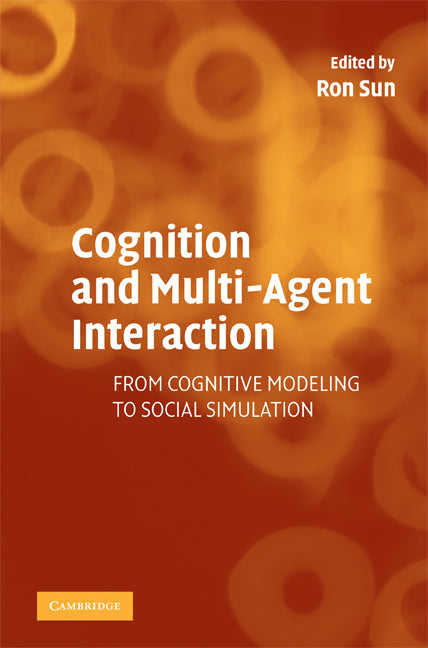
Cognition and Multi-Agent Interaction
From Cognitive Modeling to Social Simulation
This book explores the intersection between individual cognitive modeling and modeling of multi-agent interaction.
Ron Sun (Edited by)
9780521728959, Cambridge University Press
Paperback, published 26 May 2008
448 pages
22.8 x 15.1 x 2 cm, 0.59 kg
This book explores the intersection between cognitive sciences and social sciences. In particular, it explores the intersection between individual cognitive modeling and modeling of multi-agent interaction (social stimulation). The two contributing fields - individual cognitive modeling (especially cognitive architectures) and modeling of multi-agent interaction (including social simulation and, to some extent, multi-agent systems) - have seen phenomenal growth in recent years. However, the interaction of these two fields has not been sufficiently developed. We believe that the interaction of the two may be more significant than either alone. They bring with them enormous intellectual capitals. These intellectual capitals can be profitably leveraged in creating true synergy between the two fields, leading to more in-depth studies and better understanding of both individual cognition and sociocultural processes. It is possible that an integrative field of study in cognitive and social sciences is emerging and we are laying the foundation for it.
Part I. Introduction: 1. Prolegomena to integrating cognitive modeling and social simulation Ron Sun
Part II. Overviews of Cognitive Architectures: 2. Modeling paradigms in ACT-R Niel Taatgen, Christian Lebiere and John Anderson
3. Considering Soar as an agent architecture Robert Wray and Randolph M. Jones
4. The CLARION cognitive architecture: extending cognitive modeling to social simulation Ron Sun
Part III. Modeling and Simulating Cognitive and Social Processes: 5. Cognitive architectures, game playing, and human evolution Robert West, Christian Lebiere, and Dan Bothell
6. Simulating a simple case of organizational decision making Isaac Naveh and Ron Sun
7. Cognitive modeling of social behaviors William J. Clancey, Maarten Sierhuis, Bruce Damer, and Boris Brodsky
8. Cognitive agents interacting in real and virtual worlds Brad Best and Christian Lebiere
9. Modeling social emotions and social attributions Jonathan Gratch, Wenji Mao, and Stacy Marcella
10. Communicating and collaborating with robotic agents J. Gregory Trafton, Alan C. Schultz, Nicholas L. Cassimatis, Laura M. Hiatt, Dennis Perzanowski, Derek P. Brock, Magdalena D. Bugajska, and William Adams
11. Behavior-based methods for modeling and structuring control of social robots Dylan Shell and Maja Mataric
12. Evolution of a teamwork model Nathan Schurr, Steven Okamoto, Rajiv T. Matheswaran, and Milind Tambe
13. Sociality in embodied neural agents Domenico Parisi and Stefano Nolfi
14. Cognitive architecture and contents for social structures and interactions Cristiano Castelfranchi
Part IV. A Symposium: 15. Cognitive science and good social science Scott Moss
16. Collective cognition and emergence in multi-agent systems Pietro Panzarasa and Nick Jennings
17. Social judgement in multi-agent systems Tom Burns and Ewa Roszkowska
18. Including human variability in a cognitive architecture to improve team simulation Frank Ritter and Emma Norling
19. When does social simulation need cognitive models? Nigel Gilbert.
Subject Areas: Cognition & cognitive psychology [JMR]