Freshly Printed - allow 10 days lead
Couldn't load pickup availability
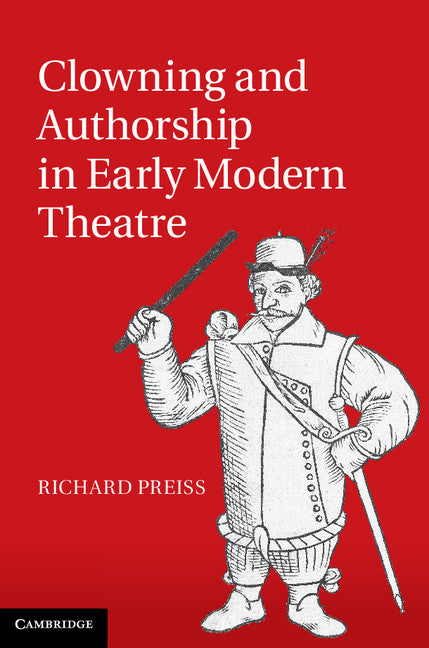
Clowning and Authorship in Early Modern Theatre
Richard Preiss presents a lively and provocative study of how the ever-popular stage clown shaped early modern playhouse theatre.
Richard Preiss (Author)
9781107036574, Cambridge University Press
Hardback, published 6 March 2014
298 pages, 11 b/w illus.
22.9 x 14.7 x 2.5 cm, 0.54 kg
'Original, sophisticated and deeply researched.' The Times Literary Supplement
To early modern audiences, the 'clown' was much more than a minor play character. A celebrity performer, he was a one-man sideshow whose interactive entertainments - face-pulling, farce interludes, jigs, rhyming contests with the crowd - were the main event. Clowning epitomized a theatre that was heterogeneous, improvised, participatory, and irreducible to dramatic texts. How, then, did those texts emerge? Why did playgoers buy books that deleted not only the clown, but them as well? Challenging the narrative that clowns were 'banished' by playwrights like Shakespeare and Jonson, Richard Preiss argues that clowns such as Richard Tarlton, Will Kemp, and Robert Armin actually made playwrights possible - bridging, through the publication of their routines, the experience of 'live' and scripted performance. Clowning and Authorship tells the story of how, as the clown's presence decayed into print, he bequeathed the new categories around which theatre would organize: the author, and the actor.
Introduction: the play is not the thing
1. What audiences did
2. Send in the clown
3. Wiring Richard Tarlton
4. Nobody's business
5. Private practice
Epilogue: the principal verb.
Subject Areas: Shakespeare studies & criticism [DSGS], Literary studies: plays & playwrights [DSG], Literary studies: classical, early & medieval [DSBB], Theatre studies [AN]