Freshly Printed - allow 10 days lead
Couldn't load pickup availability
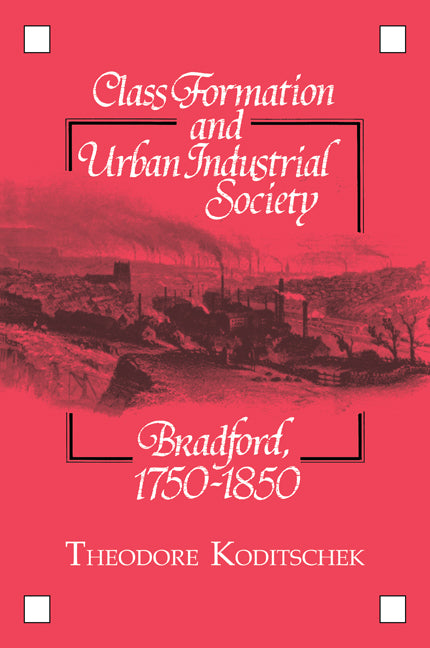
Class Formation and Urban Industrial Society
Bradford, 1750–1850
This book examines the process by which a capitalist society emerged in Bradford.
Theodore Koditschek (Author)
9780521103695, Cambridge University Press
Paperback / softback, published 18 December 2008
624 pages
22.9 x 15.2 x 3.5 cm, 0.9 kg
In 1750 Bradford was a small market town of about 4000 inhabitants in the Yorkshire, West Riding. By 1850 it had become a major industrial city of 100,000, the international centre of the worsted production and trade. Behind this massive expansion of population there occurred a fundamental transformation of society. This book examines the process by which a capitalist society emerged in Bradford. Although Bradford represents an unusual social environment where industrial development began very early and proceeded very fast, its history discloses with unusual force and clarity a process that was more gradually transforming the wider society of nineteenth-century Britain and that subsequently spread throughout the world. By explaining the process of class formation in industrialising Bradford, this book seeks to shed some historical light on the character, contradictions and ultimate resilience of the competitive liberal social order we still occupy.
Introduction
Part I. From traditional community to industrial city: Bradford: 1750–1850: 1. Protoindustrialisation in Bradford: 1750–1810
2. The crisis of the traditional community
3. The urban-industrial revolution: 1810–1850
5. The industrial city and the traditional elite
Part II. The emergence of a liberal entrepreneurial society and the rise of an urban-industrial bourgeoisie: 1825–1850: 6. The rising generation of urban entrepreneurs
7. The making of the self-made man
8. The life of the self-denying entrepreneur
9. The promise of a liberal entrepreneurial society
10. The culture of voluntarism: religious association
11. The culture of voluntarism: secular association
12. The politics of liberalism
Part III. The crisis of proletarianisation and the stabilisation of the urban-industrial world: 1825–1850
13. The process of proletarianisation
14. From self-reliance to public relief: the bourgeois response to working-class poverty
15. Urban-industrial paternalism and the Tory radical revival
16. The emergence of working-class culture and consciousness
17. The challenge of Chartism
18. The foundations of the mid-Victorian liberal consensus
Epilogue
Appendices
Index.
Subject Areas: Modern history to 20th century: c 1700 to c 1900 [HBLL], British & Irish history [HBJD1]