Freshly Printed - allow 10 days lead
Couldn't load pickup availability
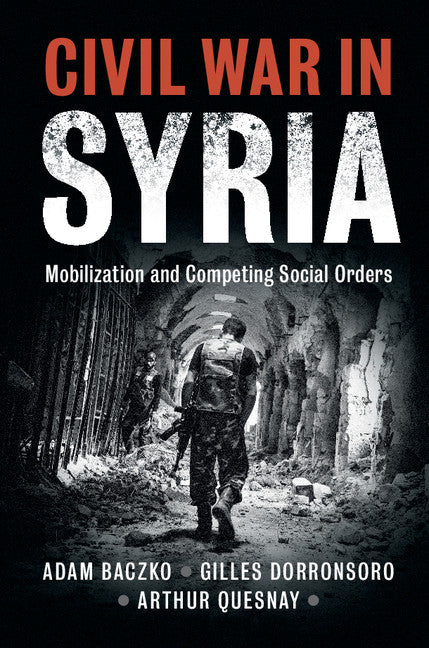
Civil War in Syria
Mobilization and Competing Social Orders
The first comprehensive field-based study of the Syrian conflict, introducing a seminal approach to civil wars.
Adam Baczko (Author), Gilles Dorronsoro (Author), Arthur Quesnay (Author)
9781108420808, Cambridge University Press
Hardback, published 8 February 2018
346 pages, 7 maps
23.6 x 15.7 x 2.2 cm, 0.6 kg
'This book skillfully draws on a large number of interviews, many of them conducted inside Syria, to paint a rich and fascinating picture of life and political authority in rebel-held Syria. It documents attempt to construct some element of governance in rebel areas of Syria and the uneven struggle between militant jihadist groups with access to funding and weapons (especially Jabhat al-Nusra and ISIS) and less well-supported groups … an interesting and revealing study.' David Keen, London School of Economics and Political Science
In 2011, hundreds of thousands of Syrians marched peacefully to demand democratic reforms. Within months, repression forced them to take arms and set up their own institutions. Two years later, the inclusive nature of the opposition had collapsed, and the PKK and radical jihadist groups rose to prominence. In just a few years, Syria turned into a full-scale civil war involving major regional and world powers. How has the war affected Syrian society? How does the fragmentation of Syria transform social and sectarian hierarchies? How does the war economy work in a country divided between the regime, the insurgency, the PKK and the Islamic State? Written by authors who have previously worked on the Iraqi, Afghan, Kurd, Libyan and Congolese armed conflicts, it includes extensive interviews and direct observations. A unique book, which combines rare field experience of the Syrian conflict with new theoretical insights on the dynamics of civil wars.
Prolegomena: for a sociological approach to civil wars
Introduction
Part I. Genesis of a Revolution: 1. The al-Assad system
2. A revolution of anonyms
3. The path to civil war
Part II. Revolutionary Institutions: 4. The building of military capital
5. Administering the revolution
6. Mobilization outside Syria
Part III. The Fragmentation of the Iinsurrection: 7. The crisis internationalizes
8. The Kurds and the PKK
9. The Islamization of the insurgency
10. The caliphate
Part IV. A Society at War
11. The variations of social capital
12. The economy for war
13. New identity regimes
Conclusion.
Subject Areas: International relations [JPS], Comparative politics [JPB], Politics & government [JP], Sociology [JHB]