Freshly Printed - allow 10 days lead
Couldn't load pickup availability
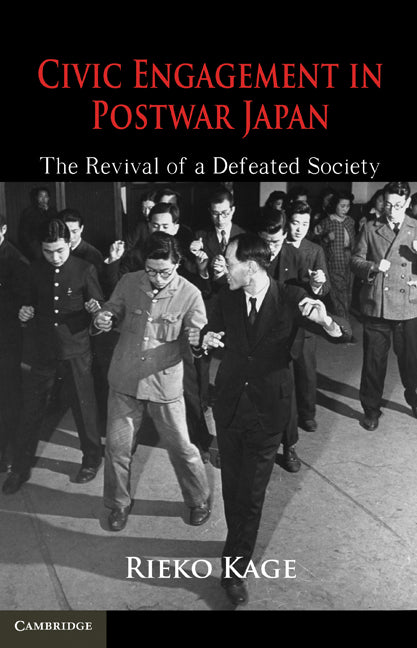
Civic Engagement in Postwar Japan
The Revival of a Defeated Society
This book illuminates one of the keys to making postwar democracies work.
Rieko Kage (Author)
9780521192576, Cambridge University Press
Hardback, published 15 December 2010
216 pages, 16 b/w illus. 21 tables
23.4 x 15.6 x 1.4 cm, 0.45 kg
“Civic Engagement in Postwar Japan has provocative implications for practice. If Kage is right, legacies of cultural belief and social practice established in the past have more influence on the response to postwar situations than the “shock and awe” that a population may have experienced.” -David C. Hammack, Case Western Reserve University, Nonprofit and Voluntary Sector Quarterly
Despite reduced incomes, diminished opportunities for education, and the psychological trauma of defeat, Japan experienced a rapid rise in civic engagement in the immediate aftermath of World War II. Why? Civic Engagement in Postwar Japan answers this question with a new general theory of the growth in civic engagement in postwar democracies. It argues that wartime mobilization unintentionally instills civic skills in the citizenry, thus laying the groundwork for a postwar civic engagement boom. Meanwhile, legacies of prewar associational activities shape the costs of association-building and information-gathering, thus affecting the actual extent of the postwar boom. Combining original data collection, rigorous statistical methods, and in-depth historical case analyses, this book illuminates one of the keys to making postwar democracies work.
1. Introduction
2. Civic engagement: the dependent variable
3. War and civic engagement: a theoretical framework
4. Quantitative analysis: the rise of civic engagement across forty-six Japanese prefectures
5. The long-term effects of wartime mobilization: cross-national analysis
6. Repression and revival of the YMCA Japan
7. Wartime promotion and postwar repression of a traditional martial art
8. Civil society and reconstruction in postwar Japan
9. Conclusions.
Subject Areas: Comparative politics [JPB], Politics & government [JP]