
Freshly Printed - allow 7 days lead
Couldn't load pickup availability
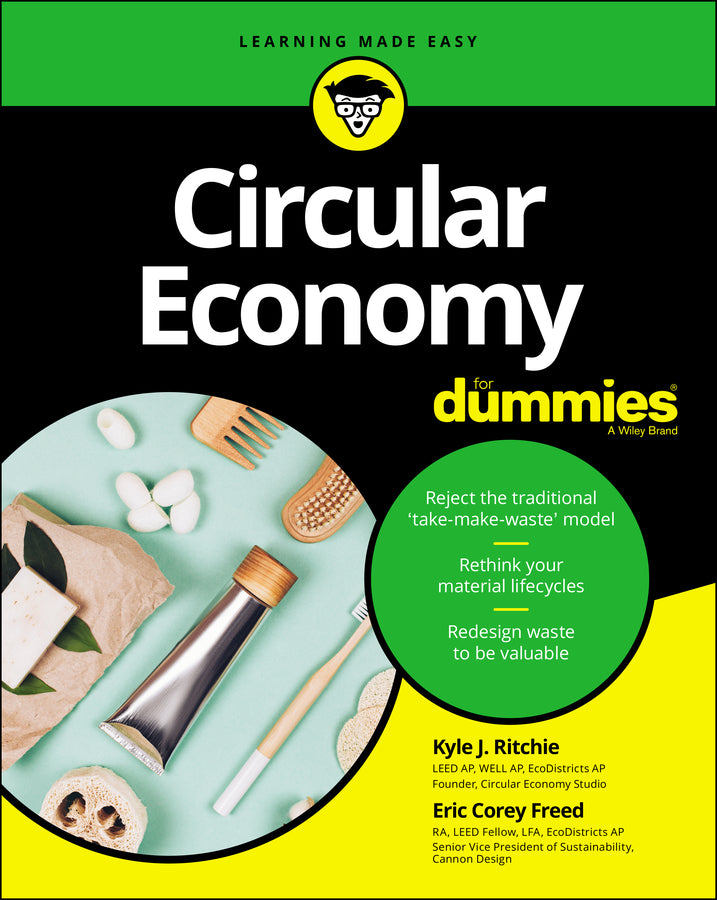
Circular Economy For Dummies
Kyle J. Ritchie (Author), Eric Corey Freed (Author)
9781119716389, Wiley
Paperback / softback, published 24 June 2021
432 pages
22.9 x 18.3 x 2.8 cm, 0.567 kg
Imagine a waste-free future for your business, your family, and yourself A circular economy is an economic system designed to save money, eliminate waste, and achieve deep sustainability. No-brainer, right? Circular Economy For Dummies explains why the old way of doing things (linear economy) is fast going the way of the dinosaurs, and it gets you ready to think circular. From business processes and material lifecycles to circular design in just about every industry, this book is a fascinating glimpse into our sustainable future. Whether you’re looking to close the resource loop in your business or develop a greener lifestyle for yourself and your family, this book shows you how. Learn how to innovate for circular economy, how to turn trash into treasure, and how to calculate the (potentially large) amount of money this will save you. And—bonus—you’ll feel good doing the right thing and being a part of our sustainable future! The future is circular. Buck business-as-usual and learn how to create a circular economy for all!
Introduction 1 About This Book 2 Foolish Assumptions 3 Icons Used in This Book 4 How This Book Is Organized 4 Part 1: Linear Is Out, Circular Is In: An Economic Revolution 4 Part 2: Rethinking Business for a Circular Economy 5 Part 3: Rethinking Material Lifecycles — The Circular Perspective 5 Part 4: Redesigning the Future to Be Circular 5 Part 5: Creating a Circular Economy for All 6 Part 6: The Part of Tens 6 Beyond the Book 6 Where to Go from Here 7 Part 1: Linear Is Out, Circular Is In: An Economic Revolution 9 Chapter 1: Rejecting Waste, Rethinking Materials, and Redesigning the World 11 Rejecting the Idea of Waste 12 Waste as a driver of the economy 13 Waste as a resource 13 Rethinking Material Lifecycles 16 Take, make, and waste 17 Making technical materials circular 17 Making biological materials circular 18 Upcycling versus downcycling 19 Redesigning the Future to Be Circular 19 Food production 20 Circular businesses, products, and clothing 20 A circular economy for all 22 Chapter 2: What’s Wrong with Being Linear, Anyway? 23 We’re Taking the Wrong Stuff 25 We’re not importing this stuff from space 27 Everyone keeps having kids 28 We don’t have as much as we thought 30 It all revolves around oil 31 We’re Making the Wrong Stuff 31 You’re buying trash 32 Even kids can build with blocks 33 Trying to recycle the unrecyclable 33 We’re using materials that are bad for us 34 We’re Wasting the Wrong Stuff 34 It all comes at a big cost 34 We’re running out of room 35 It’s expensive to throw things away 35 The debt collector is knocking at the door 35 Change Is Really Hard, We Know 36 If it ain’t broke, don’t fix it 36 Taking risks 37 Chapter 3: A Growing Demand for a Circular Economy 41 The Drive to Make Money 44 Redefining risk and liability 44 Innovating to attract new customers 46 The Drive to Be Healthier 46 Lifestyles that foster health and sustainability 46 Wellness as a priority 47 The Drive to Be in Compliance 47 Environmental, social, and corporate governance 48 Corporate social responsibility (CSR) 49 Climate and shareholders 50 A Larger Drive Toward Deep Sustainability 50 This has been brewing for a while 51 Precedents 51 Looking to the future 54 Chapter 4: From Linear To Circular: What You Need To Know 57 So Much Chaos: Understanding Entropy 58 Externalized costs 59 Linear versus circular: A hilarious-yet-depressing comparison 60 Borrow from nature, not from the future 64 Waste = Food: Redefining Disposal 66 All materials have another use 68 Product stewardship 69 Building Resilience Through Diversity: Redefining Strength 71 Responding to disruption 72 Takes a lickin’ and keeps on tickin’ 73 Durability and reparability policies 74 Part 2: Rethinking Business For a Circular Economy 77 Chapter 5: Identifying Your Business Opportunities 79 Exploring the Benefits of Going Circular 79 Exploiting the profit opportunities 80 Reducing volatility and ensuring greater supply chain security 81 Managing the new demand for business services 81 Improving customer interaction and loyalty 83 Rethinking the Business Model 85 Building new types of capital 86 Rethinking money as the only medium of exchange 87 Reflecting the true cost of products 87 Embracing diversity 89 Rethinking your supply chain 89 Designing for the future 90 Examining Business from a Global Perspective 91 Chapter 6: Rethinking the Conventional Business Model 95 Rethinking How We Look at Cost 98 The hidden cost of procurement 100 The hidden impact of transportation 104 The hidden burden of inventory 104 The hidden secrets of quality 105 Maximizing Your Value Proposition to Customers 105 Becoming a mission-driven company 106 Safeguarding your workers 107 Greenwashing 107 Turning Obstacles into Opportunities 108 Listening to customers 109 Creating unspoken demand 110 Rethinking old assumptions 110 Bending linear into loops 111 Thinking of businesses as a system 112 Chapter 7: Exploring the Essentials of a Circular Business Model 113 The Six Rs: Your New Circularity Mantra 114 Refuse: Say no to what you don’t need 114 Reduce: Use less for longer 115 Reuse and remanufacture: Extend product life 116 Repurpose: Find other uses 116 Recycle: Return materials for rebirth 116 Rot: Return it to the soil 117 Developing a Circular Business Structure: The Bones of the Operation 117 Identifying potential material loops 118 Considering innovative business models 118 Who’s at the table? Engaging your stakeholders 120 Developing a message 121 Benchmarking and improvement 122 Chapter 8: ’Round and ’Round: Making Your Products Circular 127 Managing Material Lifecycle Performance 128 Designing products for reuse 129 Designing products to be remanufactured 130 Designing products for recycling 130 Making Your Product Lifecycle Smarter 131 Creating effective and serviceable products 132 Being flexible 132 Seeking collaborators and partners 133 How It All Comes Together 134 Everything is circular first 134 Everything is transparent 135 Chapter 9: From Trash to Treasure: Converting Waste into Products 139 Seeing Why the Circular Economy Is All About Retaining Value 140 Stop Being Linear: It’s a Waste of Time 144 Why Buy Waste When You Can Sell It? 145 Selling your old stuff 147 Starting your own business 149 Troubleshooting a Wasteful Product Lifecycle 152 Where the wild things are 153 Signed, sealed, delivered 153 Waste not, want not 154 Being a sustainable shopper 154 Finding value in the ugly 155 Part 3: Rethinking Material Lifecycles: The Circular Perspective 163 Chapter 10: Understanding the Circular Material Lifecycle 165 Viewing the Entire Spectrum of Environmental Impact 166 Defining degenerative lifecycles 167 Defining sustainable lifecycles 167 Defining regenerative lifecycles 168 Understanding the Ellen MacArthur Foundation’s Butterfly Diagram 169 Examining the circular economy’s structure: The bones of the operation 169 Renewables flow management: Harnessing biological cycles 171 Stock management: Optimizing technical cycles 172 Promoting environmental restoration: Investing now to obtain even more later 175 Chapter 11: Analyzing Material Lifecycle Processes 179 Looking at Material Processes 181 Fostering transparency 183 Instituting chemical management 183 Rewarding innovation 184 The Lifecycle Principles: Identifying Where Change Can Happen 184 Preserving natural capital 185 Enhancing the usefulness of products, components, and raw materials 186 Developing effective systems that minimize negative externalities 187 Looking at Opportunities for Optimization 187 Refusing the new: Reusing the old 188 Employing the remaining factor: Remanufacturing 189 Biochemical extraction for the win 190 Chapter 12: Improving the Material Lifecycle 195 Improving How Material Lifecycles Function 196 Looking at Materials in a New Way 198 Getting to know your lifecycle 199 Refuse before you reduce, reuse, and recycle 200 Examining Operations in a New Way 201 Looking at human capital 201 You can be everywhere 201 Connecting Sourcing, Suppliers, and Customers 202 Chapter 13: It All Comes Down to Selecting the Right Materials 207 The Good, the Bad, and the Ugly: Exploring Materials 208 Oil or Plastics — They’re Really Much the Same Thing 208 What’s Harder than Rock? Metals 212 Paper Products and Cardboard 214 Through the Looking Glass 217 And Everything In-Between 218 Identifying Hazardous Materials 219 Red list materials 220 Red list material alternatives 221 Volatile organic compounds (VOCs) 221 Sourcing, Ethics, and Standards 222 Understanding strategic sourcing 222 Establishing ethics 223 Exploring certifications and standards 223 Chapter 14: Circular Materials, Products, and Packaging 227 Redesigning Materials and Products: The Transition from Linear to Circular 228 “Less bad” does not equal “good” 228 Planning for material reincarnation 230 How To Keep Materials In Use Forever 231 Why things break 232 From planned obsolescence to planned permanence 232 Shipping Global versus Producing Local 234 Building a regional economy: A shipping substitute 235 You’ve got to be shipping me 238 Permanent packaging 239 Part 4: Redesigning the Future to Be Circular 245 Chapter 15: The Circular Economy of Food Production 247 Examining the Two Ways of Producing Food 248 Investigating the Hidden Costs of Agriculture 249 Food waste: Expending money, time, and resources unnecessarily 250 Environmental degeneration: Damaging the planet with increasing speed 252 Permaculture to the Rescue 252 Following nature’s lead: Permaculture design principles 253 Taking a look at permaculture management zones 256 Chapter 16: Circularity for Design 259 Redesigning Design 260 Understanding circular design 260 Designing out waste 263 Keeping products and materials in use 264 Regenerating natural systems 264 Recognizing the Problems Designers Face 265 We’re being overtaken by trash 265 We’re running out of materials 265 We’re choking on carbon 266 Creating a Framework for Circular Design 267 Applying the ReSOLVE framework to buildings 268 Layers of useful life 269 Putting the pieces together 271 Chapter 17: Circular Economy for Builders, Makers, and Manufacturers 275 Assessing a Building’s Lifecycle 276 Defining construction and demolition debris 276 Gauging the economic opportunities of C&D waste 277 Measuring C&D waste impact 277 Defining lifecycle impacts 279 Identifying human health hazards and promoting transparency 280 People, planet and profit 280 Selecting Appropriate Building Products 283 Sourcing responsibly 284 Something stinks 285 We All Embody Carbon 287 The human’s relationship to carbon 288 The building’s relationship to carbon 290 Operational carbon 290 Embodied carbon 291 Carbon influences on building design 293 Straight from the Open Source 294 Recognizing the benefit 294 Looking at open source in action 295 Chapter 18: The Circular Economy for Fashion and Clothing 297 Sewing Together the Issue: Where Fashion Is and Where It’s Headed 298 Fashion = Waste + Pollution 299 The current trajectory to catastrophe 302 Making It Circular: A Future Forecast for Fashion 303 The Phase Out phase 304 Redesigning how clothes are used 305 Optimizing collection and recycling 306 Relying on renewable resources 307 Comparing Common Fashion Fabrics 310 Plastic 311 Plants 313 Animals 314 Part 5: Creating A Circular Economy For All 317 Chapter 19: Understanding an Individual’s Circular Opportunities 319 Looking at the Food You Eat 320 Sourcing 320 Managing food waste 321 Sizing Up the Products You Buy 327 Recycling: The last resort 327 Selecting products with reuse potential 328 Evaluating the House You Live In 328 Considering lifecycle costs 329 Building better 329 Thinking About the Way You Commute 331 Be car-less for once 331 Choose more efficient options 332 Revisiting the Way You Work 332 Promoting telecommuting and teleconferencing 332 Managing office supplies 333 Chapter 20: Creating a Career in the Circular Economy 335 Looking at the Future of Jobs 336 Jobs that are central to the circular economy 338 Jobs that are enabling the circular economy 338 Jobs that are indirectly related to the circular economy 339 Skills required for a circular economy 341 Where to Go for More Education 341 Earning certifications 341 Earning degrees and diplomas 342 Chapter 21: A Global Vision of a Circular Economy 345 Seeing What a Circular Community Looks Like 346 Sourcing community resources and aid 347 Looking at food management 348 Eyeing transportation 349 Seeing What a Circular University Looks Like 350 Learning from living laboratories 351 Insisting on data visibility 352 Seeing What a Circular Restaurant and Brewery Look Like 353 Fostering effective and efficient sourcing and prep 354 Revising service standards 355 Viewing waste as a resource 356 Part 6: The Part of Tens 359 Chapter 22: Ten Questions to Ask About Your Material Lifecycle 361 Where Did This Material Come From? 362 What Are the By-Products of Harvesting This Material? 362 What Are the By-Products of Manufacturing This Material? 362 How Is the Material Delivered? 363 How Is the Material Installed? 364 How Is the Material Maintained, Powered, or Operated? 364 How Healthy Are the Materials? 364 What Can We Do with These Materials After We’re Done with Them? 365 What Can Be Done to Extend, Prolong, or Maintain the Material? 366 What Can We Do to Encourage the Reuse, Refurbishment, Redistribution, or Remanufacture of the Material? 366 Chapter 23: Ten Questions to Foster Innovative Thinking 367 How Can We Make This Product Redundant? 368 How Can We Rethink How This Product Is Used? 369 How Can We Reduce the Resources or Materials Used? 369 In What Ways Can This Product Be Reused by Another Consumer? 369 In What Ways Can This Product Be More Easily Maintained and Repaired? 370 In What Ways Can This Product Be Restored or Kept Up-to-Date? 370 How Can Discarded Parts Be Remade into a New Version of the Same Product? 370 How Can Discarded Parts Be Remade Into a New Product? 371 In What Ways Can We Recycle These Materials into Quality Products? 371 How Can We Dispose of This Material in a Manner That Recovers Energy? 371 Chapter 24: Ten Questions to Ask about Your Supply Chain 373 What Drives Your Product Design? 374 What Are Your Users’ Needs? 374 Will Your Customers Access or Will They Own Your Product? 375 Who Are Your Partners? 376 What Materials Are Required? 377 How Will You Produce Your Product? 377 How Will Users Receive Your Product? 378 How Will You Support the Repair and Maintenance of Your Product? 379 What Refurbishment Options Will You Offer for Your Product? 379 How Will You Reclaim Your Product at Its End of Life? 380 Chapter 25: Ten Questions That Reveal How Much Your Waste Is Costing You 381 What Labor Costs Are Tied to Waste Disposal? 382 What Is the Real Cost of Waste Disposal? 382 What Is the Impact on Human Health? 383 How Does Waste Impact Ecosystem Services? 383 What Is the Innate Value of Waste? 384 How Much Raw Material Is Required to Offset Waste? 385 What Are the Indirect Costs of Waste? 385 How Much Does Poor Efficiency Cost? 386 What Natural Resources Are Required for Waste? 386 What Waste Remediation Will Be Required? 387 Index 389
Subject Areas: The environment [RN]