Freshly Printed - allow 7 days lead
Couldn't load pickup availability
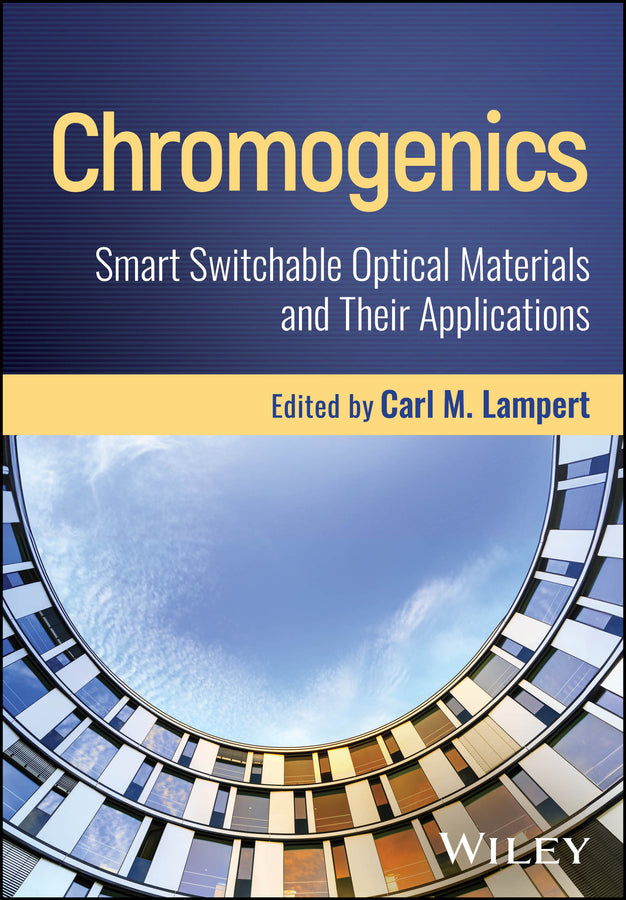
Chromogenics
Smart Switchable Optical Materials and Their Applications
Carl M. Lampert (Edited by)
9781394159079, Wiley
Hardback, published 19 December 2025
544 pages
25.4 x 17.8 x 2.9 cm, 1.402 kg
Firsthand insights into the current and future technology and large-scale applications of color- and opacity-changing optical materials Chromogenics delivers a comprehensive overview of the industry-relevant scientific background of chromogenics and provides details on successful manufacturing techniques for the scalable fabrication of products, enabling readers to apply chromogenic materials in billion-dollar market segments such as the car industry (rear-view mirrors) and building and construction industries (self-tinting windows), as well as for individual end-user products such as sunglasses. This work includes contributions from developers of chromogenic products from leading companies and industry-near research institutions such as Fraunhofer, Merck, Pleotint, and Gentex, Chromogenics explores topics including: Presenting state-of-the-art research in the field along with future outlooks, Chromogenics is an essential reference on the subject for materials scientists, physical chemists, applied physicists, and engineering scientists in industry.
List of Contributors xiii Preface xv Part I Technologies 1 1a Overview of Chromogenics 3 Nomenclature 3 1a.1 Introduction 5 1a.2 The Dynamic Glass Market 7 1a.2.1 Automotive 8 1a.2.2 Eyewear 9 1a.2.3 Architectural 10 1a.2.4 Aerospace 12 1a.2.5 Information Display 12 1a.3 Families of Chromogenic Materials 13 1a.3.1 Chromogenics Switching by Collective Physical Movement 14 1a.3.1.1 Electromechanical 17 1a.3.1.2 Mechanochromism 19 1a.3.1.3 Magnetochromics and Magnetoionics 20 1a.3.1.4 Electrokinetics 21 1a.3.1.5 Dispersed Liquid Crystals (PDLC and NCAP) 22 1a.3.1.6 Suspended Particles 26 1a.3.2 The Chemichromic and Electrochemichromic Families 28 1a.3.2.1 Gasochromic 30 1a.3.2.2 Halochromism 34 1a.3.2.3 Solvatochromism 35 1a.3.2.4 Hydrochromism 35 1a.3.2.5 Electrochemichromic 35 1a.4 Chromogenic Switching by Discrete Movement of Ions, Atoms, and Molecules 36 1a.4.1 Electrochromics 37 1a.4.1.1 Inorganic Electrochromics 38 1a.4.1.2 Organic and Polymer Electrochromics 41 1a.4.2 Light-Induced Switching – Photochromics 42 1a.4.3 Thermal-Induced Switching – Thermochromic and Thermotropics 45 1a.4.3.1 Thermal-Induced Switching – Ligand Exchange Thermochromic (LETC) 46 1a.4.3.2 Thermal-Induced Switching – Thermotropics 48 1a.5 Multiband Switching Windows and Surfaces 49 1a.6 Running a Chromogenics Business 50 1a.6.1 Organizational Viewpoint 51 1a.6.2 Materials Viewpoint – Chromogenics 51 1a.6.3 Materials Viewpoint – Electrochromics 52 1a.6.4 Manufacturing Viewpoint 52 1a.6.5 Marketing Perspective 53 1a.7 Additional Information about Chromogenics 53 Acknowledgments 54 References 54 1b Introduction to Glazing Design and Measurements 69 Nomenclature 69 1b.1 Common Metrics for Glazing 71 1b.2 Solar Radiation and the Earth’s Atmosphere 72 1b.2.1 Clearness Index 74 1b.2.2 Daylighting 74 1b.3 Transmittance, Reflectance, and Absorptance Measurements 75 1b.3.1 Solar Transmittance 75 1b.3.2 Luminous, Visible Transmittance, and Visible Light Transmittance (VLT) 75 1b.3.3 Absorbance or Optical Density Measurement 77 1b.3.4 Haze and Scattering Measurements 78 1b.4 Color Measurements 80 1b.5 Thermal Emissivity and Emittance 82 1b.5.1 Low-e Coatings and Transparent Conductors used in Insulated Glass Units (IGUs) 83 1b.6 Design of an IGU Window System 86 1b.7 Energy Flow Mechanisms in Glazing Fenestration 87 1b.7.1 Conductive Heat Transport 88 1b.7.2 Convective Heat Transport 88 1b.7.3 Radiative Heat Transport 88 1b.8 Parameters Commonly Used to Characterize Window Glazing 89 1b.8.1 U-Factor 89 1b.8.2 Solar Heat Gain Coefficient (SHGC) 90 1b.8.3 Solar Factor (g-Value) or Total Solar Energy Transmittance (TSET) 91 1b.8.4 Total Solar Transmittance 91 1b.8.5 Instantaneous Heat Flow in a Whole Glazing 91 Acknowledgments 92 References 92 2 Electrochromics 97 Nomenclature 97 2.1 Introduction to the Field of Electrochromics 100 2.2 Electrochromic Materials 101 2.2.1 Coloration Efficiency 105 2.3 Electrochromic Device Design 106 2.3.1 Transparent Conductors 110 2.3.2 Electrochromic Device Switching Time 111 2.4 Self-Dimming Automotive Rearview Mirrors 112 2.5 Early Development of Electrochromic Automotive Sunroofs 116 2.6 Early Electrochromic Windows Developed at Asahi Glass Company 118 2.7 Designing Materials Systems for Electrochromic Glazing 120 2.8 Dynamic Building Windows 123 2.9 Commercial Electrochromic Windows 124 2.9.1 Window Performance Parameters 125 2.9.2 Electrochromic Glazing Examples 127 2.10 Multiband Switching for Glazing 134 2.10.1 Localized Surface Plasma Resonance (LSPR) 134 2.10.2 Early Commercial Development of LSPR Nanocrystals for Dual-Band Switchable Glazing 136 2.10.3 Research in Dual-Band Electrochromics 136 2.11 Electrochromic Windows for Aircraft 139 2.12 Electrochromic Eyewear 142 2.13 Electrochromic Information Displays 144 2.14 Electrochromic Gradient Filter 146 2.15 Dynamic Thermal Emittance Electrochromics for Spacecraft and Spacesuits 149 2.16 Other Electrochromic Devices: Photoelectrochromic and Photovoltaic-Electrochromic 151 Acknowledgments 151 References 151 3 Trends in Organic Electrochromic Materials and Their Applications 173 Nomenclature 173 3.1 Introduction to Organic Electrochromics 174 3.2 Organic EC Materials and Device Architectures 176 3.3 Electrochromic Supercapacitors (ESCs) with at Least One Transparent State 182 3.4 Integration of PV and ECD−Photoelectrochromic Device 187 References 191 4 Polymeric Electrochromics 195 Nomenclature 195 4.1 Introduction 196 4.2 Electrochromic Polymers 196 4.2.1 Conjugated Polymers 196 4.2.2 Metal Coordination Polymers 204 4.3 Device Manufacturing 206 4.4 Industrial Applications of Polymeric Electrochromic Devices 213 4.5 Conclusion and Outlook 216 References 218 5 Evolution of Industrial Polymer Dispersed Liquid Crystal (PDLC) Technology in Europe: A Review of Research, Development, Manufacturing, and Potential Emerging Technologies 229 Nomenclature 229 5.1 Introduction to PDLC Technology 229 5.2 The Original PDLC Inventions 232 5.2.1 Micro-Emulsion (ME) Invention 233 5.2.2 Phase Separation (PS) Invention 233 5.2.2.1 Polymer Induced Phase Separation (PIPS) 233 5.2.2.2 Solvent Induced Phase Separation (SIPS) 233 5.2.2.3 Thermal Induced Phase Separation (TIPS) 233 5.3 Manufacturing Methods of PDLC Film 235 5.4 Historical Evolution of Industrial PDLC Technology 236 5.4.1 The Early Period (<1995) 237 5.4.2 The Setback Period (1995–2005) 238 5.4.3 The Revival Period (>2005) 238 5.5 PDLC Industrial Development in Italy 240 5.5.1 SNR (Italy) PDLC License 240 5.5.2 SNR Industrial R&D Program 242 5.5.3 SNR Production Program 243 5.5.3.1 Dry/Coating & Lamination Technique 244 5.5.3.2 Wet/Coating & Lamination Technique 244 5.5.4 SNR Intellectual Property 246 5.6 Important Industrial Development Issues 247 5.6.1 The Significance of Scale 247 5.6.2 The Significance of Time 247 5.7 Industrial Development of PDLC in Europe 247 5.7.1 Innoptec S.p.A. (Italy) 248 5.7.2 Dream Glass S.L. (Spain) 248 5.7.3 Gauzy Ltd. (Israel) 248 5.8 Potential Emerging Industrial PDLC Technologies 249 5.8.1 Direct PDLC Glazing 249 5.8.2 Bistable PDLC 250 5.8.3 Solar-Control PDLC 251 5.8.4 Dynamic PDLC Signage 251 5.9 The PDLC Market Situation 253 References 253 6 Suspended Particle Devices 261 Nomenclature 261 6.1 Introduction 262 6.2 Materials 264 6.3 Manufacture and Commercial Specifications 266 6.3.1 Switching Duration 267 6.3.2 Spectral Transmittance 272 6.4 Applications in the Built Environment 276 6.5 Accelerated Testing 279 6.6 Conclusion 284 Acknowledgment 287 References 287 7 Inorganic Thermochromics and Photochromics 293 Nomenclature 293 7.1 Introduction 294 7.2 Optical Properties 295 7.3 Thermochromic Coatings 297 7.3.1 Challenges for VO 2 -Based Films 299 7.3.2 Synthesis of VO 2 -Based Thermochromic Films 304 7.3.3 Synthesis of VO 2 -Based Nanoparticles and Nanocomposites 307 7.4 Photochromic Coatings 310 7.4.1 Silver Halides 312 7.4.2 Transition Metal Oxides 312 7.4.3 Rare-Earth Oxyhydrides 315 7.5 Thermochromic and Photochromic Smart Windows 318 7.5.1 Applications of Thermochromic and Photochromic Glazing 318 7.5.2 Performance Limits 322 7.6 Conclusions 324 References 325 8 Overview of Organic Thermochromic Materials 341 Nomenclature 341 8.1 Introduction 342 8.2 Clear Organic Thermochromics 344 8.2.1 Ligand-Exchange, Metal–Organic Materials 344 8.2.2 Leuco Dyes in a Matrix 350 8.3 Thermotropic Materials 353 8.3.1 Hydrogels 354 8.3.2 Polymer Blends 357 8.3.3 Ionogels 359 8.3.4 Casting Resins 360 8.3.5 Additional Materials 361 8.4 Discussion and Comparison 361 References 365 9 Other Chromogenic Technologies 371 Nomenclature 371 9.1 Introduction 372 9.2 E Ink – Encapsulated Electrophoretic Ink 373 9.3 eyrise® Liquid Crystal Glazing 379 9.4 ELSTAR Dynamics Electrophoretic Glazing 383 9.5 MEMS and Microshutter Materials 385 9.6 Optofluidics 388 9.7 Thermochromic Perovskites 390 Acknowledgments 391 References 392 Part II Manufacturing 395 10 Introduction to Manufacturing 397 Nomenclature 397 10.1 Manufacturing Introduction 398 10.2 The Glass Industry 398 10.3 Surface Cleaning 402 10.4 Flat Glass Sputter Coating 403 10.5 Vacuum Web Coating 406 10.5.1 Flexible Electrochromic Coating 406 10.5.2 Flexible Glass 407 10.6 Other Flat Glass Coating Processes 408 10.7 Slot-Die Coating 408 10.8 Wet-Chemical Sol–Gel Deposition 410 10.9 Atomic Layer Deposition (ALD) 413 10.9.1 Spatial ALD 413 10.10 Inkjet Deposition 415 10.11 Photonic Processing 417 10.12 Busbars and Electrical Connections 418 Acknowledgments 418 References 419 11 Sputter Coating Processes and Industrial Approaches 427 Nomenclature 427 11.1 Large-Area Magnetron Sputtering Basics 427 11.2 Magnetron and Process Concepts for Sputter Deposition of Metals 431 11.3 Tweaking Deposition Rate for Reactive Sputtering of SiO 2 434 11.4 Uniform Deposition of a Transparent Conductive Oxide (TCO) of Indium Tin Oxide (ITO) 436 11.5 Improved Process Stability and Performance for Metal Oxide Layers 439 11.6 Controlling Stoichiometry of Electrochromic Wo X Layers 442 11.7 High-Pressure Sputtering Increasing Mechanical Stability of NiO Layer 445 11.8 Conclusions 448 Acknowledgments 448 References 449 12 Vacuum Web Coaters and Their Large-Area Coatings Used in Chromogenic Products: Technology and Applications of Transparent Electronic Conductors 453 12.1 Vacuum Web or Roll Coaters 453 12.1.1 Definition, Basic Configuration 453 12.1.2 Industrial Systems Available on the Market 455 12.2 Coating Systems Produced on Web Coaters 458 12.2.1 Overview of a Few Important Coating Systems 458 12.2.2 An Important Building Module: Transparent Conducting Electrodes 459 12.2.2.1 Semiconducting ITO 459 12.2.2.2 Nodule Formation 460 12.2.2.3 Typical ITO Compositions for Web Coating 461 12.2.2.4 Other Transparent Electronic Conductors 463 12.3 Outlook 464 12.3.1 Web Coating on Thin Rollable Glass 464 12.3.2 Machine-Related Developments 465 12.3.2.1 Combination of Several Deposition Technologies on the Same Web Coater 465 12.3.2.2 Air-to-Air Coaters 465 References 466 13 Pyrolytic Fluorine-Doped Tin Oxide on Glass for Chromogenic Products 469 13.1 Introduction 469 13.2 The Development of Online Pyrolytic Deposition of Conductive Tin Oxide 469 13.3 Manufacturers 484 13.4 Chemical Vapor Deposition (CVD) 484 13.5 Properties 488 13.6 Color Suppression Technology (CSI) 493 13.7 Physical and Chemical Properties 494 13.8 Commercial Products 497 13.9 Conclusion 497 Acknowledgments 498 References 499 Index 503
Carl M. Lampert
Carl M. Lampert
Carl M. Lampert, Anoop Agrawal, and Junichi Nagai
Melepurath Deepa and Anoop Agrawal
Marco Schott and Uwe Posset
H. Hakemi
Philippe Lemarchand and Brian Norton
Lars Österlund, José Montero, and Gunnar A. Niklasson
Gunnar A. Niklasson, José Montero, and Carl M. Lampert
Carl M. Lampert
Carl M. Lampert
Wilmert C.S. De Bosscher
Paul Lippens
George Neuman
Subject Areas: Mechanical engineering & materials [TG]