Freshly Printed - allow 10 days lead
Couldn't load pickup availability
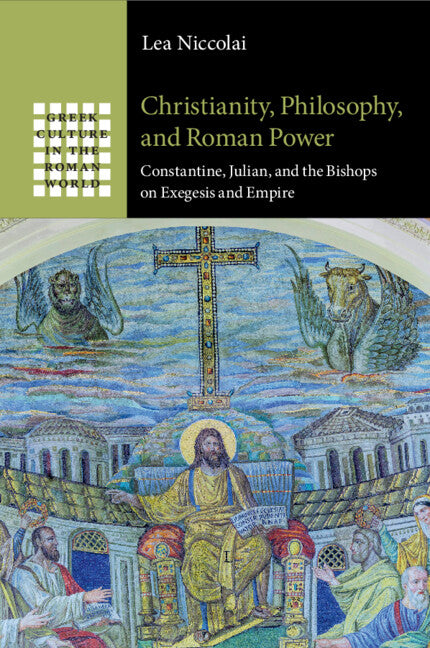
Christianity, Philosophy, and Roman Power
Constantine, Julian, and the Bishops on Exegesis and Empire
Rethinks Rome's Christianisation as a crisis of knowledge propelled by Constantine, with Emperor Julian as its key interpreter and catalyst.
Lea Niccolai (Author)
9781009299275, Cambridge University Press
Paperback / softback, published 10 April 2025
380 pages
22.9 x 15.2 x 2 cm, 0.614 kg
'… the author offers an important contribution to the understanding of the internal tensions of the clergy and pagan culture of the 4th century, studied in the light of an extremely rich bibliography and a great variety of literary and iconographic sources (fifteen images, mainly coins). Lea Niccolai's book thus marks a fundamental stage in the study of the political and religious history of the 4th century AD.' Gianluca Piscini, Bryn Mawr Classical Review
This book rethinks the Christianisation of the late Roman empire as a crisis of knowledge, pointing to competitive cultural re-assessment as a major driving force in the making of the Constantinian and post-Constantinian state. Emperor Julian's writings are re-assessed as key to accessing the rise and consolidation of a Christian politics of interpretation that relied on exegesis as a self-legitimising device to secure control over Roman history via claims to Christianity's control of paideia. This reconstruction infuses Julian's reaction with contextual significance. His literary and political project emerges as a response to contemporary reconfigurations of Christian hermeneutics as controlling the meaning of Rome's culture and history. At the same time, understanding Julian as a participant in a larger debate re-qualifies all fourth-century political and episcopal discourse as a long knock-on effect reacting to the imperial mobilisation of Christian debates over the link between power and culture.
Introduction
Part I. At Constantius' Court: Julian Caeser: 1. How philosophers should take compliments when they happen to become kings
2. Climbing the ladder
Part II. Making and Breaking Constantine: Julian Augustus
3. Holy hermeneutics
4. A life for a life
Part III. After Julian: Philosophy in the World: 5. Those who know if the emperor knows
6. Wisdom for the many, and wisdom for the few
Conclusions.
Subject Areas: Ancient history: to c 500 CE [HBLA]