Freshly Printed - allow 10 days lead
Couldn't load pickup availability
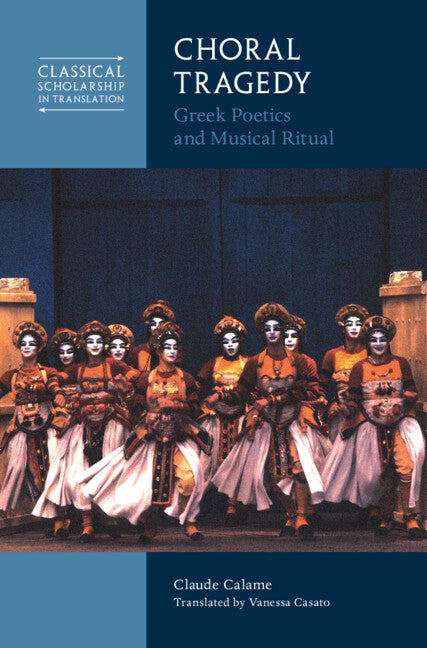
Choral Tragedy
Greek Poetics and Musical Ritual
Explores how Greek tragedy was fundamentally choral and deeply connected to the cultic and ritual contexts of its performance.
Claude Calame (Author), Vanessa Casato (Translated by), Simon Goldhill (Preface by)
9781316516256, Cambridge University Press
Hardback, published 2 May 2024
244 pages
23.5 x 15.9 x 1.6 cm, 0.49 kg
Ever since Aristotle opened the discussion on the role of the chorus in Greek tragedy, theories of the chorus have continued to proliferate and provoke debate to this day. The tragic chorus had its own story to tell; it was a collective identity, speaking within and to a collective citizen body, acting as an instrument through which stories of other times and places were dramatized into resonant heroic narratives for contemporary Athens. By including detailed case studies of three different tragedies (one each by Aeschylus, Euripides and Sophocles), Claude Calame's seminal study not only re-examines the role of the chorus in Greek tragedy, but pushes beyond this to argue for the 'polyphony' of choral performance. Here, he explores the fundamentally choral nature of the genre, and its deep connection to the cultic and ritual contexts in which tragedy was performed.
1. The essence of 'The Tragic'
2. Tragedy, cult, and ritual
3. Choral polyphonies and tragedy
4. Aeschylus' Persians: questioning choral identity
Euripides' Hippolytus: choral song and gender
6. Sophocles' Oedipus Tyrannus: 'Why Should I Dance (Chorally)?'
7. Poets, tragic diction, and tragic fiction.
Subject Areas: Classical history / classical civilisation [HBLA1]