Freshly Printed - allow 7 days lead
Couldn't load pickup availability
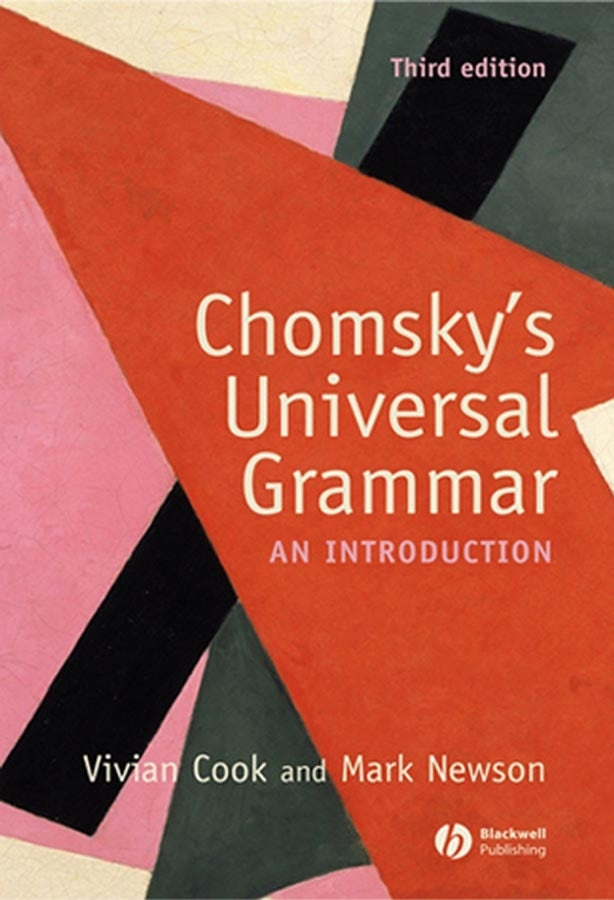
Chomsky's Universal Grammar
An Introduction
“Cook and Newson’s book is a theoretically sound and didactically well-designed overview and analysis. It will be an excellent textbook for any course on the sources and concerns of current syntactic developments, especially because it does not shy away from discussing problematic points and alternative solutions.” “The book is a masterly introduction to a complex body of work. The new edition has been thoroughly rewritten to bring it up to date with recent developments. For a clear and reliable guide to Chomsky’s linguistics, and its relevance to first and second language acquisition, students need look no further.”
–István Kenesei, University of Szeged
–Raphael M. Salkie, University of Brighton
Vivian J. Cook (Author), Mark Newson (Author)
9781405111867, Wiley
Hardback, published 17 April 2007
336 pages
25.4 x 17.9 x 2.3 cm, 0.748 kg
"The authors have held to their promise of presenting a broad view to a broad spectrum of potential readers." (Acta Linguistica Hungarica. December 2008) “Linguist, philosopher and political activist, Noam Chomsky, has spent six decades developing his theory of Universal Grammar, a concept now central to contemporary linguistics. The authors provide a cogent, accessible introduction that situates the still-evolving concept in the broader framework of Chomsky’s work.” (Times Higher Education Supplement
The 3rd edition of Chomsky's Universal Grammar introduces the reader to Noam Chomsky's theory of language by setting the specifics of syntactic analysis in the framework of his general ideas.
Preface to the Third Edition. 1. The Nature of Universal Grammar. 1.1. The Early Development of Universal Grammar Theory. 1.2. Relating 'Sounds' and 'Meanings'. 1.3. The Computational System. 1.4. Questions for Linguistics. 1.5. General Ideas of Language. 1.6. Linguistic Universals. 1.7. The Evidence for Universal Grammar Theory. 1.8. Conclusion. 2. Principles, Parameters and Language Acquisition. 2.1. Principles and Parameters. 2.2. Language Acquisition. 3. Structure in the Government/Binding model. 3.1. The Heart of the Government/Binding Model. 3.2. Modules, Principles and Parameters. 3.3. X-bar Theory in Government and Binding. 3.4. Theta Theory. 3.5. Control Theory and Null Subjects. 3.6. Further Developments in X-bar Theory. 3.7. Summary. 4. Movement in Government/Binding Theory. 4.1. An Overview of Movement. 4.2. Further Developments to the Theory of Movement. 4.3. Bounding, Barriers and Relativized Minimality. 4.4. Case Theory. 4.5. Binding Theory. 4.6. Beyond S-structure and the Empty Category Principle. 5. Chomskyan Approaches to Language Acquisition. 5.1. The Physical Basis for Universal Grammar. 5.2. A Language Learning Model. 5.3. The Innateness Hypothesis. 5.4. The Role of Universal Grammar in Learning. 5.5. Complete from the Beginning or Developing with Time?. 5.6. Issues in Parameter Setting. 5.7. Markedness and Language Development. 6. Second Language Acquisition and Universal Grammar. 6.1. The Purity of the Monolingual Argument. 6.2. Universal Bilingualism. 6.3. The Multi-competence View. 6.4. The Poverty-of-the-stimulus Argument and Second Language Acquisition. 6.5. Models and Metaphors. 6.6. Hypotheses of the Initial Second Language State. 6.7. The Final State of Second Language Acquisition. 7. Structure in the Minimalist Program. 7.1. From Government/Binding to the Minimalist Program. 7.2. Basic Minimalist Concepts. 7.3. Phrase Structure in the Minimalist Program. 7.4. Thematic Roles and Structural Positions. 7.5. Adjunction. 7.6. Linear Order. 8. Movement in the Minimalist Program. 8.1. Functional Heads and Projections. 8.2. The Motivation for Movement. 8.3. The Nature of Movement. 8.4. Overt and Covert Movement. 8.5. Properties of Movement. 8.6. Phases. 8.7. Conclusion. References. Index
Subject Areas: Language teaching & learning [other than ELT CJ]