Freshly Printed - allow 7 days lead
Couldn't load pickup availability
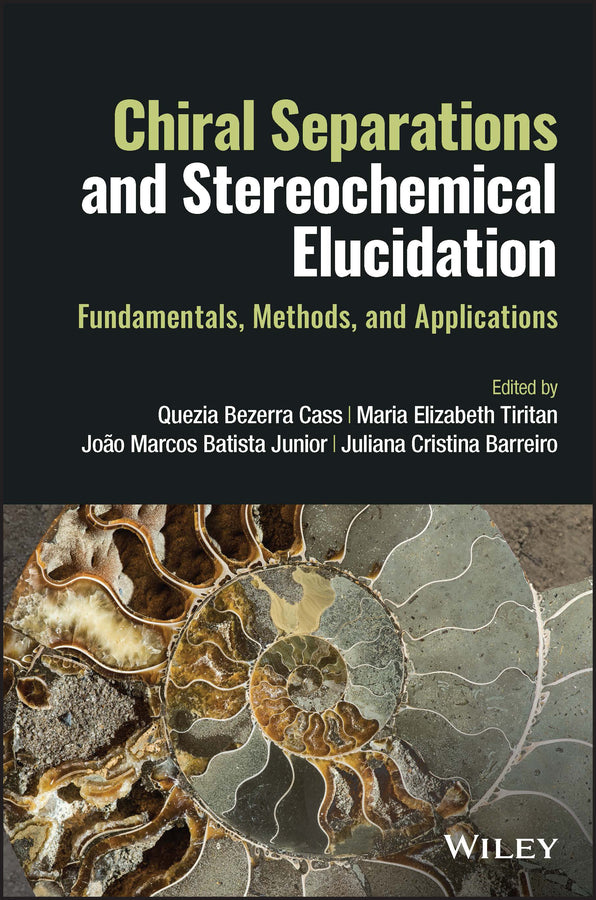
Chiral Separations and Stereochemical Elucidation
Fundamentals, Methods, and Applications
Quezia Bezerra Cass (Edited by), Maria Elizabeth Tiritan (Edited by), João Marcos Batista Junior (Edited by), Juliana Cristina Barreiro (Edited by)
9781119802259, Wiley
Hardback, published 27 March 2023
640 pages
22.9 x 15.2 x 3.1 cm, 1.338 kg
An expert resource for chemists using stereochemical analysis methods In Chiral Separations and Stereochemical Elucidation: Fundamentals, Methods, and Applications, a team of distinguished researchers delivers a robust and authoritative discussion of the theoretical fundamentals of chiral separation, the most commonly used chiral selectors, and stereochemical elucidation methods. The book offers expert discussions of a variety of chiral separation methods by gas chromatography (GC), supercritical fluid chromatography (SFC), capillary electrophoresis (CE), and liquid chromatography (LC). The authors also describe several methods for stereochemical elucidation, including X-ray crystallography, nuclear magnetic resonance spectroscopy, and chiroptical methods. The explored material is ideal for practicing chemists seeking a resource to help them guide method development and optimization or to explain quality control-complements during target compound production. Readers will also find: Perfect for academic and industrial chemists specially in organic, analytical chemistry and pharmaceutical analysis. Chiral Separations and Stereochemical Elucidation: Fundamentals, Methods, and Applications will also benefit biochemists, environmental analysts, forensic and medicinal chemists as well as natural product chemists and those involved with stereochemistry or structural elucidation.
List of Contributors xv Preface xix Part I Fundamentals of Chiral Separation 1 1.1 Introduction 3 1.2 Workflow for LC Chiral Method Development 7 1.3 New Column Technologies 9 1.4 Selected Examples of Fast Separation 12 1.5 Chiral 2D- LC 14 1.5.1 LC–LC and mLC–LC 14 1.5.2 LC × LC and sLC × LC 17 1.6 Future and Perspectives 19 References 20 2 Chiral Separation by GC 27 2.1 Introduction 27 2.2 Chiral Recognition in Gas Chromatography 29 2.2.1 Chiral Recognition by Hydrogen Bonding 31 2.2.2 Chiral Recognition Using Chiral Metal Complexes 31 2.2.3 Chiral Recognition by Host–Guest Interactions 31 2.3 Preparation of Fused- Silica Capillaries for GC with CSPs 33 2.4 Application of CSPs in Chiral Gas Chromatography 34 2.4.1 CSPs with Diamide Selectors 34 2.4.1.1 Chirasil- Val 34 2.4.2 CSPs with CD Selectors 35 2.4.2.1 Heptakis(2,3,6- tri- O- Methyl)- β- Cyclodextrin (Permethyl- β- Cyclodextrin) 38 2.4.2.2 Heptakis(2,3,6- tri- O- Methyl)- β- Cyclodextrin Immobilized to Hydrido Dimethyl Polysiloxane (Chirasil- β- Dex) 39 2.4.2.3 Heptakis(2,6- di- O- Methyl- 3- O- Pentyl)- β- Cyclodextrin 43 2.4.2.4 Hexakis- (2,3,6-tri- O- Pentyl)- α- Cyclodextrin 47 2.4.2.5 Heptakis(2,3,6- tri- O- Pentyl)- β- Cyclodextrin 48 2.4.2.6 Hexakis- (3- O- Acetyl- 2,6- di- O- Pentyl)- α- Cyclodextrin 51 2.4.2.7 Heptakis(3- O- Acetyl- 2,6- di- O- Pentyl)- β- Cyclodextrin 51 2.4.2.8 Octakis(3- O- Butyryl- 2,6- di- O- Pentyl)- γ- Cyclodextrin 53 2.4.2.9 Hexakis/Heptakis/Octakis(2,6- di- O- Alkyl- 3- O- Trifluoroacetyl)- α/β/γ- Cyclodextrins 57 2.4.2.10 Heptakis(2,3- di- O- Acetyl- 6- O-tert- Butyldimethylsilyl)- β- Cyclodextrin (DIAC- 6- TBDMS- β- CD) 58 2.4.2.11 Heptakis(2,3- di- O- Methyl- 6- O-tert- Butyldimethylsilyl)- β- Cyclodextrin (DIME- 6- TBDMS- β- CD) 58 2.4.3 Cyclofructans 62 2.4.4 CSPs with Metal Complexes 65 2.5 Conclusion 69 References 69 3 Chiral Separation by Supercritical Fluid Chromatography 85 3.1 Introduction 85 3.2 Characteristics and Properties of Supercritical Fluids 87 3.3 Development of a Chiral SFC Method 89 3.3.1 Chiral Stationary Phases 89 3.3.2 Mobile Phases 91 3.3.2.1 Mobile Phase: Type of Co- solvent Used 93 3.3.2.2 Mobile Phase: Percentage of Co- solvent Used 94 3.3.2.3 Mobile Phase: Use of Additives 94 3.4 Operating Parameters 94 3.4.1 Effect of the Flow Rate 95 3.4.2 Effect of the Outlet Pressure (Back- pressure) 95 3.4.2.1 Effect of Pressure When the Mobile Phase is a Gas- Like Fluid 96 3.4.2.2 Effect of Pressure When the Mobile Phase is a Liquid- Like Fluid 97 3.4.3 Effect of Temperature 97 3.4.3.1 Effect of Temperature When the Mobile Phase is a Gas- Like Fluid 98 3.4.3.2 Effect of Temperature When the Mobile Phase is a Liquid- Like Fluid 98 3.5 Detection 99 3.6 Scale- Up to Preparative Separation 99 3.7 Conclusion 100 References 101 4 Chiral Separation by Capillary Electrophoresis and Capillary Electrophoresis–Mass Spectrometry: Fundamentals, Recent Developments, and Applications 103 4.1 Introduction 103 4.2 Principles of Chiral CE 105 4.2.1 Electrophoretic Mobility 105 4.2.2 CE Separation Efficiency 106 4.2.3 Chiral Resolution in CE 107 4.2.4 Chiral Micellar Electrokinetic Chromatography and Capillary Electrochromatography 109 4.3 Short History of Chiral CE Modes 111 4.3.1 Chiral CE 111 4.3.2 Chiral MEKC and Chiral CEC 111 4.4 State of the Art and Recent Developments 112 4.4.1 Common Chiral Selectors 112 4.4.2 Ionic Liquids as Chiral Selectors 117 4.4.3 Nanoparticles as Chiral Selector Carriers 117 4.4.4 Microfluidic Chiral CE 118 4.5 Applications of Chiral CE 119 4.5.1 Pharmaceutical Analysis 119 4.5.2 Food Analysis 120 4.5.3 Environmental Analysis 121 4.5.4 Bioanalysis 123 4.5.5 Forensic Analysis 126 4.6 Chiral CE- MS: Strategies and Challenges 126 4.6.1 Hyphenation Approaches 129 4.6.1.1 Sheath–Liquid and Sheathless CE- MS Interfacing 129 4.6.1.2 Partial- Filling Techniques 130 4.6.1.3 Counter- Migration Techniques 131 4.6.2 Chiral MEKC- MS 132 4.6.3 Chiral CEC- MS 133 4.7 Conclusions and Perspectives 135 References 135 5 Chiral Separations at Semi and Preparative Scale 143 5.1 Introduction 143 5.2 Selection of Operating Conditions 145 5.3 Batch HPLC Purification 146 5.3.1 Analytical Method Development for Preparative Separations 146 5.3.2 Batch HPLC Examples 148 5.3.2.1 Batch HPLC Example 1 148 5.3.2.2 Batch HPLC Example 2 149 5.4 Steady- State Recycle Introduction 151 5.4.1 SSR Example 1 153 5.5 Simulated Moving Bed Chromatography – Introduction 154 5.5.1 SMB Examples for R&D and Separation of Compound 2 156 5.5.2 Development of a Manufacturing SMB Process (Compound 1) 158 5.5.3 Cost for SMB Processes 160 5.6 Introduction to Supercritical Fluid Chromatography 161 5.6.1 Analytical Method Development for Scale- up to Preparative SFC 162 5.6.2 Preparative SFC Example 1 163 5.6.3 Preparative SFC Example 2 163 5.7 Options for Increasing Purification Productivity 165 5.7.1 Closed- Loop Recycling 165 5.7.2 Stacked Injections 166 5.7.3 Choosing the Best Synthetic Intermediate for Separation 167 5.7.3.1 Choosing Synthetic Step for Separation – HPLC/SMB Example 168 5.7.3.2 Choosing Synthetic Step for Separation – SFC Example 169 5.7.4 Use of Non- Commercialized CSP 170 5.7.5 Immobilized CSP for Preparative Resolution 173 5.7.5.1 Processing of Low Solubility Racemate 173 5.7.5.2 Preparative Resolution of EMD 53986 174 5.8 Choosing a Technique for Preparative Enantioseparation 176 5.9 Conclusion 178 References 179 Part II Chiral Selectors 187 6.1 Introduction 189 6.2 The Early Years 190 6.3 Polysaccharide Chiral Separation Mechanism 193 6.4 Coated Chiral Stationary Phases 197 6.5 Immobilized Chiral Stationary Phases 201 6.6 Applications of Polysaccharide- Derived CSPs 208 6.6.1 Analytical Applications 210 6.6.1.1 Pharmaceuticals 211 6.6.1.2 Agrochemicals 218 6.6.1.3 Food Analysis 219 6.6.2 Preparative Applications 220 6.7 Summation 224 References 224 7 Macrocyclic Antibiotics and Cyclofructans 247 7.1 Introduction 247 7.2 Macrocyclic Glycopeptides Physicochemical Properties 248 7.3 Using the Chiral Macrocyclic Glycopeptides Stationary Phases 253 7.3.1 Mobile Phases and Chromatographic Modes 253 7.3.2 Chromatographic Enantioseparations 254 7.3.2.1 Amino Acids and Peptides 254 7.3.2.2 Chiral Compounds 257 7.3.2.3 Particle Structure 257 7.4 Using and Protecting Macrocyclic Glycopeptide Chiral Columns 260 7.4.1 Operating Conditions 260 7.4.2 Storage 261 7.5 Cyclofructans 261 7.5.1 Cyclofructan Structure and Properties 261 7.5.2 Chiral Separations with Cyclofructan- Based Stationary Phases 264 7.5.3 Cyclofructan Stationary Phases Used in the HILIC Mode 264 7.5.4 Cyclofructan Stationary Phases Used in Supercritical Fluid Chromatography 266 7.6 Conclusions 267 References 268 8 Cyclodextrins 273 8.1 Introduction 273 8.2 Structure and Properties 274 8.3 Cyclodextrin Complexes 279 8.4 Application in Separation Science 288 8.4.1 Gas Chromatography 288 8.4.1.1 Types of Cyclodextrins 289 8.4.1.2 Types of Columns 289 8.4.1.3 Separation Mechanisms 291 8.4.1.4 Applications 293 8.4.2 Thin- Layer Chromatography 294 8.4.3 High- Performance Liquid Chromatography 294 8.4.3.1 Types of Columns 295 8.4.3.2 Types of Cyclodextrins 297 8.4.3.3 Separation Mechanisms 298 8.4.3.4 Applications 300 8.4.4 Supercritical Fluid Chromatography 300 8.4.5 Capillary Electromigration Techniques 301 8.4.5.1 Types of Cyclodextrins 301 8.4.5.2 Separation Mechanisms 302 8.4.5.3 Migration Modes and Enantiomer Migration Order Using CDs as Selectors 304 8.4.5.4 Applications 310 8.4.6 Membrane Technologies 312 8.5 Miscellaneous Applications 314 8.6 Conclusions and Outlook 315 References 315 9 Pirkle Type 325 9.1 Introduction 325 9.2 CSPs Developed by Pirkle’s Group: Chronological Evolution 327 9.3 Pirkle- Type CSPs Developed by Other Research Groups 334 9.4 Example of Applications in Analytical and Preparative Scales 340 9.4.1 Analytical Applications 341 9.4.2 Preparative Applications 349 9.5 Conclusions and Perspectives 349 References 350 10 Proteins 363 10.1 Introduction 363 10.2 Preparation of Protein- and Glycoprotein- Based Chiral Stationary Phases 364 10.3 Types of Protein- and Glycoprotein- Based Chiral Stationary Phases 368 10.3.1 Proteins 368 10.3.1.1 Bovine Serum Albumin 368 10.3.1.2 Human Serum Albumin 370 10.3.1.3 Trypsin and α- Chymotrypsin 372 10.3.1.4 Lysozyme and Pepsin 372 10.3.1.5 Fatty Acid- Binding Protein 373 10.3.1.6 Penicillin G Acylase 375 10.3.1.7 Streptavidin 375 10.3.1.8 Lipase 376 10.3.2 Glycoproteins 376 10.3.2.1 Human α 1 - Acid Glycoprotein 376 10.3.2.2 Chicken Ovomucoid 377 10.3.2.3 Chicken α 1- Acid Glycoprotein 378 10.3.2.4 Avidin 380 10.3.2.5 Riboflavin- Binding Protein and Ovotransferrin 380 10.3.2.6 Cellobiohydrolase 381 10.3.2.7 Glucoamylase 383 10.3.2.8 Antibody (Immunoglobulin G) 385 10.3.2.9 Nicotinic Acetylcholine Receptor and Human Liver Organic Cation Transporter 387 10.4 Chiral Recognition Mechanisms on Proteinand Glycoprotein- Based Chiral Stationary Phases 387 10.4.1 Human Serum Albumin 387 10.4.2 Penicillin G Acylase 389 10.4.3 Human α 1- Acid Glycoprotein 390 10.4.4 Turkey Ovomucoid 392 10.4.5 Chicken α 1- Acid Glycoprotein 393 10.4.6 Cellobiohydrolase 395 10.4.7 Antibody 396 10.4.8 Nicotinic Acetylcholine Receptor and Human Liver Organic Cation Transporter 400 10.5 Conclusions 401 References 402 11 Chiral Stationary Phases Derived from Cinchona Alkaloids 415 11.1 Introduction 415 11.2 Cinchona Alkaloid- Derived Chiral Stationary Phases 416 11.3 Chiral Recognition 420 11.4 Chromatographic Retention Mechanisms 424 11.4.1 Multimodal Applicability 424 11.4.2 Surface Charge of Cinchonan- Based CSPs 424 11.4.3 Retention Mechanisms and Models, and Method Development on Chiral WAX CSPs 427 11.4.4 Retention Mechanisms and Method Development on ZWIX CSPs 430 11.5 Structural Variants of Cinchona Alkaloid CSPs and Immobilization Chemistries 436 11.6 Cinchonan- Based UHPLC Column Technologies 442 11.7 Applications 446 11.7.1 Pharmaceutical and Biotechnological Applications 446 11.7.2 Biomedical Applications 453 11.8 Conclusions 460 References 460 Part III Methods for Stereochemical Elucidation 473 12.1 Introduction 475 12.2 Absolute Structure and Absolute Configuration 476 12.3 Best Practices 482 12.4 Structure Validation 486 12.5 The Absolute Configuration of (+)- Lanatine A 486 12.6 The Absolute Configuration of the Diacetylated Form of Acrenol and the Acetylated Form of Humirianthol 488 12.7 The Absolute Configuration of Ester Form of Clemateol 491 12.8 Relative Configurations of Waltherione A, Waltherione B, and Vanessine 492 12.9 The Absolute Configuration of Condaline A 493 12.10 CSD Deposit Numbers 496 12.11 Conclusions and Future Directions 498 References 498 13 NMR for Stereochemical Elucidation 505 13.1 Conventional NMR Methods for Stereochemical Elucidation 505 13.1.1 Determination of the Planar Structure Using 1D 1 H, 13 C NMR (DEPT), 2D HSQC, COSY, TOCSY, HMBC 506 13.1.2 Determination of Relative Configuration Using J- Couplings and NOEs/ROEs 507 13.1.2.1 Scalar Coupling 507 13.1.2.2 NOE/ROE 510 13.1.2.3 Examples of Stereochemical Elucidation Using J- Couplings and NOEs/ROEs 510 13.2 Determination of the Relative Configuration Using Anisotropic NMR- Based Methods 516 13.2.1 Basic Principles of Anisotropic NMR Parameters 517 13.2.2 Alignment Media 518 13.2.2.1 Preparation of Anisotropic Sample with PMMA Gel 520 13.2.2.2 Preparation of Anisotropic Sample with AAKLVFF 521 13.2.3 Acquisition of the Anisotropic NMR Data 522 13.2.4 Computational Approaches for Analyzing Anisotropic NMR Data 525 13.2.5 Successful Examples of Determination of Relative Configuration of Challenging Molecules Using Anisotropic NMR 528 13.3 Determination of the Relative Configuration Using DP 4 Probability and CASE- 3D 529 13.4 Determination of the Absolute Configuration Using a Combination of NMR Spectroscopy and Chiroptical Spectroscopy 533 13.5 Determination of the Absolute Configuration Using NMR Alone 534 13.5.1 Mosher Ester Analysis 535 13.5.2 Other Chiral Derivatizing Agents 536 13.6 Future Perspective 536 References 537 14 Absolute Configuration from Chiroptical Spectroscopy 551 14.1 Introduction 551 14.2 Chiroptical Methods 554 14.2.1 Optical Rotation and Optical Rotatory Dispersion 554 14.2.1.1 Instrumentation 556 14.2.1.2 Measurements 557 14.2.2 Electronic Circular Dichroism 558 14.2.2.1 Instrumentation 560 14.2.2.2 Measurements 561 14.2.3 Vibrational Circular Dichroism and Raman Optical Activity 561 14.2.3.1 Instrumentation 563 14.2.3.2 Measurements 565 14.2.4 Simulation of Chiroptical Properties 567 14.2.4.1 Common Theoretical Steps 568 14.2.4.2 OR and ORD Simulations 570 14.2.4.3 ECD Simulations 572 14.2.4.4 VCD and ROA Simulations 573 14.2.5 Examples of Application 575 14.2.5.1 OR 575 14.2.5.2 ORD 577 14.2.5.3 ECD 578 14.2.5.4 VCD 579 14.2.5.5 ROA 581 14.2.5.6 Association of Different Chiroptical Methods 582 14.3 Concluding Remarks 585 References 586 Index 593
1 Chiral Separation by LC 3
Juliana Cristina Barreiro and Quezia Bezerra Cass
Oliver Trapp
Emmanuelle Lipka
Charles Clark, Govert W. Somsen, and Isabelle Kohler
Larry Miller
6 Polysaccharides 189
Weston Umstead, Takafumi Onishi, and Pilar Franco
Saba Aslani, Alain Berthod, and Daniel W. Armstrong
Gerhard K. E. Scriba, Mari- Luiza Konjaria, and Sulaiman Krait
Maria Elizabeth Tiritan, Madalena Pinto, and Carla Fernandes
Jun Haginaka
Michael Lämmerhofer and Wolfgang Lindner
12 X- Ray Crystallography for Stereochemical Elucidation 475
Ademir F. Morel and Robert A. Burrow
Xiaolu Li, Xiaoliang Yang, and Han Sun
Fernando Martins dos Santos Junior and João Marcos Batista Junior
Subject Areas: Chemistry [PN]