Freshly Printed - allow 10 days lead
Couldn't load pickup availability
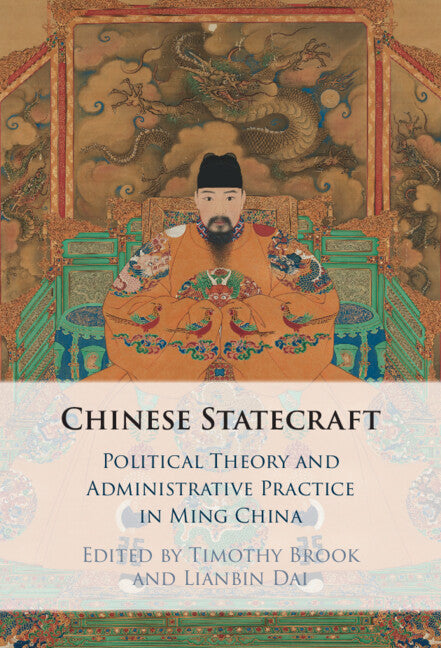
Chinese Statecraft
Political Theory and Administrative Practice in Ming China
Introduces specialists and non-specialists alike to the Confucian tradition of statecraft as practised at the level of state policy.
Timothy Brook (Edited by), Lianbin Dai (Edited by)
9781009636131, Cambridge University Press
Hardback, published 31 July 2025
280 pages
22.9 x 15.2 x 1.8 cm, 0.57 kg
'This book offers a study of 'political theory' beyond Confucian moral philosophy. Highly recommended for anyone wishing to understand the interdisciplinary intellectual and material contexts in which a real Chinese administrator thought and worked.' Leigh Jenco, London School of Economics and Political Science
Engaging the writing of the fifteenth-century Confucian theorist and chancellor of the Imperial Academy, Qiu Jun, these essays enlarge our grasp of both Confucianism and the Chinese state, exploring what educated Chinese imagined as best practice in meeting the challenges of administering the realm. Rediscovering statecraft in the Ming period allows us to think about the tradition of applied Confucian duty without the moralism dominating conventional Chinese intellectual history, redirecting that history away from purely philosophical terms. As Qiu reminded Emperor Hongzhi, this 'is not empty talk. I humbly hope that your enlightened majesty will give these ideas your careful attention when you have the leisure to reflect. The people of the realm have no greater wish.' Drawing together a team of leading historians, this volume provides a vivid sense of the day-to-day policy calculations of Ming government, and brings Chinese political thought into the mainstream of comparative political theory.
Introduction
1. Statecraft Confucian Timothy Brook
2. Ideological modules for diagnosing disorder Lianbin Dai
3. The problem of monarchy Timothy Brook
4. Waiting: the seniority system R. Kent Guy
5. Relieving famines Pierre-Étienne Will
6. Financial administration, market, and merchants Desmond Cheung
7. The institution of penal prudence Jérôme Bourgon
8. Feeling, the State, and the problem of filial revenge C. D. Alison Bailey
9. Employing military force to rule the realm Wicky Wai-kit Tse
10. Strengthening the army Jun Fang
11. The limits of all-under-heaven Leo K. Shin
12. Paramount boundaries Aaron Throness
Conclusion: Neo-Confucian learning as a knowledge practice for sociopolitical engagement Lianbin Dai
Bibliography
Index.
Subject Areas: Asian history [HBJF]