Freshly Printed - allow 7 days lead
Couldn't load pickup availability
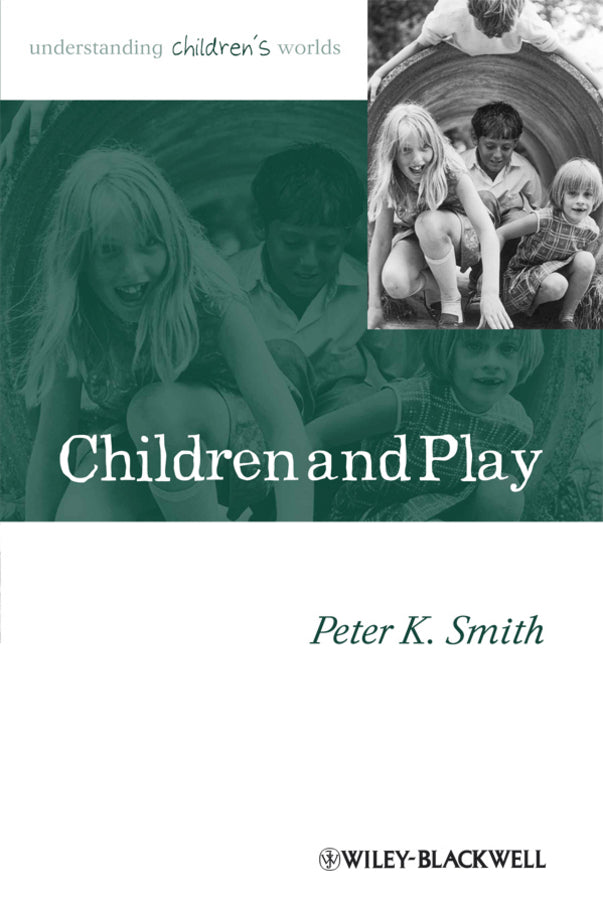
Children and Play
Understanding Children's Worlds
"Peter Smith is to be congratulated for producing the first truly comprehensive synthesis on the subject of juvenile play. The work's breadth and thoroughness make it the definitive reference, while the quality of the prose enables the book's use as a textbook. Smith's treatment of methodology and theoretical history is especially thorough and insightful. Smith's unique contribution to play scholarship has been his identification of the play ethos. This social movement has had a distorting effect on research by inflating evidence for the value of play for children and of the necessity for parent-child play. In this volume, Smith almost surgically removes the play ethos cataract that obscures play scholarship. In doing so he reminds us that there are still many important questions regarding juvenile play which await serious research." "Peter Smith's book, Children and Play, is what one would expect from one of the leading figures in the field of play. Drawing on his extensive knowledge of evolutionary theory and the human developmental and comparative play literatures, Smith presents a comprehensive picture of the complexities of the place of play in human development as well as measured analyses of its place in schools. This book is a crowning achievement to his close to 40 years of careful study of the field. I learned a great deal from it." "This book is an excellent synthesis of what is currently known about the play of children. Peter Smith, one of the leading play researchers of our time, sheds new light on some long-debated issues such as the definition of play, play’s role in development and evolution, and the relationship between play and culture. In addition, individual chapters provide rich detail about particular types of play, including the much neglected category of physical play. The volume concludes with a very interesting discussion of practical issues, including parental involvement in play, play's role in education, the importance of school recess, and war play. I was very impressed with Professor Smith’s balanced, objective discussion of play research. He effectively argues for a “middle way” of viewing play, a view that neither idealizes nor denigrates its importance in the lives of children."
–Professor David F. Lancy, Anthropology, Utah State University, USA
–Professor Anthony D. Pellegrini, Educational Psychology, University of Minnesota, USA
–Professor James Christie, Curriculum and Instruction, Arizona State University, USA
Peter K. Smith (Author)
9780631235217, Wiley
Hardback, published 17 April 2009
272 pages
23.9 x 16 x 2.1 cm, 0.54 kg
The role of play in child development is a source of ongoing interest and debate. In this book, renowned expert Peter Smith offers an expansive definition of the term “play”, taking an in-depth look at its impact on children, as well as its adaptive value for birds and mammals, including primates. Using both contemporary and classic research, Smith examines how different age groups and sexes participate in a wide variety of play, including exercise and rough-and- tumble play, fantasy play and imaginary friends, and play with objects. The book gauges the function of play in early childhood education and makes the case for and against recess breaks in school. How play occurs in different societies and among various populations – including children with special needs – is also explored. With its comprehensive coverage of theoretical, historical, cross-cultural, and evolutionary perspectives, Children and Play holds significant insights for parents, educators, and clinicians.
Contents Series Editor’s Preface Acknowledgments viii x Chapter 1 An Introduction to Play 1 Why Play? 1 Examples of What Is and What Is Not Play 2 Characteristics of Playful Behavior 4 Types of Play 8 Things That Are Probably Not Play: Exploration, Stereotypic Behavior, Work, Rule-Governed Games 10 Methods of Studying Play 12 Plan of the Book 20 Chapter 2 A Brief History of the Study of Play and of Play Theories 21 Early European Educators and the Role of Play 22 Evolutionary Theory and Play: Darwin, Spencer, and Groos 24 Psychoanalytic Perspectives on Play 27 The Play Ethos 27 Anthropological Perspectives on Play 30 Psychological Perspectives: Vygotsky and Piaget 31 Developmental Sequences in Play: Piaget, Smilansky, Rubin 35 More Recent Play Theorists 39 Chapter 3 Animal Play: Definitions and Descriptions 41 Possible Play in Birds, Lower Vertebrates, and Invertebrates 41 Play in Mammals 44 Some Examples of Mammalian Play 46 Do All Mammals Play? 52 Play in Monkeys and Apes 54 Chapter 4 Animal Play: Theoretical Perspectives on Function 62 Theories and Evidence Concerning the Evolution and Adaptive Value of Animal Play 62 Examining Possible Benefits of Play 70 General Views on the Benefits of Play 70 The Possible Relevance for Human Play of Studying Animal Play 77 Chapter 5 Play in Different Cultures 80 (author: Yumi Gosso) Parakanã Children 81 Factors Contributing to Cultural Similarities and Differences 85 Similarities and Differences across Cultures 95 Chapter 6 Physical Activity Play: Exercise Play and Rough-and-Tumble 99 Stages in Physical Activity Play 100 Rough-and-Tumble Play 104 Sex Differences in Physical Activity Play 113 Functions of Physical Activity Play 115 Chapter 7 Object Play 124 Sensorimotor or Functional Play 124 Beyond the Sensorimotor Period 131 Functions of Object Play 134 Experiments with Object Play and Creative Problem-Solving 140 Chapter 8 Pretend Play: Description 148 Definitions of Pretend or Fantasy Play 148 The Development of Pretend Play in Children 155 Solitary and Social Pretend Play 157 Sociodramatic Play 158 Imaginary Companions 159 Distinguishing Fantasy and Reality 161 Gender Differences 163 Pretend Play and Friendship 163 Other Factors Affecting Pretend Play 165 A Universal Human Feature? 166 Children with Autism 167 Pretend Play as a Lifespan Activity? 168 Chapter 9 Pretend Play: Theories and Functions 170 Arguments for Benefits of Pretend or Fantasy Play 170 Theories Concerning the Function of Pretend Play 172 Models of the Role of Pretend Play in Development 178 Evidence for the Functions of Pretend Play 180 Experimental Studies 188 Chapter 10 Some Practical Issues Concerning Play 194 The Role of Parents in Encouraging and Structuring Children’s Play 194 The Role of Play in the Early Childhood Curriculum: Play Training 196 Attitudes to War Play 197 The Arguments For (and Against) Recess Breaks 201 The Role of Play in Helping Children under Stress, or with Illness or Disability 205 Chapter 11 Concluding Comments: Play and the Middle Way 213 Play: Ignored or Idealized? 213 References 218 Author Index 247 Subject Index 253
Subject Areas: Psychology [JM]