Freshly Printed - allow 10 days lead
Couldn't load pickup availability
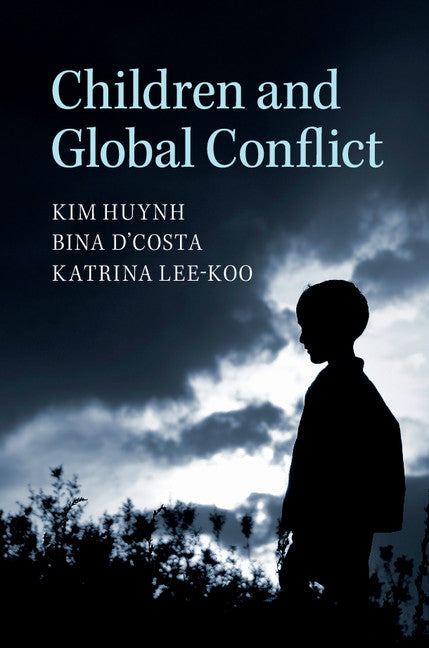
Children and Global Conflict
Examines how children, armed conflict and the international community interact in the twenty-first century.
Kim Huynh (Author), Bina D'Costa (Author), Katrina Lee-Koo (Author)
9781107038844, Cambridge University Press
Hardback, published 9 April 2015
356 pages, 1 b/w illus. 2 tables
23.5 x 15.7 x 2.1 cm, 0.63 kg
'This is an important piece of work and fills what, for a long time, has been a significant gap in the literature - the relationship between children and conflict and the international responses to it. Huynh, D'Costa and Lee-Koo have written a book that students, academics and policymakers should read - and with some urgency.' Ali Watson, University of St Andrews, Scotland
Over one billion people under the age of eighteen live in territories affected by armed conflict. Despite this, scholars and practitioners often lack a comprehensive knowledge of how children both struggle within and shape conflict zones. Children and Global Conflict provides this understanding with a view to enhancing the prospects of conflict resolution and peacebuilding. This book presents key ideas and issues relating to children's experiences of war, international relations and international law. The authors explore the political, conceptual and moral debates around children in these contexts and offer examples and solutions based on case studies of child soldiers from Vietnam, child forced migrants in Australia, young peace-builders in post-conflict zones, youth in the international justice system, and child advocates across South Asia and the Middle East.
Introduction: why children matter to global conflict
1. Children and armed conflict: mapping the terrain, 2. Children and agency: care-takers, free-rangers and everyday life
3. Children and international relations: creating spaces for children
4. The rights of the child: political history, practices and protection
5. Child soldiers: causes, solutions and cultures
6. Child forced migrants: biopolitics, autonomy and ambivalence
7. Children and peacebuilding: propagating peace
8. Children and justice: past crimes, healing and the future
9. Who speaks for children: advocacy, activism and resistance
Conclusion
Appendix.
Subject Areas: International relations [JPS], Politics & government [JP]