Freshly Printed - allow 10 days lead
Couldn't load pickup availability
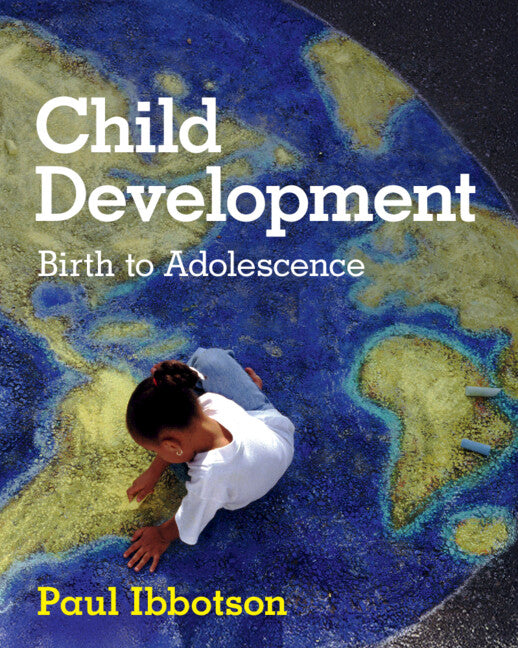
Child Development
Birth to Adolescence
Accessible, inclusive, and engaging. Discover the global story of child development told from multiple perspectives.
Paul Ibbotson (Author)
9781009591270, Cambridge University Press
Paperback / softback, published 12 June 2025
296 pages
25.3 x 20.2 x 1.6 cm, 0.72 kg
'This would be an excellent text for undergraduate students interested in a background to child development theories.' Linda Shaw, Oxford Brookes University
Take a global tour of childhood that spans 50 countries and explore everyday questions such as 'Why does love matter?', 'How do children learn right from wrong'? and 'Why do adolescent relationships feel like a matter of life and death?' Combining psychology, anthropology, and evolution, you will learn about topics such as language, morality, empathy, creativity, learning and cooperation. Discover how children's skills develop, how they adapt to solve challenges, and what makes you, you. Divided into three chronological sections – early years, middle childhood, and adolescence – this book is enriched with a full set of pedagogical features, including key points to help you retain the main takeaway of each section, space for recap, a glossary of key terms, learning outcomes and chapter summaries. Embedded videos and animations throughout bring ideas to life and explain the methods researchers use to reveal the secrets of child development.
1. Perspectives on child development
Section I. The Early Years
2. Why does love matter?
3. Are children mind readers?
4. How do children learn language?
5 How do children learn so much so quickly?
6. Growing up globally – the early years
7. How do children learn right from wrong?
Section II. Middle Childhood
8. How do children think about groups?
9. How does imagination develop?
10. How does children's memory work?
11. Growing up globally – middle childhood
12. Who do teenagers think they are?
Section III. Adolescence
13. How do adolescents think about risk and reward?
14. Are young people happy?
15. Growing up globally – adolescence
16. The many paths of development
17. Reflections on child development.
Subject Areas: Child & developmental psychology [JMC]