Freshly Printed - allow 10 days lead
Couldn't load pickup availability
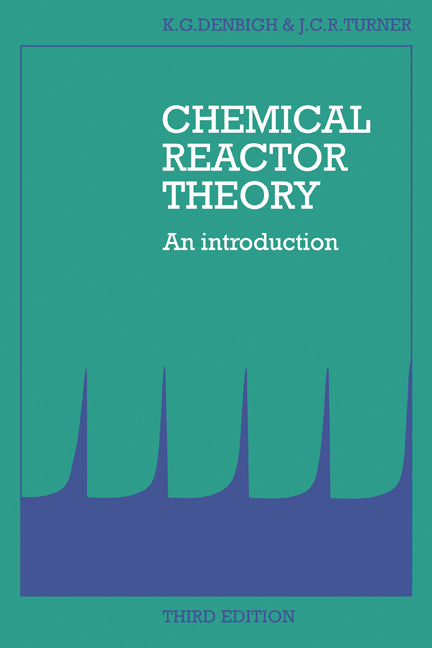
Chemical Reactor Theory
An Introduction
This 1984 book presents a fascinating account of chemical reaction engineering, reflecting changes since the 1950s.
K. G. Denbigh (Author), J. C. R. Turner (Author)
9780521276306, Cambridge University Press
Paperback / softback, published 23 February 1984
264 pages
22.9 x 15.2 x 1.5 cm, 0.39 kg
Chemical reaction engineering has as its objective the taking of desired reaction processes from the laboratory to the full-scale production plant. From its early roots in applied chemistry, it started expanding in the 1950s, since when there has been a substantial growth of the subject as a result of much research in universities and industry. In this 1984 third edition of their established textbook, Professors Denbigh and Turner present a fascinating account of the subject, reflecting these changes. The authors have retained their primary aim of giving the reader a sense of orientation within the subject. The design and operation of industrial reactors nowadays requires computer skills, but such computation must be based on a firm grasp of the principles of chemical reaction engineering. The text was written primarily for undergraduate students of chemical engineering, however, there are selections of references enabling all interested readers to find their way into the literature.
Preface
1. Introduction: reactor types
2. Chemical kinetics
3. Tubular reactors
4. Continuous stirred tank reactors
5. Residence-time distributions, mixing and dispersion
6. Chemical factors affecting the choice of reactor
7. Packed-bed catalytic reactors: mass- and heat-transfer effects
8. Multiphase reactors
9. Some further temperature effects in reactors
10. Optimization: concluding comments
Index.
Subject Areas: Industrial chemistry & manufacturing technologies [TD]