Freshly Printed - allow 7 days lead
Couldn't load pickup availability
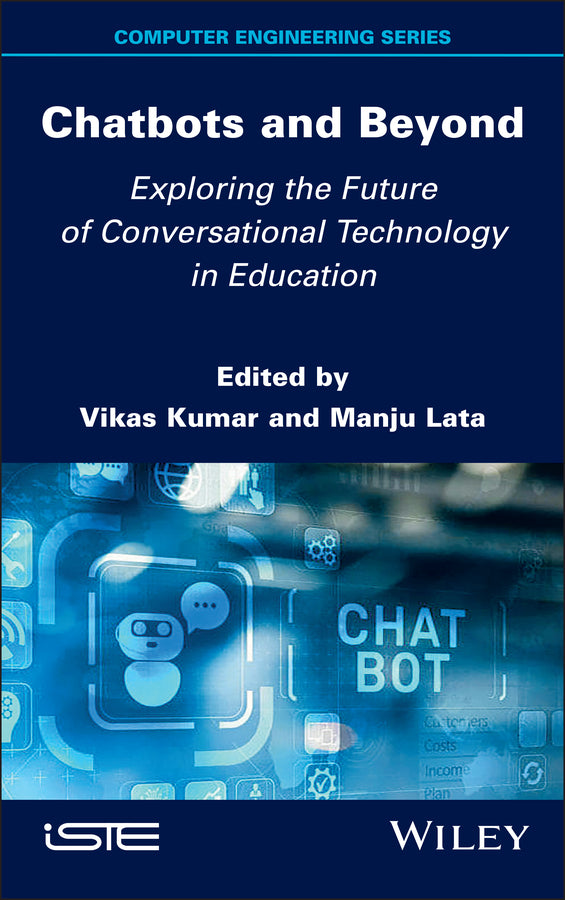
Chatbots and Beyond
Exploring the Future of Conversational Technology in Education
Vikas Kumar (Edited by), Manju Lata (Edited by)
9781836690108, Wiley
Hardback, published 24 October 2025
304 pages
23.5 x 15.6 x 2 cm, 0.708 kg
Chatbots and Beyond provides an innovative analysis of the transformative prospective of conversational technology in the field of education. It reveals the numerous advantages of integrating chatbots into an educational environment and identifies the obstacles in their perfect integration. This book explores how these technologies can reform teaching and learning experiences, modify learning paths, and streamline administrative processes by using real-world examples and case studies. Rapid developments in artificial intelligence and its implementation in education have also raised many eyebrows. With millennial students practicing the application of AI on a large scale, it has become important to harness its power for student life cycle integration. With the educational landscape promptly developing, this book makes a strong case for embracing conversational technology as a cornerstone of future-focused educational methods, and serves as a complete guide for researchers, educators and administrators, proposing practical advice and techniques for utilizing chatbots to create a more productive, efficient and engaging learning environment.
Foreword xiii Preface xv Acknowledgements xxi Vikas KUMAR and Manju LATA Chapter 1 Nurturing an Inquisitive Mind in the Era of All-Knowing Chatbots 1 1.1 Introduction 1 1.2 Technological cognitive enhancement 3 1.3 From endless distraction to cognitive erosion 4 1.4 Fundamental differences between chatbots and humans 7 1.5 What we can know that chatbots cannot 11 1.6 Using chatbots to cultivate critical thinking 13 1.7 Conclusion 16 1.8 References 17 Chapter 2 Artificial Intelligence (AI) in Education 23 2.1 Introduction 23 2.2 Basic concepts of artificial intelligence in education 24 2.2.1 Definition of artificial intelligence in education 25 2.2.2 History and evolution of AI in education 25 2.2.3 Categories and types of AI used in education 26 2.3 Implementation of AI in education 27 2.3.1 AI in adaptive learning 27 2.3.2 AI in the writing of a scientific journal 28 2.3.3 AI in assessment 30 2.4 Opportunities and impact of AI in education 32 2.4.1 Opportunities and benefits of AI to improve the quality of education 32 2.4.2 Impact of AI in education 32 2.4.3 Digital divide and accessibility 34 2.5 Case studies of AI implementation in various educational institutions 35 2.6 Recommendations for AI development in education 36 2.7 Conclusion 37 2.8 References 38 Chapter 3 AI and Higher Education 41 3.1 Introduction 41 3.2 Defining AI 42 3.3 Need for AI in higher education 43 3.4 Research methodology 43 3.5 Discussion 54 3.6 Implications 54 3.7 Conclusion 55 3.8 References 56 Chapter 4 Chatbot Technologies in Digital Entrepreneurship Education for Adults 61 4.1 Introduction 61 4.2 Literature review 62 4.3 Development of a chatbot learning environment 66 4.3.1 Teachers 67 4.3.2 Learners 69 4.3.3 Multilingual 70 4.3.4 Learning modules 71 4.3.5 Courses content and quizzes 72 4.4 Methodology 74 4.4.1 Post-design phase and pilot implementation 74 4.4.2 Pilot study 74 4.4.3 Target group 75 4.4.4 Procedure 75 4.5 Results 75 4.5.1 Quantitative data 75 4.5.2 Qualitative data 77 4.6 Discussion 78 4.7 Conclusion 79 4.8 Future work 80 4.9 Acknowledgments 82 4.10 References 82 Chapter 5 Role of Chatbots as Virtual Tutors in LMS 85 5.1 Introduction 85 5.1.1 Virtual tutors 87 5.2 Definition and role of virtual tutors in modern education 88 5.3 Virtual tutors and learning management systems 90 5.4 Designing an effective chatbot tutor 92 5.4.1 Key features and capabilities of a chatbot tutor 93 5.5 Chatbot tutors versus human tutors 94 5.6 Challenges in implementing chatbots as virtual tutors 96 5.7 The future of chatbot tutors in LMSs 97 5.8 Conclusion 99 5.9 References 100 Chapter 6 Pre-Class Learning in a Flipped Classroom and the Role of Chatbot 103 6.1 Introduction 103 6.1.1 Pre-class learning 105 6.2 Pre-class learning: importance, roles and methods 106 6.3 Pre-class learning chatbots 109 6.3.1 Types of chatbots 109 6.3.2 Role of the chatbot in pre-class learning 111 6.3.3 Examples of merger of chatbot and flipped classroom 113 6.4 Challenges of integrating AI chatbots into flipped learning 114 6.5 Conclusion 115 6.6 References 116 Chapter 7 Leveraging Chatbots in Management Education: Enhancing LMS Integration and Flipped Classroom Models 121 7.1 Introduction 121 7.2 Literature review and hypothesis development 123 7.2.1 Flipped classrooms 123 7.2.2 Learning management system 123 7.2.3 Institute readiness 124 7.2.4 Students’ attitudes 125 7.2.5 Pedagogical design 125 7.2.6 Academic outcomes 126 7.3 Theoretical framework 126 7.4 Methodology 127 7.5 Findings 128 7.6 Discussion 132 7.7 Conclusion 134 7.7.1 Implications 134 7.7.2 Limitations and future research directions 135 7.8 References 135 Chapter 8 An Analysis of the Quality of Technology Integration in Learning Management Systems and Its Impact on Teaching Performance 141 8.1 Introduction 142 8.2 Literature review and hypothesis 143 8.2.1 The impact of PEU on enhancing academic performance 143 8.2.2 The function of user engagement as a mediating factor 143 8.2.3 The impact of TIQ on enhancing academic performance 144 8.2.4 The function of user engagement as a mediating factor 144 8.2.5 The impact of resource access on enhancing academic performance 145 8.2.6 The mediating role of user engagement in academic performance 146 8.3 Method 148 8.4 Results 149 8.4.1 The measurement model 149 8.4.2 Results of convergent validity and reliability 149 8.4.3 Discriminant validity 151 8.4.4 The structural model 153 8.5 Discussion 157 8.5.1 PEU and academic performance 157 8.5.2 User engagement as a mediator between PEU and academic performance 159 8.5.3 Relationship between TIQ and academic performance improvement 160 8.5.4 The role of user engagement in mediating TIQ and academic performance 162 8.5.5 Access to resources and improvement in academic performance 163 8.5.6 User engagement as a mediator between access to resources and academic performance 164 8.6 References 165 Chapter 9 The 4IR Paradox: Navigating Autonomy and Regulation in Higher Education 171 9.1 Introduction 171 9.2 Literature review 175 9.2.1 Conceptual framework 177 9.2.2 Emerging concepts 177 9.2.3 Introducing relations between conceptions 177 9.2.4 Critical evaluation 178 9.3 Methodology 179 9.3.1 Study population and sampling 179 9.3.2 Data analyzed using NVivo 180 9.4 Findings 181 9.4.1 In what ways do academic institutions utilize their autonomy to leverage new innovative 4IR technologies? 181 9.4.2 What are the main regulatory challenges about the adoption of 4IR technologies by HEI? 182 9.4.3 When it comes to conflict between regulation and autonomy, which strategies do universities use? 183 9.4.4 What virtuous and/or vicious circles does the 4IR paradox create for higher education institutions to transform society? 184 9.5 Conclusion 185 9.6 References 188 Chapter 10 AI-Driven Chatbots: Enhancing Educational Experiences Through Data Analytics 193 10.1 Introduction 194 10.2 Literature review 195 10.3 Understanding chatbot interactions: data collection 198 10.4 Gaining insights from chatbot data 201 10.5 Identifying trends, patterns and user segmentation 202 10.6 Challenges and best practices 203 10.7 Future trends and conclusions in chatbot analytics 205 10.8 References 208 Chapter 11 A Chatbot-integrated Deep Learning Approach for Rice Leaf Disease Detection in the Mekong Delta Region of Vietnam 211 11.1 Introduction 211 11.2 Related work 213 11.3 System architecture 216 11.4 Rice leaf disease detection component 217 11.4.1 Data collection 217 11.4.2 Data preprocessing 219 11.4.3 Deep learning model configurations 220 11.5 Chatbot component 222 11.5.1 Data collection and preprocessing 222 11.5.2 Rasa framework 224 11.6 Experimental analysis 225 11.6.1 Computational environment and evaluation metrics 225 11.6.2 Deep learning model performance 225 11.6.3 Chatbot creation 230 11.7 Conclusion and perspectives 235 11.8 References 237 Chapter 12 Opportunities, Limitations and Challenges of EDA Playground and ChatGPT Regarding Verification: A Case Study on Testbench Failures 241 12.1 Introduction 241 12.2 Testbench and software testing 242 12.3 The case of EDA Playground 244 12.4 Using ChatGPT 254 12.5 Comparative analysis 256 12.6 Conclusion 258 12.7 References 259 List of Authors 261 Index 265
Tuan Hung VU
Vikas KUMAR and Manju LATA
Ikbal MAULANA
Tiara Nur ANISAH and Andika ANDIKA
Mandakini PARUTHI, Sonam RANI, Sailaja BOHARA, Gaurav GUPTA and Amitabh BHARGAVA
Thomas FOTIADIS, Ioanna THEOPHILOU, Evangelia VANEZI, Christos METTOURIS and George Angelos PAPADOPOULOS
Shilpi CHAKRAVARTY, Mahesh Chandra JOSHI and Iti GAUR
Sandhya RAI and Vy Ngoc LE HO
Arunava DALAL and Subhajit BHATTACHARYA
FAISOL and Diah NURDIWATY
Linda PAUL and Ravinder RENA
Jyoti ARORA, Charnpreet KAUR, Puneet KAUR, Anupam MITTAL and Manju LATA
Huu-Hoa NGUYEN, Van-Kiet VO and Thai-Nghe NGUYEN
Joel Gonçalves DE OLIVEIRA and Marcio Eduardo KREUTZ
Subject Areas: Education [JN]