Freshly Printed - allow 10 days lead
Couldn't load pickup availability
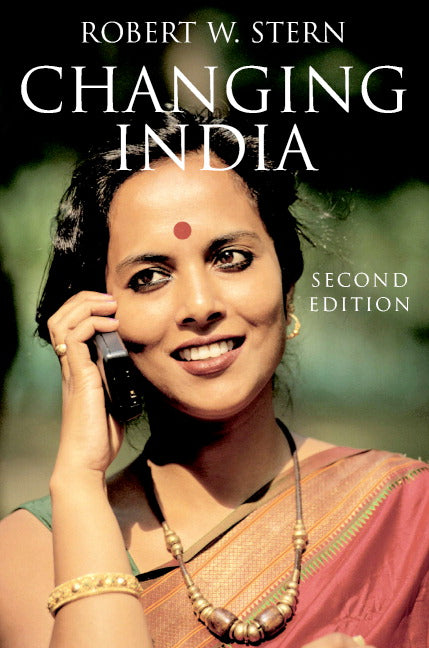
Changing India
Bourgeois Revolution on the Subcontinent
Revised edition brings India's remarkable story up to date in a comprehensive and readable introduction.
Robert W. Stern (Author)
9780521009126, Cambridge University Press
Paperback / softback, published 26 February 2003
272 pages, 3 maps 4 tables
22.9 x 15.3 x 1.7 cm, 0.38 kg
'… a florid and highly readable account … addressing the non-specialist reader interested in South Asia, the book casts a cheerful light upon the variegated fabric of India's social institutions and traces the recent history of their evolution … this book is an ideal introduction for anyone seeking to understand 'the extraordinary emergence of India as a lively, genuine and stable parliamentary democracy … despite the ravages of time and circumstance … a brilliant achievement indeed. A most enjoyable read.' The Round Table
The revised edition of Robert Stern's book brings India's story up to date. Since its original publication in 1993, much has altered and yet central to the author's argument remains his belief in the remarkable continuity and vitality of India's social systems and its resilience in the face of change. This is a colourful, readable and comprehensive introduction to modern India. In a journey through its family households and villages, the author explains its long-lived and little understood caste and class systems, its venerable faiths and extraordinary ethnic diversity, its history as 'the jewel in the crown' of British imperialism and its post-Independence career as a major agricultural and industrial nation. While paradoxes abound in an India which is constantly transforming, Stern demonstrates how and why it remains the largest and most enduring democracy in the developing world.
Introduction: change, the societies of India and Indian society
Part I. The Changing Countryside: 1. Families and villages
2. Varna, jati and caste, Muslim quasi castes and untouchability
3. Class: primordial group representation, stimuli-response and patron–client relationships
4. Homelands, 'linguistic', 'tribal' and 'regional' states: nation provinces and bourgeois revolution
Part II. Change from Above: 5. British imperialism, Indian nationalism and Muslim separatism
6. Political and economic development in the Indian Union and its international politics.
Subject Areas: Political economy [KCP], Politics & government [JP], 20th century history: c 1900 to c 2000 [HBLW], Asian history [HBJF]