In Stock - dispatch within 48 hours
Couldn't load pickup availability
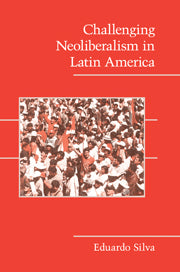
Challenging Neoliberalism in Latin America
Eduardo Silva offers the first comprehensive comparative study of anti-free market movements in Latin America and a resulting shift in governmental intervention in the economy and society.
Eduardo Silva (Author)
9780521879934, Cambridge University Press
Hardback, published 31 August 2009
336 pages, 21 tables
24.1 x 16 x 2.3 cm, 0.59 kg
'Challenging Neoliberalism in Latin America is an essential book for analysts of social movements and Latin American politics, as well as anyone who cares about economic inequality, social justice, and citizenship in a globalized world. In it, Eduardo Silva makes a bold argument about the causes and significance of recent protests in Argentina, Bolivia, Ecuador, and Venezuela. Seeing these protests as part of a wave of anti-neoliberal collective action, Silva shows how the social movements behind them have transformed state-society relations in the region. Silva keeps big questions about popular contention and state formation firmly in view throughout the book. He combines research with insightful commentary on relevant theory in a text that is both original and accessible.' Anthony W. Pereira, Tulane University
At the turn of the twentieth century, a concatenation of diverse social movements arose unexpectedly in Latin America, culminating in massive anti-free market demonstrations. These events ushered in governments in Argentina, Bolivia, Ecuador, and Venezuela that advocated socialization and planning, challenging the consensus over neoliberal hegemony and the weakness of movements to oppose it. Eduardo Silva offers the first comprehensive comparative account of these extraordinary events, arguing that the shift was influenced by favorable political associational space, a reformist orientation to demands, economic crisis, and mechanisms that facilitated horizontal linkages among a wide variety of social movement organizations. His analysis applies Karl Polanyi's theory of the double movement of market society to these events, predicting the dawning of an era more supportive of government intervention in the economy and society.
1. The inconvenient fact of antineoliberal mobilization
2. Contentious politics, contemporary market society, and power
3. The argument: explaining episodes of antineoliberal contention in Latin America
4. Argentina
5. Bolivia
6. Ecuador
7. Venezuela
8. Peru and Chile
Conclusion.
Subject Areas: Comparative politics [JPB], Politics & government [JP]