Freshly Printed - allow 7 days lead
Couldn't load pickup availability
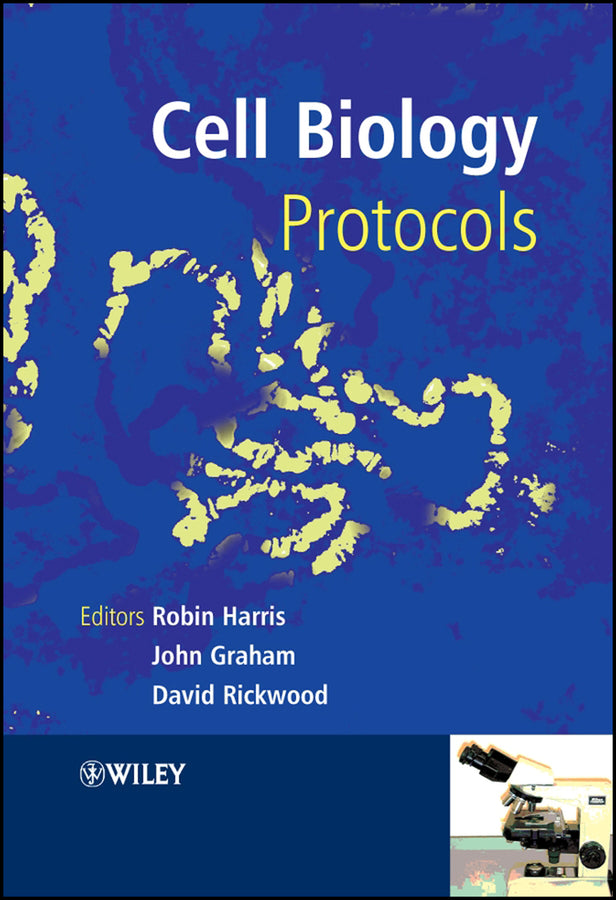
Cell Biology Protocols
J. Robin Harris (Edited by), John M. Graham (Edited by), David Rickwood (Edited by)
9780470847589, Wiley
Hardback, published 27 January 2006
432 pages
24.5 x 19.6 x 3 cm, 1.021 kg
"A valuable possession for every cell biologist’s library." (BSCB Newsletter, September 2006)
As a modern composite scientific discipline, Cell Biology has expanded and moved forward rapidly in recent years. Cell Biologists now require a wide range of techniques, including those of analytical biochemistry and microscopy in all its diverse forms. These are often used alongside the techniques of molecular biology and molecular genetics. This book contains numerous useful protocols, covering light and electron microscopy, cell culture, cell separation, subcellular fractionation, organelle and membrane isolation, and the use of in vitro reassembly systems in Cell Biology. Many of these protocols feature helpful notes and safety information for practical application. The format favours easy use at the bench with space for notes and important safety information. An appendix contains essential analytical information that will prove invaluable to those working on all aspects of cell biology.
This book will be of interest to students and more experienced cell biologists, as well as molecular biologists and those working in genomics and proteomics who are looking for cellular techniques to validate their findings within intact cells.
Preface xi List of Contributors xiii 1 Basic Light Microscopy 1 Introduction 1 Key components of the compound microscope 2 Techniques of microscopy 6 Protocols 1.1 Setting up the microscope for bright field microscopy 7 1.2 Setting K¨ohler illumination 8 1.3 Focusing procedure 9 1.4 Setting up the microscope for phase contrast microscopy 11 1.5 Setting up the microscope for epifluorescence 14 1.6 Poly-L-lysine coating 18 References 19 2 Basic Electron Microscopy 21 Introduction 21 EM methods available 22 Protocols 2.1 Preparation of carbon-formvar, continuous carbon and holey carbon support films 25 2.2 The ‘droplet’ negative staining procedure (using continuous carbon, formvar–carbon and holey carbon support films) 27 2.3 Immunonegative staining 29 2.4 The negative staining-carbon film technique: cell and organelle cleavage 31 2.5 Preparation of unstained and negatively stained vitrified specimens 33 2.6 Metal shadowing of biological specimens 35 2.7 A routine schedule for tissue processing and resin embedding 37 2.8 Agarose encapsulation for cell and organelle suspensions 39 2.9 Routine staining of thin sections for electron microscopy 40 2.10 Post-embedding indirect immunolabelling of thin sections 42 2.11 Imaging the nuclear matrix and cytoskeleton by embedment-free electron microscopy 44 References 50 3 Cell Culture 51 Cells: isolation and analysis 51 Mechanical disaggregation of tissue 52 Protocols 3.1 Tissue disaggregation by mechanical mincing or chopping 54 3.2 Tissue disaggregation by warm trypsinization 56 3.3 Cold trypsinization 58 3.4 Disaggregation using collagenase or dispase 60 3.5 Recovery of cells from effusions 63 3.6 Removal of red blood cells by snap lysis 64 3.7 Removal of red blood cells and dead cells using isopycnic centrifugation 65 3.8 Quantitation of cell counts and viability 67 3.9 Recovery of cells from monolayer cultures 71 3.10 Freezing cells 74 3.11 Thawing cells 76 3.12 Purification of human PBMCs on a density barrier 80 3.13 Purification of human PBMCs using a mixer technique 82 3.14 Purification of human PBMCs using a barrier flotation technique 83 References 84 4 Isolation and Functional Analysis of Organelles 87 Introduction 88 Homogenization 88 Differential centrifugation 90 Density gradient centrifugation 91 Nuclei and nuclear components 92 Mitochondria 93 Lysosomes 94 Peroxisomes 94 Rough and smooth endoplasmic reticulum (ER) 95 Golgi membranes 96 Plasma membrane 96 Chloroplasts 97 Protocols 4.1 Isolation of nuclei from mammalian liver in an iodixanol gradient (with notes on cultured cells) 98 4.2 Isolation of metaphase chromosomes 100 4.3 Isolation of the nuclear envelope 102 4.4 Nuclear pore complex isolation 104 4.5 Preparation of nuclear matrix 106 4.6 Preparation of nucleoli 107 4.7 Isolation of a heavy mitochondrial fraction from rat liver by differential centrifugation 108 4.8 Preparation of a light mitochondrial fraction from tissues and cultured cells 110 4.9 Purification of yeast mitochondria in a discontinuous Nycodenz® gradient 112 4.10 Purification of mitochondria from mammalian liver or cultured cells in a median-loaded discontinuous Nycodenz® gradient 114 4.11 Succinate–INT reductase assay 116 4.12 Isolation of lysosomes in a discontinuous Nycodenz® gradient 117 4.13 β-Galactosidase (spectrophotometric assay) 119 4.14 β-Galactosidase (fluorometric assay) 120 4.15 Isolation of mammalian peroxisomes in an iodixanol gradient 121 4.16 Catalase assay 123 4.17 Analysis of major organelles in a preformed iodixanol gradient 124 4.18 Separation of smooth and rough ER in preformed sucrose gradients 127 4.19 Separation of smooth and rough ER in a self-generated iodixanol gradient 129 4.20 NADPH-cytochrome c reductase assay 131 4.21 Glucose-6-phosphatase assay 132 4.22 RNA analysis 133 4.23 Isolation of Golgi membranes from liver 134 4.24 Assay of UDP-galactose galactosyl transferase 136 4.25 Purification of human erythrocyte ‘ghosts’ 137 4.26 Isolation of plasma membrane sheets from rat liver 139 4.27 Assay for 5’-nucleotidase 141 4.28 Assay for alkaline phosphodiesterase 143 4.29 Assay for ouabain-sensitive Na+/K+-ATPase 144 4.30 Isolation of chloroplasts from green leaves or pea seedlings 145 4.31 Measurement of chloroplast chlorophyll 147 4.32 Assessment of chloroplast integrity 148 5 Fractionation of Subcellular Membranes in Studies on Membrane Trafficking and Cell Signalling 153 Introduction 154 Methods available 154 Plasma membrane domains 155 Analysis of membrane compartments in the endoplasmic reticulum–Golgi–plasma membrane pathway 156 Separation of membrane vesicles from cytosolic proteins 157 Endocytosis 158 Protocols 5.1 Separation of basolateral and bile canalicular plasma membrane domains from mammalian liver in sucrose gradients 160 5.2 Isolation of rat liver sinusoidal domain using antibody-bound beads 162 5.3 Fractionation of apical and basolateral domains from Caco-2 cells in a sucrose gradient 163 5.4 Fractionation of apical and basolateral domains from MDCK cells in an iodixanol gradient 165 5.5 Isolation of lipid rafts 167 5.6 Isolation of caveolae 170 5.7 Analysis of Golgi and ER subfractions from cultured cells using discontinuous sucrose–D2O density gradients 172 5.8 Analysis of Golgi, ER, ERGIC and other membrane compartments from cultured cells using continuous iodixanol density gradients 174 5.9 Analysis of Golgi, ER, TGN and other membrane compartments in sedimentation velocity iodixanol density gradients (continuous or discontinuous) 177 5.10 SDS–PAGE of membrane proteins 180 5.11 Semi-dry blotting 182 5.12 Detection of blotted proteins by enhanced chemiluminescence (ECL) 183 5.13 Separation of membranes and cytosolic fractions from (a) mammalian cells and (b) bacteria 185 5.14 Analysis of early and recycling endosomes in preformed iodixanol gradients; endocytosis of transferrin in transfected MDCK cells 188 5.15 Analysis of clathrin-coated vesicle processing in self-generated iodixanol gradients; endocytosis of asialoglycoprotein by rat liver 191 5.16 Polysucrose–Nycodenz® gradients for the analysis of dense endosome–lysosome events in mammalian liver 194 References 196 6 In Vitro Techniques 201 Introduction 203 Protocols Nuclear components 6.1 Nucleosome assembly coupled to DNA repair synthesis using a human cell free system 204 6.2 Single labelling of nascent DNA with halogenated thymidine analogues 210 6.3 Double labelling of DNA with different halogenated thymidine analogues 214 6.4 Simultaneous immunostaining of proteins and halogen-dU-substituted DNA 217 6.5 Uncovering the nuclear matrix in cultured cells 220 6.6 Nuclear matrix–lamin interactions: in vitro blot overlay assay 228 6.7 Nuclear matrix–lamin interactions: in vitro nuclear reassembly assay 230 6.8 Preparation of Xenopus laevis egg extracts and immunodepletion 234 6.9 Nuclear assembly in vitro and immunofluorescence 237 6.10 Nucleocytoplasmic transport measurements using isolated Xenopus oocyte nuclei 240 6.11 Transport measurements in microarrays of nuclear envelope patches by optical single transporter recording 244 Cells and membrane systems 6.12 Cell permeabilization with Streptolysin O 248 6.13 Nanocapsules: a new vehicle for intracellular delivery of drugs 250 6.14 A rapid screen for determination of the protective role of antioxidant proteins in yeast 255 6.15 In vitro assessment of neuronal apoptosis 259 6.16 The mitochondrial permeability transition: PT and Δѱm loss determined in cells or isolated mitochondria with confocal laser imaging 265 6.17 The mitochondrial permeability transition: measuring PT and Δѱm loss in isolated mitochondria with Rh123 in a fluorometer 268 6.18 The mitochondrial permeability transition: measuring PT and Δѱm loss in cells and isolated mitochondria on the FACS 270 6.19 Measuring cytochrome c release in isolated mitochondria by Western blot analysis 271 6.20 Protein import into isolated mitochondria 272 6.21 Formation of ternary SNARE complexes in vitro 274 6.22 In vitro reconstitution of liver endoplasmic reticulum 277 6.23 Asymmetric incorporation of glycolipids into membranes and detection of lipid flip-flop movement 280 6.24 Purification of clathrin-coated vesicles from rat brains 286 6.25 Reconstitution of endocytic intermediates on a lipid monolayer 288 6.26 Golgi membrane tubule formation 293 6.27 Tight junction assembly 296 6.28 Reconstitution of the major light-harvesting chlorophyll a/b complex into liposomes 300 6.29 Reconstitution of photosystem 2 into liposomes 305 6.30 Golgi–vimentin interaction in vitro and in vivo 307 Cytoskeletal and fibrillar systems 6.31 Microtubule peroxisome interaction 313 6.32 Detection of cytomatrix proteins by immunogold embedment-free electron microscopy 317 6.33 Tubulin assembly induced by taxol and other microtubule assembly promoters 326 6.34 Vimentin production, purification, assembly and study by EPR 331 6.35 Neurofilament assembly 337 6.36 α-Synuclein fibril formation induced by tubulin 342 6.37 Amyloid-β fibril formation in vitro 345 6.38 Soluble Aβ1–42 peptide induces tau hyperphosphorylation in vitro 348 6.39 Anti-sense peptides 353 6.40 Interactions between amyloid-β and enzymes 359 6.41 Amyloid-β phosphorylation 364 6.42 Smitin–myosin II coassembly arrays in vitro 369 6.43 Assembly/disassembly of myosin filaments in the presence of EF-hand calcium-binding protein S100A4 in vitro 372 6.44 Collagen fibril assembly in vitro 375 7 Selected Reference Data for Cell and Molecular Biology 379 Chemical safety information 379 Centrifugation data 386 Radioisotope data 388 Index 391
Minnie O’Farrell
J. Robin Harris
Jeffrey A. Nickerson and Jean Underwood
Anne Wilson and John Graham
Anne Wilson
Anne Wilson
Anne Wilson
Anne Wilson
Anne Wilson
Anne Wilson
John Graham
John Graham
J. Robin Harris
John Graham
Edited by J. Robin Harris
Geneviève Almouzni and Doris Kirschner
Daniela Dimitrova
Jeffrey A. Nickerson, Jean Underwood and Stefan Wagner
Barbara Korbei and Roland Foisner
Tobias C. Walther
Martin Hetzer
Reiner Peters
Reiner Peters
Ivan Walev
Anton I. P. M. de Kroon, Rutger W. H. M. Staffhorst, Ben de Kruijff and Koert N. J.Burger
Luis Eduardo Soares Netto
Eric Bertrand
Judie B. Alimonti and Arnold H. Greenberg
Judie B. Alimonti and Arnold H. Greenberg
Judie B. Alimonti and Arnold H. Greenberg
Judie B. Alimonti and Arnold H. Greenberg
Judie B. Alimonti and Arnold H. Greenberg
Jinnan Xiao, Anuradha Pradhan and Yuechueng Liu
Jacques Paiement and Robin Young
Félix M. Goñi, Ana-Victoria Villar, F.-Xabier Contreras and Alicia Alonso
Brian J. Peter and Ian G. Mills
Brian J. Peter and Matthew K. Higgins
William J. Brown, K. Chambers and A. Doody
C. Yan Cheng and Dolores D. Mruk
Chunhong Yang, Helmut Kirchhoff, Winfried Haase, Stephanie Boggasch and Harald Paulsen
Julie Benesova, Sven-T. Liffers and Matthias Rögner
Ya-sheng Gao and Elizabeth Sztul
Meinolf Thiemann and H. Dariush Fahimi
Robert Gniadecki and Barbara Gajkowska
Susan L. Bane
John F. Hess, John C. Voss and Paul G. FitzGerald
Shin-ichi Hisanaga and Takahiro Sasaki
Kenji Uéda and Shin-ichi Hisanaga
J. Robin Harris
Terrence Town and Jun Tan
Nathaniel G. N. Milton
Nathaniel G. N. Milton
Nathaniel G. N. Milton
Richard Chi and Thomas C. S. Keller III
Marina Kriajevska, Igor Bronstein and Eugene Lukanidin
David F. Holmes and Karl E. Kadler
David Rickwood
Subject Areas: Biology, life sciences [PS]