Freshly Printed - allow 10 days lead
Couldn't load pickup availability
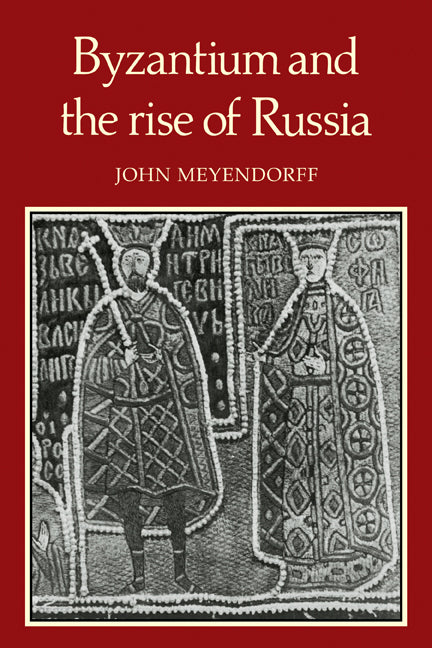
Byzantium and the Rise of Russia
A Study of Byzantino-Russian relations in the fourteenth century
This book describes the role of Byzantine diplomacy in the emergence of Moscow in the fourteenth century.
John Meyendorff (Author)
9780521135337, Cambridge University Press
Paperback / softback, published 24 June 2010
350 pages
22.8 x 15.1 x 2.2 cm, 0.55 kg
The history of Russia is often considered as if that immense country had always been an isolated continent. However, at the time of its rise as a nation, it was politically a province of the Mongol Empire, whose capital was in Central Asia; and ecclesiastically, it was a dependency of the Orthodox Patriarchate of Constantinople, or Byzantium. This book describes the role of Byzantine (predominantly ecclesiastical) diplomacy in the emergence of Moscow as the capital of Russia in the fourteenth century, and the cultural, religious and political ties which connected the Northern periphery of the Byzantine Orthodox 'Commonwealth' with its centre in Constantinople. After 1370, the religious and monastic revival in Byzantium and the weakening of Mongol power provided an orientation to the policies of the Orthodox church in Russia: towards supra-national unity, spiritual and artistic achievements, and political reconciliation between principalities.
Abbreviations
Acknowledgements
Note on proper names
Introduction
1. Byzantine civilization in Russia
2. The catastrophes of the thirteenth century
3. The Mongols, their Western neighbours and their Russian subjects
4. The metropolitanate of Kiev and all Russia
5. Victory of the Hesychasts in Byzantium: ideological and political consequences
6. Cultural ties: Byzantium, the Southern Slavs and Russia
7. Byzantium and Moscow
8. Patriarch Philotheos and Russia (1364–76)
9. Metropolitan Cyprian and Moscow's separatism (1376–81)
10. Lithuania turns westwards
Conclusion: dreams and reality
Appendices
Index.
Subject Areas: Early history: c 500 to c 1450/1500 [HBLC], European history [HBJD]