Freshly Printed - allow 7 days lead
Couldn't load pickup availability
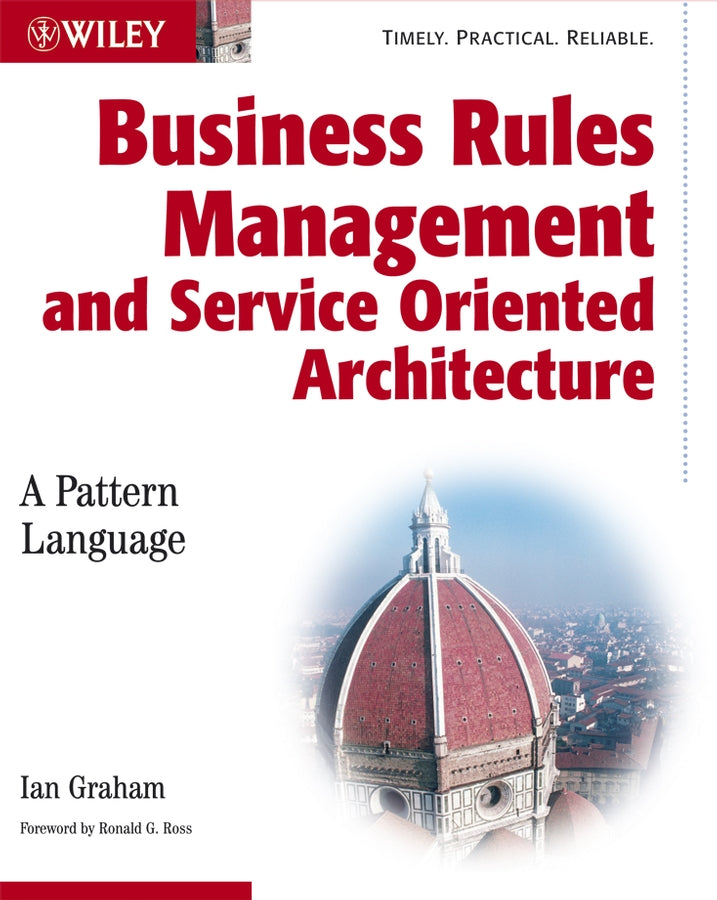
Business Rules Management and Service Oriented Architecture
A Pattern Language
Ian Graham (Author)
9780470027219, Wiley
Paperback / softback, published 17 November 2006
296 pages
23.8 x 19.1 x 1.7 cm, 0.51 kg
Business rules management system (BRMS) is a software tools that work alongside enterprise IT applications. It enables enterprises to automate decision-making processes typically consisting of separate business rules authoring and rules execution applications. This proposed title brings together the following key ideas in modern enterprise system development best practice. Ian Graham is an industry consultant with over 20 years. He is recognized internationally as an authority on business modelling, object-oriented software development methods and expert systems. He has a significant public presence, being associated with both UK and international professional organizations, and is frequently quoted in the IT and financial press.
Foreword. Preface. 1 Aligning IT with Business. 1.1 Historical Background. 1.2 What are Business Rules? 1.3 What is Business Rules Management? 1.4 Why use a Business Rules Management System? 1.5 The Benefits. 1.6 Summary. 1.7 Bibliographical Notes. 2 Service Oriented Architecture and Software Components. 2.1 Service Oriented Architecture and Business Rules. 2.2 Service Implementation using Components. 2.3 Agents and Rules. 2.4 Service Oriented Architecture andWeb Services. 2.5 Adoption Strategies. 2.6 Summary. 2.7 Bibliographical Notes. 3 Approaches to Business Rules. 3.1 Database-centric Approaches. 3.2 GUIDE and the Business Rules Group. 3.3 Using UML and OCL to Express Rules. 3.4 Business Rules Management Systems and Expert Systems. 3.5 Other Developments. 3.6 Standards, Directions and Trends. 3.7 Summary. 3.8 Bibliographical Notes. 4 Business Rules Management Technology and Terminology. 4.1 Rules and Other Forms of Knowledge Representation. 4.2 Knowledge and Inference. 4.3 Inference in Business Rules Management Systems. 4.4 Data Mining and Rule Induction. 4.5 Techniques for Representing Rules. 4.6 Uncertainty Management. 4.7 Ontology and Epistemology: the Rˆole of Object Modelling in. Natural Language Processing. 4.8 Summary. 4.9 Bibliographical Notes. 5 Features of Business Rules Management Systems. 5.1 The Components and Technical Features of a BRMS. 5.2 BRMS Products. 5.3 A Simple Application. 5.4 Usability Issues. 5.5 Summary. 5.6 Bibliographical Notes. 6 Development Methods. 6.1 Knowledge Acquisition and Analysis. 6.2 System Development. 6.3 Halle’s Guidelines. 6.4 Rule Style Guidance. 6.5 Summary. 6.6 Bibliographical Notes. 7 A Pattern Language for BRMS Development. 7.1 What are Patterns? 7.2 Why a Pattern Language? 7.3 The RulePatterns Language – Part I. 7.4 The RulePatterns Language – Part II. 7.5 Related Patterns and Pattern Languages. APPENDICES. A The Business Rules Manifesto. B A Simple Method for Evaluating BRMS Products. References and Bibliography. Index.
Subject Areas: Ethical & social aspects of IT [UBJ]