Freshly Printed - allow 10 days lead
Couldn't load pickup availability
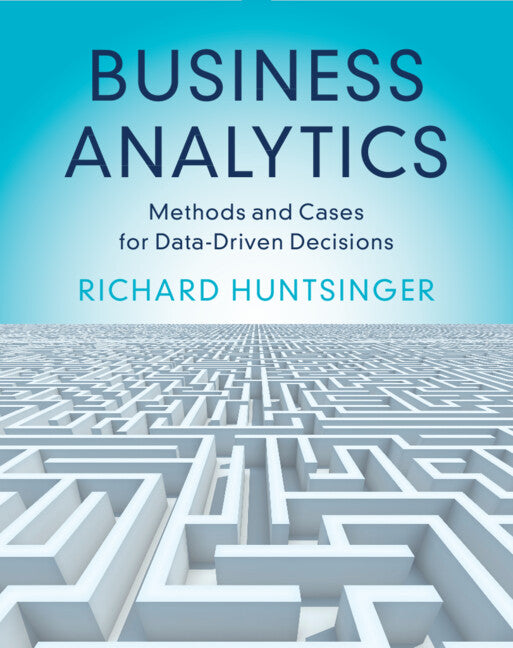
Business Analytics
Methods and Cases for Data-Driven Decisions
A comprehensive, innovative textbook suitable for senior and graduate students in business or data science departments.
Richard Huntsinger (Author)
9781316512159, Cambridge University Press
Hardback, published 2 January 2025
700 pages
26 x 21.1 x 3.2 cm, 1.66 kg
'This book is an excellent practical resource, providing an executive level perspective to its readership.' Janos Pinter, Rutgers University - New Brunswick
Business analytics is all about leveraging data analysis and analytical modeling methods to achieve business objectives. This is the book for upper division and graduate business students with interest in data science, for data science students with interest in business, and for everyone with interest in both. A comprehensive collection of over 50 methods and cases is presented in an intuitive style, generously illustrated, and backed up by an approachable level of mathematical rigor appropriate to a range of proficiency levels. A robust set of online resources, including software tools, coding examples, datasets, primers, exercise banks, and more for both students and instructors, makes the book the ideal learning resource for aspiring data-savvy business practitioners.
Executive Overview
1. Data and Decisions
1.1 Learning Objectives
1.2 Introduction
1.3 Data-to-Decision Process Model
1.4 Decision Models
1.5 Sensitivity Analysis
2. Data Preparation
2.1 Learning Objectives
2.2 Data Objects
2.3 Selection
2.4 Amalgamation
2.5 Synthetic Variables
2.6 Normalization
2.7 Dummy Variables
2.8 CASE | High-Tech Stocks
3. Data Exploration
3.1 Learning Objectives
3.2 Descriptive Statistics
3.3 Similarity
3.4 Cross-Tabulation
3.5 Data Visualization
3.6 Kernel Density Estimation
3.7 CASE | Fundraising Strategy
3.8 CASE | Iowa Liquor Sales
4. Data Transformation
4.1 Learning Objectives
4.2 Balance
4.3 Imputation
4.4 Alignment
4.5 Principal Component Analysis
4.6 CASE | Loan Portfolio
5. Classification I
5.1 Learning Objectives
5.2 Classification Methodology
5.3 Classifier Evaluation
5.4 k-Nearest Neighbors
5.5 Logistic Regression
5.6 Decision Tree
5.7 CASE | Loan Portfolio Revisited
6. Classification II
6.1 Learning Objectives
6.2 Naive Bayes
6.3 Support Vector Machine
6.4 Neural Network
6.5 CASE | Telecom Customer Churn
6.6 CASE | Truck Fleet Maintenance
7. Classification III
7.1 Learning Objectives
7.2 Multinomial Classification
7.3 CASE | Facial Recognition
7.4 CASE | Credit Card Fraud
8. Regression
8.1 Learning Objectives
8.2 Regression Methodology
8.3 Regressor Evaluation
8.4 Linear Regression
8.5 Regression Versions
8.6 CASE | Call Center Scheduling
9. Ensemble Assembly
9.1 Learning Objectives
9.2 Bagging
9.3 Boosting
9.4 Stacking
10. Cluster Analysis
10.1 Learning Objectives
10.2 Cluster Analysis Methodology
10.3 Cluster Model Evaluation
10.4 k-Means
10.5 Hierarchical Agglomeration
10.6 Gaussian Mixture
10.7 CASE | Fortune 500 Diversity
10.8 CASE | Music Market Segmentation
11. Special Data Types
11.1 Learning Objectives
11.2 Text Data
11.3 Time Series Data
11.4 Network Data
11.5 PageRank for Network Data
11.6 Collaborative Filtering for Network Data
11.7 CASE | Deceptive Hotel Reviews
11.8 CASE | Targeted Marketing.
Subject Areas: Business strategy [KJC]