Freshly Printed - allow 10 days lead
Couldn't load pickup availability
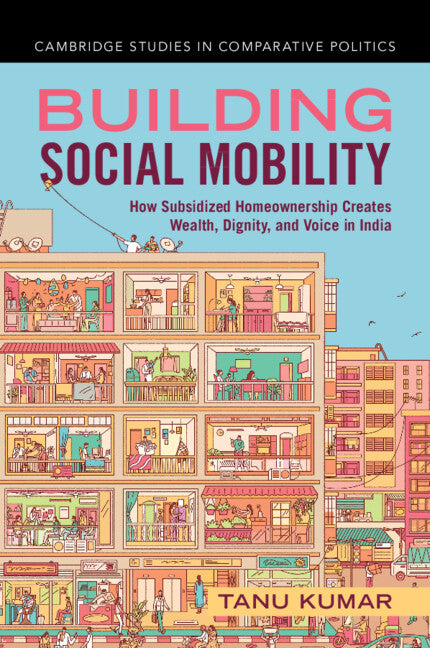
Building Social Mobility
How Subsidized Homeownership Creates Wealth, Dignity, and Voice in India
Shows how subsidized homeownership transforms household trajectories by fostering investment, wealth accumulation, dignity, and political participation.
Tanu Kumar (Author)
9781009636995, Cambridge University Press
Paperback / softback, published 2 October 2025
240 pages
22.8 x 15.1 x 1.3 cm, 0.35 kg
'Cash transfers, work guarantees, and investments in social services have traditionally been the focus of efforts to bring people out of poverty in low- and middle-income countries. In this remarkable book, Kumar shows how a different form of public policy-subsidized home ownership-can transform poor people's lives by bolstering not just wealth but also agency and civic participation.' Daniel N. Posner, University of California, Los Angeles
Which policies can help households improve their economic, social and political status? Building Social Mobility is an in-depth exploration of how policies to subsidize homeownership in low- and middle-income countries shape beneficiaries' decision-making in nearly every facet of their lives. Tanu Kumar develops a multidimensional and cross-disciplinary theory that argues that these initiatives affect how citizens invest in the future, climb out of poverty, develop agency in their social relationships, and exert power in local politics. Kumar supports the theory using a multi-method study of three policies in India. Evidence includes a natural experiment, original surveys, paired qualitative interviews, and an 18-year matched panel study. Building Social Mobility is a book about both housing and behavior. It goes beyond assessing the effects of an important policy to provide deep insights about how upwardly mobile citizens make decisions and the interactions between wealth, dignity, and voice in low- and middle-income countries.
1. Building social mobility
2. Policies to improve housing quality
3. Wealth
4. Dignity
5. Voice
6. Implications for effective policy.
Subject Areas: Comparative politics [JPB]