Freshly Printed - allow 8 days lead
Couldn't load pickup availability
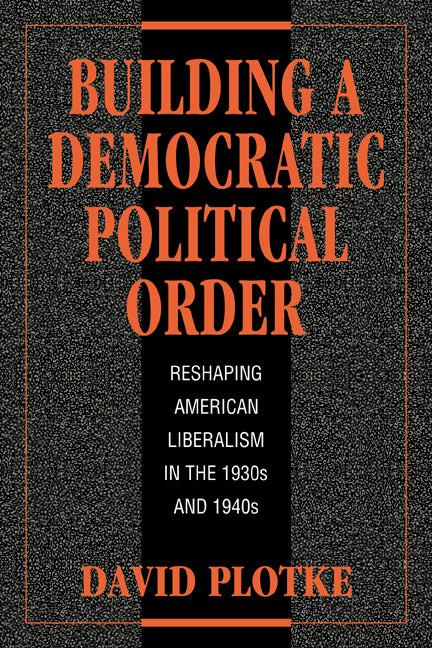
Building a Democratic Political Order
Reshaping American Liberalism in the 1930s and 1940s
This 1996 book explores the dramatic changes in American politics that occurred during the 1930s and 1940s.
David Plotke (Author)
9780521034593, Cambridge University Press
Paperback / softback, published 14 December 2006
404 pages
22.8 x 15.3 x 2.2 cm, 0.614 kg
'… a volume that marks a major advance in our understanding of how political orders - form and persist in an advanced capitalist social formation'. Political Science and History
This 1996 book analyses the dramatic changes in American politics that occurred during the 1930s and 1940s - including the break-up of national Republican power, the growth of the federal government, the emergence of a new labour movement, American entry into World War II, the Cold War and domestic anti-Communism, and the opening of national political debate about civil rights. The central dynamic of this era was the creation and maintenance of a distinctive new political order, formed through the creative political action of progressive liberals in alliance with mass movements, notably labour. At the core of this new order was a powerful triangle formed by a national state, a leading party, and major nonparty interest groups and movements. Democratic progressive liberalism recast American political institutions and discourses in ways that went well beyond what was expected in the early 1930s, and in forms strong enough to endure for several decades after Roosevelt's death.
Preface
Introduction: the Democratic order as a political project
1. When does politics change?
2. Creating political orders: the logic of the Democratic experience
3. Democratic opportunities in the crises of the 1930s
4. Passing the Wagner Act and building a new Democratic state
5. Party and movements in the Democratic upsurge, 1935–7
6. Progressive liberalism as pragmatic common sense
7. Surprising years: electing Truman and sustaining the Democratic order, 1947–9
8. Passing Taft-Hartley: what the losers won (and what the winners lost)
9. New political fronts? Growth and civil rights in the late 1940s
10. Democratic anti-Communism and the Cold War
11. From Truman to Kennedy: the reach and limits of Democratic power
12. Was the Democratic order democratic?
Index.
Subject Areas: Political science & theory [JPA]