Freshly Printed - allow 7 days lead
Couldn't load pickup availability
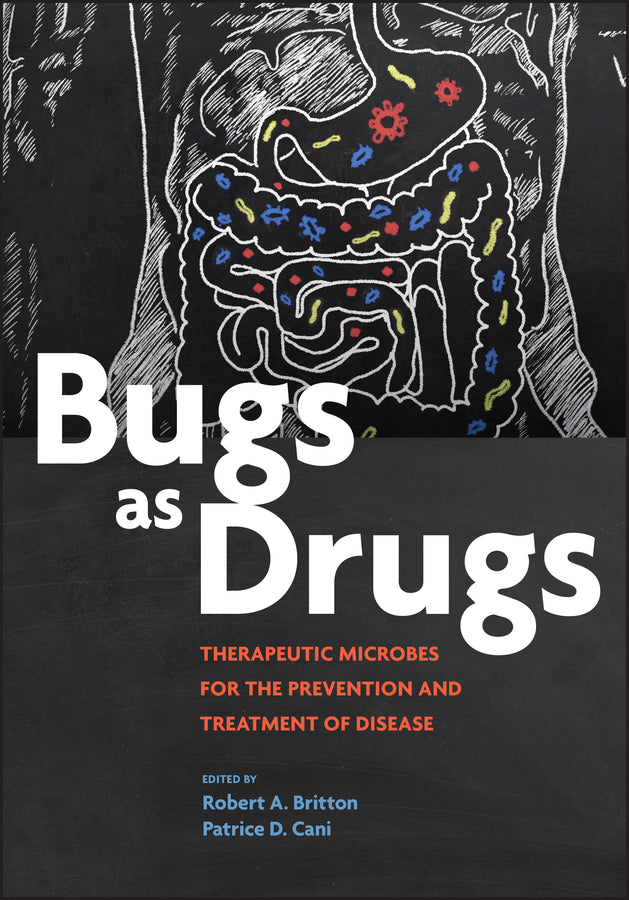
Bugs as Drugs
Therapeutic Microbes for Prevention and Treatment of Disease
Robert A. Britton (Edited by), Patrice D. Cani (Edited by)
9781555819699, Wiley
Hardback, published 1 February 2018
514 pages
25.7 x 17.8 x 2.8 cm, 1.247 kg
Because microbiome research studies are being published at an unprecedented rate, a reliable book that reviews the seminal work and knowledge gaps in this field is pressingly needed. In Bugs as Drugs: Therapeutic Microbes for the Prevention and Treatment of Disease, the authors address major themes in microbiome research, particularly focusing on therapeutic applications.
This ~500-page volume, edited by Robert A. Britton and Patrice D. Cani, comprises 5 main sections of varying scope and length. The introductory section reviews pathways used by commensals, particularly Lactobacilli and Bifidobacteria spp., to benefit the host. The first chapter is particularly impressive, providing a thorough and well-cited overview of the various microbial metabolites and how they influence the host.
...Overall, this book is a commendable and timely volume of well-sourced reviews written by experts in the field well organized into broad research themes. This work will serve as a helpful resource for both scientists and clinicians interested in using microbes for therapeutic applications.
-Excerpted from the full review in Emerging Infectious Diseases, Vol. 25, No.7, Books and Media
Examining the enormous potential of microbiome manipulation to improve health Associations between the composition of the intestinal microbiome and many human diseases, including inflammatory bowel disease, cardiovascular disease, metabolic disorders, and cancer, have been elegantly described in the past decade. Now, whole-genome sequencing, bioinformatics, and precision gene-editing techniques are being combined with centuries-old therapies, such as fecal microbiota transplantation, to translate current research into new diagnostics and therapeutics to treat complex diseases. Bugs as Drugs provides a much-needed overview of microbes in therapies and will serve as an excellent resource for scientists and clinicians as they carry out research and clinical studies on investigating the roles the microbiota plays in health and disease. In Bugs as Drugs, editors Robert A. Britton and Patrice D. Cani have assembled a fascinating collection of reviews that chart the history, current efforts, and future prospects of using microorganisms to fight disease and improve health. Sections cover traditional uses of probiotics, next-generation microbial therapeutics, controlling infectious diseases, and indirect strategies for manipulating the host microbiome. Topics presented include: Because systems biology approaches and synthetic engineering of microbes are now high-throughput and cost-effective, a much wider range of therapeutic possibilities can be explored and vetted. If you are looking for online access to the latest clinical microbiology content, please visit www.wiley.com/learn/clinmicronow.
Contributors vii About the Editors xii Preface xiii A. Traditional Probiotic Approaches 1 Biochemical Features of Beneficial Microbes: Foundations for Therapeutic Microbiology 3 2 The Genomic Basis of Lactobacilli as Health-Promoting Organisms 49 3 Bifidobacteria and Their Health-Promoting Effects 73 B. Next-Generation Bacteriotherapy: Opportunities in Chronic Diseases 4 Microbial Interactions and Interventions in Colorectal Cancer 101 5 Microbial Impact on Host Metabolism: Opportunities for Novel Treatments of Nutritional Disorders? 131 6 Therapeutic Opportunities in the Vaginal Microbiome 149 7 Lung Microbiota and Its Impact on the Mucosal Immune Phenotype 161 8 Microbiota, Liver Diseases, and Alcohol 187 9 The Potential of Probiotics as a Therapy for Osteoporosis 213 10 Ecological Therapeutic Opportunities for Oral Diseases 235 C. Control of Infectious Disease by Microbes 11 Control of Clostridium difficile Infection by Defined Microbial Communities 269 12 Fecal Microbiota Transplantation: Therapeutic Potential for a Multitude of Diseases beyond Clostridium difficile 291 13 Enterococci and Their Interactions with the Intestinal Microbiome 309 D. Next-Generation Microbial Therapeutics: Tools and Regulation 14 Engineering Diagnostic and Therapeutic Gut Bacteria 333 15 Use of Traditional and Genetically Modified Probiotics in Human Health: What Does the Future Hold? 363 16 Genetic Tools for the Enhancement of Probiotic Properties 371 17 Genome Editing of Food-Grade Lactobacilli to Develop Therapeutic Probiotics 389 18 United States Regulatory Considerations for Development of Live Biotherapeutic Products as Drugs 409 E. Indirect Strategies to Target Microbiome Function for Health 19 Bacteriophage Clinical Use as Antibacterial “Drugs”: Utility and Precedent 419 20 Modulation of the Gastrointestinal Microbiome with Nondigestible Fermentable Carbohydrates to Improve Human Health 453 Index 485
Melinda A. Engevik and James Versalovic
Elisa Salvetti and Paul W. O’Toole
Claudio Hidalgo-Cantabrana, Susana Delgado, Lorena Ruiz, Patricia Ruas-Madiedo, Borja Sánchez, and Abelardo Margolles
Terence Van Raay and Emma Allen-Vercoe
Hubert Plovier and Patrice D. Cani
Gregor Reid
Benjamin G. Wu and Leopoldo N. Segal
Anne-Marie Cassard, Philippe Gérard, and Gabriel Perlemuter
Fraser L. Collins, Naiomy D. Rios-Arce, Jonathan D. Schepper, Narayanan Parameswaran, and Laura R. McCabe
Anilei Hoare, Philip D. Marsh, and Patricia I. Diaz
James Collins and Jennifer M. Auchtung
Guido J. Bakker and Max Nieuwdorp
Krista Dubin and Eric G. Pamer
Brian P. Landry and Jeffrey J. Tabor
Luis G. Bermúdez-Humarán and Philippe Langella
Laura Ortiz-Velez and Robert Britton
Jan-Peter van Pijkeren and Rodolphe Barrangou
Sheila M. Dreher-Resnick, Scott Stibitz, and Paul E. Carlson, Jr.
Stephen T. Abedon
Edward C. Deehan, Rebbeca M. Duar, Anissa M. Armet, Maria Elisa Perez-Muñoz, Mingliang Jin, and Jens Walter
Subject Areas: Clinical & internal medicine [MJ]