Freshly Printed - allow 7 days lead
Couldn't load pickup availability
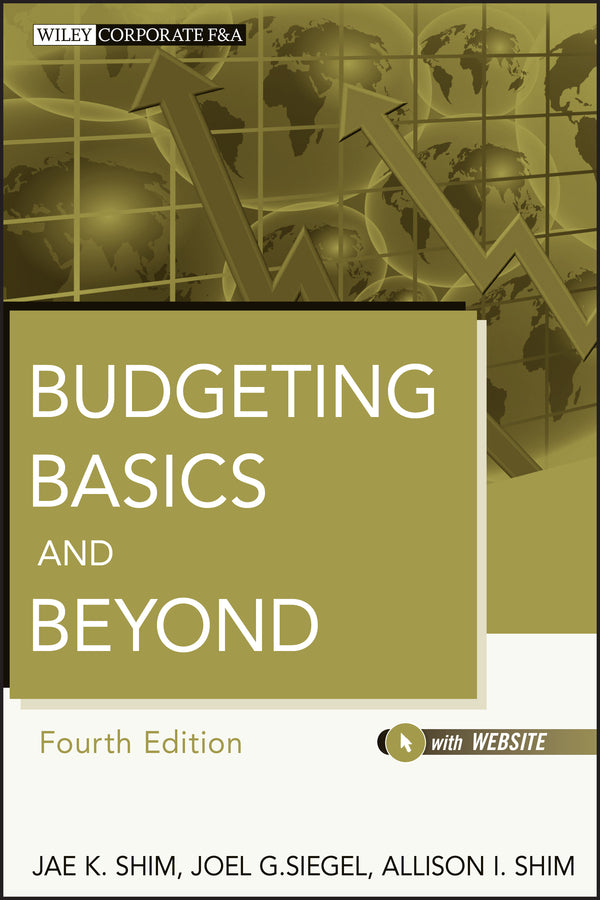
Budgeting Basics and Beyond
Jae K. Shim (Author), Joel G. Siegel (Author), Allison I. Shim (Author)
9781118096277, Wiley
Hardback, published 2 December 2011
560 pages
23.1 x 15.8 x 4.6 cm, 0.794 kg
A convenient and up-to-date reference tool for today's financial and nonfinancial managers in public practice and private industry If the very thought of budgets pushes your sanity over the limit, then this practical, easy-to-use guide is just what you need. Budgeting Basics and Beyond, Fourth Edition equips you with an all-in-one resource guaranteed to make the budgeting process easier, less stressful, and more effective. The new edition covers rolling budgets (forecasts), activity-based budgeting, life-cycle budgeting. Cloud computing, Balanced Scorecard, budgeting for nonprofit organizations, business simulations for executive and management training, and much more! Budgeting Basics and Beyond, Fourth Edition is a practical, easy-to-use problem-solver and up-to-date reference tool for today's financial and nonfinancial managers in public practice and private industry.
About the Authors xi Preface xiii Chapter 1: The What and Why of Budgeting: An Introduction 1 Chapter 2: Strategic Planning and Budgeting: Process, Preparation, and Control 29 Chapter 3: Administering the Budget: Reports, Analyses, and Evaluations 45 Chapter 4: Break-Even and Contribution Margin Analysis: Profit, Cost, and Volume Changes 57 Chapter 5: Profit Planning: Targeting and Reaching Achievable Goals 79 Chapter 6: Master Budget: Genesis of Financial Forecasting and Profit Planning 95 Chapter 7: Cost Behavior: Emphasis on Flexible Budgets 119 Chapter 8: Evaluating Performance: The Use of Variance Analysis 131 Chapter 9: Manufacturing Costs: Sales Forecasts and Realistic Budgets 191 Chapter 10: Marketing: Budgeting for Sales, Advertising, and Distribution 203 Chapter 11: Research and Development: Budgets for a Long-Term Plan 223 Chapter 12: General and Administrative Costs: Budgets for Maximum Productivity 237 Chapter 13: Capital Expenditures: Assets to Be Bought, Sold, and Discarded 243 Chapter 14: Forecasting and Planning: Reducing Risk in Decision Making 267 Chapter 15: Moving Averages and Smoothing Techniques: Quantitative Forecasting 277 Chapter 16: Regression Analysis: Popular Sales Forecast System 289 Chapter 17: Cash Budgeting and Forecasting Cash Flow: Two Pragmatic Methods 301 Chapter 18: Financial Modeling: Tools for Budgeting and Profit Planning 315 Chapter 19: Using Software Packages and E-Budgeting: Computer-Based Models, Spreadsheets, and Web-Based Systems 329 Chapter 20: Capital Budgeting: Selecting the Optimum Long-Term Investment and Real Options 351 Chapter 21: Budgeting for Cost Management: Activity-Based Budgeting and Life-Cycle Budgeting 393 Chapter 22: Zero-Base Budgeting: Priority Budgeting for Best Resource Allocation 411 Chapter 23: Managers’ Performance and Balanced Scorecard: Evaluation at the Division Level 419 Chapter 24: Budgeting for Service Organizations: Special Features 453 Chapter 25: Budgeting for Nonprofit Organizations: Diverse Types 463 Chapter 26: Using Management Games for Executive Training 487 Appendix I: Future and Present Value Tables 505 Appendix II: Statistical Table 511 Glossary of Budgeting and Planning Terms 513 Index 531
Subject Areas: Finance & accounting [KF]