Freshly Printed - allow 10 days lead
Couldn't load pickup availability
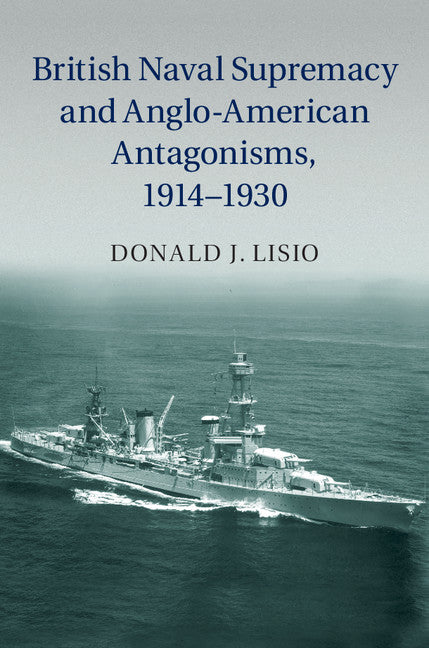
British Naval Supremacy and Anglo-American Antagonisms, 1914–1930
This book analyzes British efforts to preserve its naval supremacy during the 1920s.
Donald J. Lisio (Author)
9781107056954, Cambridge University Press
Hardback, published 27 October 2014
344 pages, 14 b/w illus.
23.5 x 15.8 x 2.4 cm, 0.63 kg
'Based on its extensive review of underutilized military records and the archives of military advisors such as Beatty, British Naval Supremacy should be of interest to historians with specializations in fields such as military, diplomatic, and international history, as well as scholars focused on the interwar years, Anglo–American relations, and arms control.' Alan M. Anderson, US Military History Review
During World War I, Britain's naval supremacy enabled it to impose economic blockades and interdiction of American neutral shipping. The United States responded by building 'a navy second to none', one so powerful that Great Britain could not again successfully challenge America's vital economic interests. This book reveals that when the United States offered to substitute naval equality for its emerging naval supremacy, the British, nonetheless, used the resulting two major international arms-control conferences of the 1920s to ensure its continued naval dominance.
Introduction
1. Clashing world interests
2. Washington conference legacy
3. Beatty's Japanese war plan
4. Churchill's challenge
5. Beatty embraces arms control
6. The general boards' new hope
7. American arms-control politics
8. Beatty takes control
9. Combat equivalency
10. Beatty's new strategies
11. Conference shocks
12. Hardening positions
13. The failure of the Anglo-Japanese Accord
14. Cabinet crisis
15. Final efforts
16. Breakdown and recriminations
17. Conclusion.
Subject Areas: 20th century history: c 1900 to c 2000 [HBLW], History of the Americas [HBJK], British & Irish history [HBJD1]