Freshly Printed - allow 10 days lead
Couldn't load pickup availability
Brecht and Tragedy
Radicalism, Traditionalism, Eristics
Explores Brecht's complex relationship with Greek tragedy and the tragic tradition, including significant archival material not seen before.
Martin Revermann (Author)
9781108489683, Cambridge University Press
Hardback, published 16 December 2021
494 pages, 36 b/w illus. 4 colour illus.
25.1 x 17.6 x 3.3 cm, 1.02 kg
'… Brecht's utilitarian aims will inspire younger generations to continue studying and appreciating the great theater practitioner … Recommended.' G. Divay, Choice
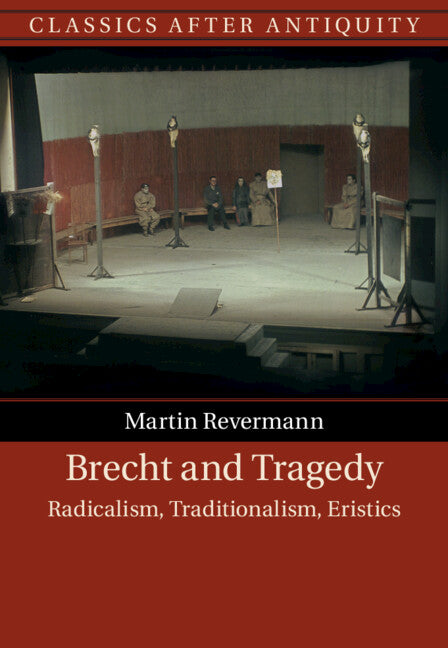
This wide-ranging, detailed and engaging study of Brecht's complex relationship with Greek tragedy and tragic tradition argues that this is fundamental for understanding his radicalism. Featuring an extensive discussion of The Antigone of Sophocles (1948) and further related works (the Antigone model book and the Small Organon for the Theatre), this monograph includes the first-ever publication of the complete set of colour photographs taken by Ruth Berlau. This is complemented by comparatist explorations of many of Brecht's own plays as his experiments with tragedy conceptualized as the 'big form'. The significance for Brecht of the Greek tragic tradition is positioned in relation to other formative influences on his work (Asian theatre, Naturalism, comedy, Schiller and Shakespeare). Brecht emerges as a theatre artist of enormous range and creativity, who has succeeded in re-shaping and re-energizing tragedy and has carved paths for its continued artistic and political relevance.
Introduction: Radicalism, traditionalism, eristics
Part I. Point of contact 1948: 1. 1948 – A year of krisis
2. Professing non-Aristotelianism: Brecht's Small Organon for the Theatre (1948)
3. Utilizing Greek tragedy: Brecht's The Antigone of Sophocles (1948)
4. The making of a model: Antigonemodell 1948
Part II. Positionings: 5. The other Other: Brecht's Asia
6. Naturalism and related diseases
7. Schiller: rival and inspiration
8. Comedy and the comic
9. Shakespeare and the road beyond tragedy
Part III. Comparatist explorations: 10. The tragedy of Mother Courage
11. Brechtian chorality
12. Threepenny Opera: the view from below
13. Appellative anti-tragedy: gods, parody and closure in The Good Person of Sezuan
14. Mahagonny: rise and fall of a dystopian city
15. Anti-tragic justice: The Measure
16. Heroism and its discontents I: the epic tragedy The Judith of Shimoda – expansion, commentary, metapoetics
17. Heroism and its discontents II: Galileo, a tragic hero of science?
Conclusion: Brecht and tragedy – pulling threads together.
Subject Areas: Ancient history: to c 500 CE [HBLA], Literary studies: classical, early & medieval [DSBB], Theatre studies [AN]