Special Order - allow 2+ weeks lead
Couldn't load pickup availability
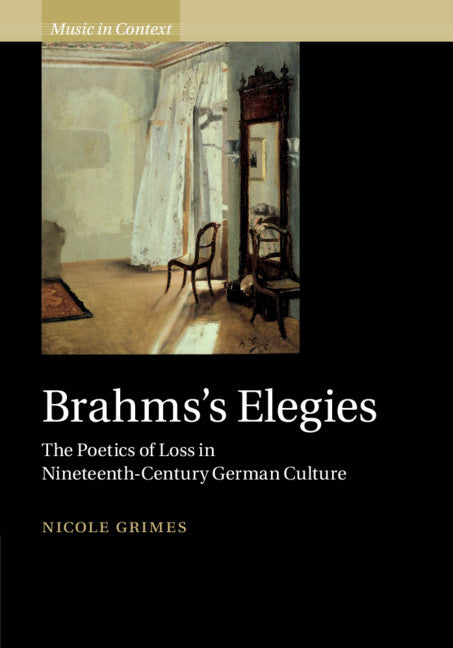
Brahms's Elegies
The Poetics of Loss in Nineteenth-Century German Culture
A unique insight into the relationship between Brahms's music and his philosophical and literary context from a modernist perspective.
Nicole Grimes (Author)
9781108474498, Cambridge University Press
Hardback, published 24 January 2019
292 pages, 16 b/w illus. 12 tables 25 music examples
25.4 x 18 x 1.8 cm, 0.75 kg
'a disciplined and imaginative piece of scholarship which thematically draws together a selection of Brahms's elegiac works using an interdisciplinary analytical framework. Grimes investigates the deep relationship between the musical works and their contemporaneous worlds in literature, visual art, and philosophy. This book examines a relatively unknown collection of works within Brahms's catalogue, both from musical/analytical and literary perspectives. The focus and breadth are notable in this regard, and the author's examination of Brahms's own literary proclivities and knowledge are particularly significant.' Society for Musicology in Ireland
Nicole Grimes provides a compellingly fresh perspective on a series of Brahms's elegiac works by bringing together the disciplines of historical musicology, German studies, and cultural history. Her exploration of the expressive potential of Schicksalslied, Nänie, Gesang der Parzen, and the Vier ernste Gesänge reveals the philosophical weight of this music. She considers the German tradition of the poetics of loss that extends from the late-eighteenth-century texts by Hölderlin, Schiller and Goethe set by Brahms, and includes other philosophical and poetic works present in his library, to the mid-twentieth-century aesthetics of Adorno, who was preoccupied as much by Brahms as by their shared literary heritage. Her multifaceted focus on endings - the end of tonality, the end of the nineteenth century, and themes of loss in the music - illuminates our understanding of Brahms and lateness, and the place of Brahms in the fabric of modernist culture.
Introduction
1. Brahms's ascending circle: Hölderlin and Schicksalslied
2. The ennoblement of mourning: Nänie and the death of beauty
3. A disembodied head for mythic justice: Gesang der Parzen
4. The last great cultural harvest: Nietzsche and the Vier ernste Gesänge
5. The sense of an ending: music's return to the land of childhood
Epilogue.
Subject Areas: European history [HBJD], Literary studies: c 1800 to c 1900 [DSBF], Individual composers & musicians, specific bands & groups [AVH], Romantic music [c 1830 to c 1900 AVGC5], Music reviews & criticism [AVC], Theory of music & musicology [AVA]