Freshly Printed - allow 7 days lead
Couldn't load pickup availability
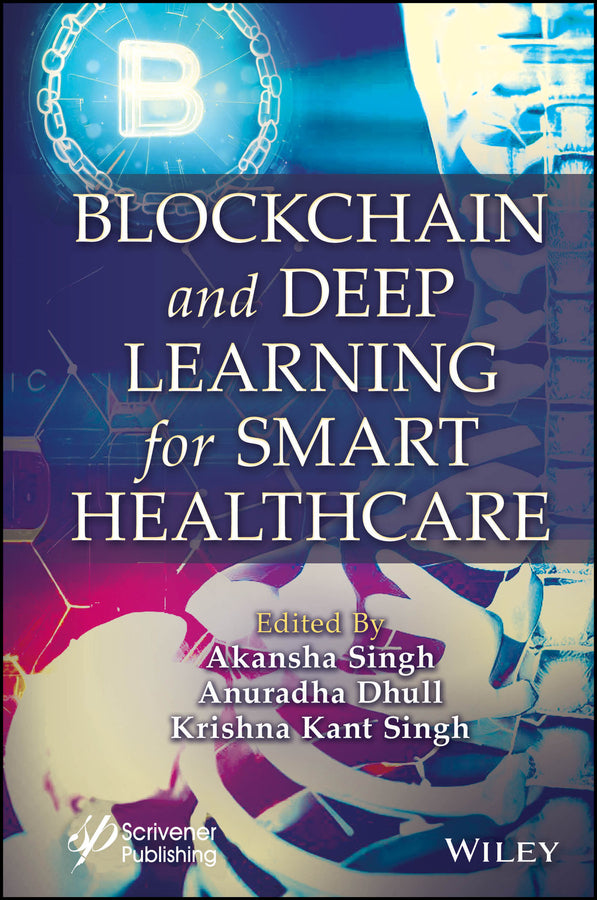
Blockchain and Deep Learning for Smart Healthcare
Akansha Singh (Edited by), Anuradha Dhull (Edited by), Krishna Kant Singh (Edited by)
9781119791744, Wiley
Hardback, published 3 May 2024
480 pages
22.9 x 15.2 x 2.9 cm, 0.966 kg
BLOCKCHAIN and DEEP LEARNING for SMART HEALTHCARE The book discusses the popular use cases and applications of blockchain technology and deep learning in building smart healthcare. The book covers the integration of blockchain technology and deep learning for making smart healthcare systems. Blockchain is used for health record-keeping, clinical trials, patient monitoring, improving safety, displaying information, and transparency. Deep learning is also showing vast potential in the healthcare domain. With the collection of large quantities of patient records and data, and a trend toward personalized treatments. there is a great need for automated and reliable processing and analysis of health information. This book covers the popular use cases and applications of both the above-mentioned technologies in making smart healthcare. Audience Comprises professionals and researchers working in the fields of deep learning, blockchain technology, healthcare & medical informatics. In addition, as the book provides insights into the convergence of deep learning and blockchain technology in healthcare systems and services, medical practitioners as well as healthcare professionals will find this essential reading.
Preface xv Part 1: Blockchain Fundamentals and Applications 1 1 Blockchain Technology: Concepts and Applications 3 1.1 Introduction 3 1.2 Blockchain Types 4 1.3 Consensus 8 1.4 How Does Blockchain Work? 10 1.5 Need of Blockchain 12 1.6 Uses of Blockchain 12 1.7 Evolution of Blockchain 14 1.8 Blockchain in Ethereum 17 1.9 Advantages of Smart Contracts 21 1.10 Use Cases of Smart Contracts 21 1.11 Real-Life Example of Smart Contracts 22 1.12 Blockchain in Decentralized Applications 22 1.13 Decentraland 25 1.14 Challenges Faced by Blockchain 27 1.15 Weaknesses of Blockchain 29 1.16 Future of Blockchain 30 1.17 Conclusion 31 2 Blockchain with Federated Learning for Secure Healthcare Applications 35 2.1 Introduction 36 2.2 Federated Learning 36 2.3 Motivation 37 2.4 Federated Machine Learning 38 2.5 Federated Learning Frameworks 39 2.6 FL Perspective for Blockchain and IoT 39 2.7 Federated Learning Applications 41 2.8 Limitations 42 3 Futuristic Challenges in Blockchain Technologies 45 3.1 Introduction 46 3.2 Blockchain 47 3.3 Issues and Challenges with Blockchain 53 3.4 Internet of Things (IoT) 58 3.5 Background of IoT 59 3.6 Conclusion 67 4 AIML-Based Blockchain Solutions for IoMT 73 4.1 Introduction 74 4.2 Objective and Contribution 75 4.3 Security Challenges in Different Domains 76 4.4 Healthcare 77 4.5 Agriculture 77 4.6 Transportation 78 4.7 Smart Grid 78 4.8 Smart City 78 4.9 Smart Home 79 4.10 Communication 79 4.11 Security Attacks in IoT 81 4.12 Solutions for Addressing Security Using Machine Learning 83 4.13 Solutions for Addressing Security Using Artificial Intelligence 83 4.14 Solutions for Addressing Security Using Blockchain 86 4.15 Summary 88 4.16 Critical Analysis 89 4.17 Conclusion 89 5 A Blockchain-Based Solution for Enhancing Security and Privacy in the Internet of Medical Things (IoMT) Used in e-Healthcare 95 5.1 Introduction: E-Health and Medical Services 96 5.2 Literature Review 98 5.3 Architecture of Blockchain-Enabled IoMT 101 5.4 Proposed Methodology 104 5.5 Conclusion and Future Work 108 6 A Review on the Role of Blockchain Technology in the Healthcare Domain 113 6.1 Introduction 113 6.2 Systematic Literature Methodology 119 6.3 Applications of Blockchain in the Healthcare Domain 122 6.4 Blockchain Challenges 136 6.5 Future Research Directions and Perspectives 139 6.6 Implications and Conclusion 140 7 Blockchain in Healthcare: Use Cases 147 7.1 Introduction 147 7.2 Challenges Faced in the Healthcare Sector 149 7.3 Use Cases of Blockchains in the Healthcare Sector 150 7.4 What is Medicalchain? 159 7.5 Implementing Blockchain in SCM 165 7.6 Why Use Blockchain in SCM 167 Part 2: Smart Healthcare 171 8 Potential of Blockchain Technology in Healthcare, Finance, and IoT: Past, Present, and Future 173 8.1 Introduction 173 8.2 Types of Blockchain 175 8.3 Literature Review 177 8.4 Methodology and Data Sources 188 8.5 The Application of Blockchain Technology Across Various Industries 189 8.6 Conclusion 199 9 AI-Enabled Techniques for Intelligent Transportation System for Smarter Use of the Transport Network for Healthcare Services 205 9.1 Introduction 206 9.2 Artificial Intelligence 208 9.3 Artificial Intelligence: Transport System and Healthcare 209 9.4 Artificial Intelligence Algorithms 211 9.5 AI Workflow 215 9.6 AI for ITS and e-Healthcare Tasks 216 9.7 Intelligent Transportation, Healthcare, and IoT 218 9.8 AI Techniques Used in ITS and e-Healthcare 221 9.9 Challenges of AI and ML in ITS and e-Healthcare 223 9.10 Conclusions 225 10 Classification of Dementia Using Statistical First-Order and Second-Order Features 235 10.1 Introduction 236 10.2 Materials and Methods 238 10.3 Proposed Framework 239 10.4 Experimental Results and Discussion 247 10.5 Conclusion 251 11 Pulmonary Embolism Detection Using Machine and Deep Learning Techniques 257 11.1 Introduction 257 11.2 The State-of-the-Art of PE Detection Models 260 11.3 Literature Survey 261 11.4 Publications Analysis 270 11.5 Conclusion 270 12 Computer Vision Techniques for Smart Healthcare Infrastructure 277 12.1 Introduction 278 12.2 Literature Survey 280 12.3 Proposed Idea 308 12.4 Results 316 12.5 Conclusion 317 13 Energy-Efficient Fog-Assisted System for Monitoring Diabetic Patients with Cardiovascular Disease 323 13.1 Introduction 324 13.2 Literature Review 326 13.3 Architectural Design of the Proposed Framework 328 13.4 Fog Services 330 13.5 Smart Gateway and Fog Services Implementation 337 13.6 Cloud Servers 338 13.7 Experimental Results 339 13.8 Future Directions 345 13.9 Conclusion 350 14 Medical Appliances Energy Consumption Prediction Using Various Machine Learning Algorithms 353 14.1 Introduction 354 14.2 Literature Review 355 14.3 Methodology 356 14.4 Machine Learning Algorithms Used 364 14.5 Results and Analysis 368 14.6 Model Analysis 369 14.7 Conclusion and Future Work 374 Part 3: Future of Blockchain and Deep Learning 379 15 Deep Learning-Based Smart e-Healthcare for Critical Babies in Hospitals 381 15.1 Introduction 382 15.2 Literature Survey 383 15.3 Evaluation Criteria 392 15.4 Results 393 15.5 Conclusion and Future Scope 394 16 An Improved Random Forest Feature Selection Method for Predicting the Patient’s Characteristics 399 16.1 Introduction 400 16.2 Literature Survey 402 16.3 Dataset 403 16.4 Data Analysis 406 16.5 Data Pre-Processing 407 16.6 Feature Selection Methods 408 16.7 Variable Importance by Machine Learning Methods 414 16.8 Random Forest Feature Selection 415 16.9 Proposed Methodology 418 16.10 Results and Discussion 420 16.11 Conclusion 421 17 Blockchain and Deep Learning: Research Challenges, Open Problems, and Future 425 17.1 Introduction 426 17.2 Research Challenges 427 17.3 Open Problems 428 17.4 Future Possibilities 429 17.5 Conclusion 430 References 431 Index 433
Hermehar Pal Singh Bedi, Valentina E. Balas, Sukhpreet Kaur and Rubal Jeet
Akansha Singh and Krishna Kant Singh
Arun Kumar Singh, Sandeep Saxena, Ashish Tripathi, Arjun Singh and Shrikant Tiwari
Rishita Khurana, Manika Choudhary, Akansha Singh and Krishna Kant Singh
Meenakshi and Preeti Sharma
Aryan Dahiya, Anuradha, Shilpa Mahajan and Swati Gupta
Utsav Sharma, Aditi Ganapathi, Akansha Singh and Krishna Kant Singh
Chetna Tiwari and Anuradha
Meenakshi and Preeti Sharma
Deepika Bansal and Rita Chhikara
Renu Vadhera, Meghna Sharma and Priyanka Vashisht
Reshu Agarwal
Rishita Khurana, Manika Choudhary, Akansha Singh and Krishna Kant Singh
Kaustubh Pagar, Tarun Jain, Horesh Kumar, Aditya Bhardwaj and Rohit Handa
Ritam Dutta
K. Indhumathi and K. Sathesh Kumar
Akansha Singh and Krishna Kant Singh
Subject Areas: Computer science [UY]