Freshly Printed - allow 10 days lead
Couldn't load pickup availability
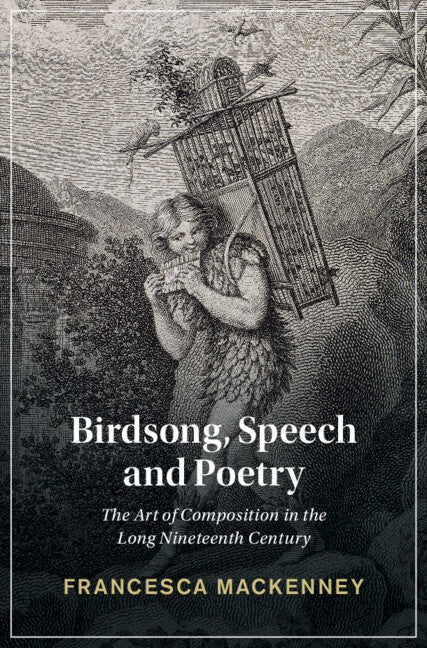
Birdsong, Speech and Poetry
The Art of Composition in the Long Nineteenth Century
Illuminating the poetry of birdsong in the Romantic and Victorian periods, this timely study dissects historical attitudes to nonhuman life.
Francesca Mackenney (Author)
9781316513712, Cambridge University Press
Hardback, published 22 September 2022
256 pages
23.5 x 15.8 x 1.9 cm, 0.52 kg
'… an impressive contribution to the recent critical conversation on this subject… Mackenney is distinctive in focusing on the epistemological and moral questions that were raised for the Victorians by the 'special affinities between birdsong and human speech'.… By examining what might seem a narrow subject at first glance - birdsong in nineteenth-century poetry - Mackenney shows how, then and now, poetry raises crucial questions about humanity and the lives of other animals.' Lee Behlman, SEL Studies in English Literature 1500–1900
In the long nineteenth century, scientists discovered striking similarities between how birds learn to sing and how children learn to speak. Tracing the 'science of birdsong' as it developed from the 'ingenious' experiments of Daines Barrington to the evolutionary arguments of Charles Darwin, Francesca Mackenney reveals a legacy of thought which informs, and consequently affords fresh insights into, a canonical group of poems about birdsong in the Romantic and Victorian periods. With a particular focus on the writings of Samuel Taylor Coleridge, the Wordsworth siblings, John Clare and Thomas Hardy, her book explores how poets responded to an analogy which challenged definitions of language and therefore of what it means to be human. Drawing together responses to birdsong in science, music and poetry, her distinctive interdisciplinary approach challenges many of the long-standing cultural assumptions which have shaped (and continue to shape) how we respond to other creatures in the Anthropocene.
Introduction
1. The science of birdsong: 1773-1871
2. The science of language: 1755-1873
3. 'Prelusive notes': Coleridge and the Wordsworths
4. 'Undersong': John Clare
5. 'We Teach 'Em Airs That Way': Thomas Hardy
Conclusion
Bibliography
Index.
Subject Areas: Literary studies: poetry & poets [DSC], Literature: history & criticism [DS], Literature & literary studies [D]