Freshly Printed - allow 10 days lead
Couldn't load pickup availability
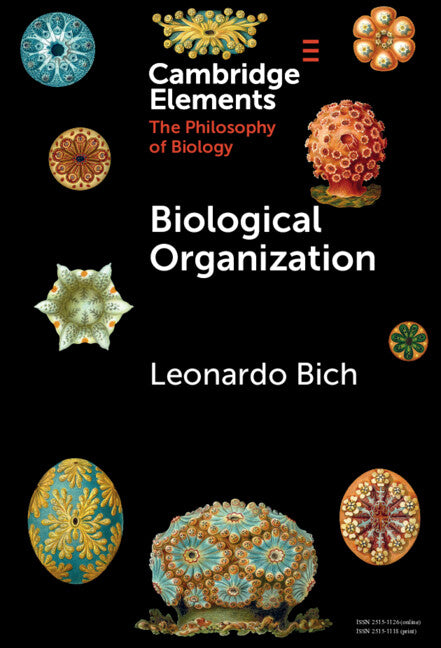
Biological Organization
This Element critically explores terrorism, counterterrorism, and the US government's war on terror after 9/11 terror attacks.
Leonardo Bich (Author)
9781009539401, Cambridge University Press
Hardback, published 9 January 2025
82 pages
22.9 x 15.2 x 0.6 cm, 0.255 kg
'This volume provides readers with a broad introduction and overview of efforts to understand why and how living systems come to be and operate the way they do by appealing to how they are organized …' Armin P. Moczek, The Quarterly Review of Biology
Living systems are complex systems made of components that tend to degrade, but nonetheless they maintain themselves far from equilibrium. This requires living systems to extract energy and materials from the environment and use them to build and repair their parts by regulating their activities based on their internal and external conditions in ways that allow them to keep living. The philosophical and theoretical approach discussed in this Element aims to explain these features of biological systems by appealing to their organization. It addresses classical and more recent issues in philosophy of biology, fromorigins and definitions of life to biological teleology and functions, from an original perspective mainly focused on the living system, its physiology and behavior, rather than evolution. It discusses and revises the conceptual foundations of this approach and presents an updated version of it. This title is also available as Open Access on Cambridge Core.
1. Introduction: understanding what makes a system living
2. Different uses of organization: organizational motifs, organizing principles, and the organizational framework
3. Biological organization as a self-maintaining causal regime: from autopoiesis to closure of constraints
4. Reinterpreting closure: from basic self-maintenance to regulatory control
5. Naturalizing biological teleology and functions
6. Interpreting biological phenomena through the lens of organization
7. Bridging philosophical frameworks: organization and mechanisms
8. Open challenges: symbiotic associations and the environment
References.
Subject Areas: Philosophy [HP]