Freshly Printed - allow 7 days lead
Couldn't load pickup availability
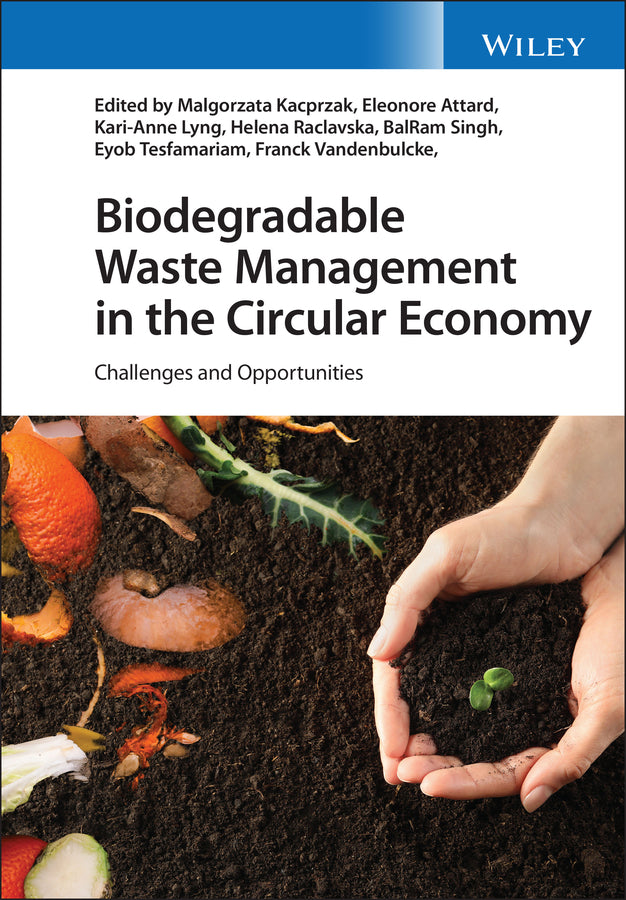
Biodegradable Waste Management in the Circular Economy
Challenges and Opportunities
Malgorzata Kacprzak (Edited by), Eleonore Attard (Edited by), Kari-Anne Lyng (Edited by), Helena Raclavska (Edited by), BalRam Singh (Edited by), Eyob Tesfamariam (Edited by), Franck Vandenbulcke (Edited by)
9781119679844, Wiley
Hardback, published 14 July 2022
592 pages
24.4 x 17 x 1.5 cm, 0.68 kg
Biodegradable Waste Management in the Circular Economy Presents the major developments in new technologies and strategies for more effective recovery of matter, resources, and energy from biodegradable waste The volume of biodegradable waste produced worldwide is progressively increasing—a trend that is predicted to continue well into the foreseeable future. Developing sustainable, cost-effective, and eco-friendly approaches for processing food waste, agricultural and organic industrial waste, cardboard, biodegradable plastics, sewage sludge, and other types of biodegradable waste is one of the most significant challenges of the coming decades. Biodegradable Waste Management in the Circular Economy provides a detailed overview of the latest advances in the management of biomass for economic development. Featuring contributions from an interdisciplinary team of experts, this comprehensive resource addresses various technologies and strategies for recycling organic matter and many other renewable compounds. In-depth chapters describe the concept of circular economy, identify new sources of biodegradable waste, explore technologies for the production of biodegradable waste end-products, discuss the positive and negative effects of end-products on soil and the environment, and more. Throughout the text, the authors explore systematic approaches for secure biodegradable management in various countries and regions around the world. Reflecting the latest trends in the rapidly changing field, Biodegradable Waste Management in the Circular Economy is essential reading for researchers, engineers, scientists, and consultants working in waste engineering and management, resource recovery, renewable resources, environmental science, agricultural and environmental engineering, soil science, and bioenergy.
Preface 1.Circular Bioeconomy and Sustainability 2. Cradle to Cradle Marketplace 3. New Products from Old Wastes Concept – Analysis of the Current State of CE in the Biodegradable Waste Management 3.1. Valorization to Energy 3.2. Valorization to Matter 3.3. Valorization of Food Waste to Food 4. Definitions and the Procedures for Characterization of Biodegradable Waste 5. Biodegradable Waste Streams 6. Limitation for Use of Biodegradable Waste onto Soil 6.1. Organic, Inorganic, and Microbiological Contaminations in Biodegradable Waste 6.2. Toxicity Assessment 7. Biodegradable Waste Collection Systems 8. Anaerobic digestion 9. Types of Composting 9.1 Composting 9.2. Vermicomposting 10. Biorefineries 11. Impact of Processing Technology on the Chemical Contaminants Occurrence in End Products 12. Effect of End Products on the Soil Microbial Communities 12.1. Impact of End Products on Microbial Communities with Special Reference to Pathogens 12.2 Modification of Bio-wastes for Alteration of Soil Microbial Communities 13. The Use of End Products on Soil 13.1. The Use of Biodegradable End Products on Soil – Impact on Plant Productivity 13.2. Biodegradable End Products for Bioremediation of Degraded Areas 13.3. The Use of Biodegradable End Products for Reclamation of Metal Contaminated Soils 13.4. Biodegradable Waste: Ecotoxicological/Environmental Assessment 14. Restoration, Sequestration, and Modelling of Carbon in Degraded Soils 15. Impact of Treatments of Biodegradable Waste for Nutrient Recovery 16. Energy and Biomethane Production 17. The Governance and Social Aspects 18. Biofuels – More Than Electricity, Heat, and Biomethane 18.1. The Role of Biofuels in the Circular Economy 18.2. Metal Recovery 18.3. Biosorbents and Biochar Production 18.4. Other Perspectives (e.g. Chitin Recovery, Carbon-Coated Magnet-Sensitive Nanoparticles, Proteins, Carbohydrates, and Humic Acid) 18.5. Biofuel Production from Agricultural Waste Index
Işıl Aksan Kurnaz, Elif Damla Arison, and M. Levent Kurnaz
Małgorzata J. Kacpraz
Ewa Neczaj and Anna Grosser
Kari-Anne Lyng and Aneta Kowalska
Kari-Anne Lyng
Helena Raclavská, Jana Růičková, Marek Kucbel, Barbora Švédová, and Konstantin Raclavský
Helena Raclavská, Jana Růičková, Barbora Švédová, Marek Kucbel, Michal Šafář, Konstantin Raclavský, and Elton Luis Da Silva Abel
Krzysztof Fijałkowski and Anna Kwarciak-Kozłowska
Krzysztof Fijałkowski and Anna Kwarciak-Kozłowska
Jolanta Sobik-Szołtysek
Anna Grosser and Ewa Neczaj
Shahriar Shams and Beston F. Nore
Agnieszka Rorat and Franck Vandenbulcke
Anna Grosser and Ewa Neczaj
Eyob Habte Tesfamariam, Taruvinga Badza, and Craig Cogger
Daquan Sun, Eléonore Attard, and Rémy Guyoneaud
Daquan Sun
Bal Ram Singh, Anna Grobelak, Aneta Kowalska, and Åsgeir Almås
Aneta Kowalska, Anna Grobelak, Åsgeir Almås, and Bal Ram Singh
Åsgeir Almås, Aneta Kowalska, Anna Grobelak, and Bal Ram Singh
Pauline Courtois, Axel Beauchamp, and Franck Vandenbulcke
Kennedy Were, Bal Ram Singh, Eleanor Milne, and George Ayaga
Eyob Habte Tesfamariam, Craig Cogger, and John Ngoni Zvimba
Dagmar Juchelková, Helena Raclavská, Maw Maw Tun, Klaus Koppe, Abdulaziz Atabani, Barbora Švédová, and Marek Kucbel
Małgorzata Kacprzak and Iwona Kupich
Kari-Anne Lyng
Agata Rosińska
Anna Grobelak, Agata Rosińska
Agata Rosińska
Esra Meşe Erdoğan, Pınar Karagöz, Enes Yilmaz, and Melek Özkan
Subject Areas: Chemistry [PN]