Freshly Printed - allow 10 days lead
Couldn't load pickup availability
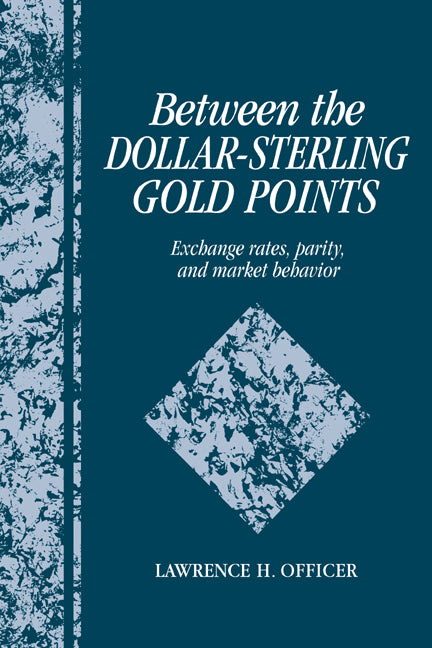
Between the Dollar-Sterling Gold Points
Exchange Rates, Parity and Market Behavior
This book investigates US-UK monetary relations, 1791 to 1931.
Lawrence H. Officer (Author)
9780521038218, Cambridge University Press
Paperback / softback, published 2 July 2007
368 pages
22.7 x 15.1 x 2 cm, 0.551 kg
'… the book is a beautiful example of the best kind of analysis of market micro-structure, and deserves to be on the shelves of any serious student of the history of the dollar-sterling exchange rate.' The Economic Journal
Officer begins this book with a historical perspective of the monetary standards of the United States and Britain. He then develops data on exchange rates, mint parity and gold points, with which he investigates three important features of Anglo-American monetary history. First, the integration of the American foreign-exchange market over time. Second, it is proved that gold-point arbitrage is markedly more efficient than either interest arbitrage or forward speculation. Third, regime efficiency is explored from standpoints of both private agents and policy-makers; the 1925–1931 gold standard, though less durable than the pre-war standard, is nevertheless shown to be surprisingly stable. The book will serve as a Dollar-Sterling handbook for those interested in this important aspect of international monetary history.
List of figures
List of tables
Preface
List of symbols
1. Introduction
Part I. Monetary Standards: 2. The various monetary standards
3. American monetary standard
4. British monetary standard
Part II. Exchange Rate: 5. Parity
6. Exchange-rate data
7. Exchange-market integration
Part III. Gold Points: 8. Gold points: theory and practice
9. Gold-point estimates
Part IV. External and Internal Integration: 10. External integration
11. Internal integration
Part V. Market Efficiency: 12. Theory of market efficiency
13. Empirical testing of market efficiency
Part VI. Regime Efficiency
14. Market forces
15. Policy variables
16. Net outcome
Part VII. Conclusions: 17. Summary and conclusions
Notes
References
Index.
Subject Areas: Monetary economics [KCBM]