Freshly Printed - allow 10 days lead
Couldn't load pickup availability
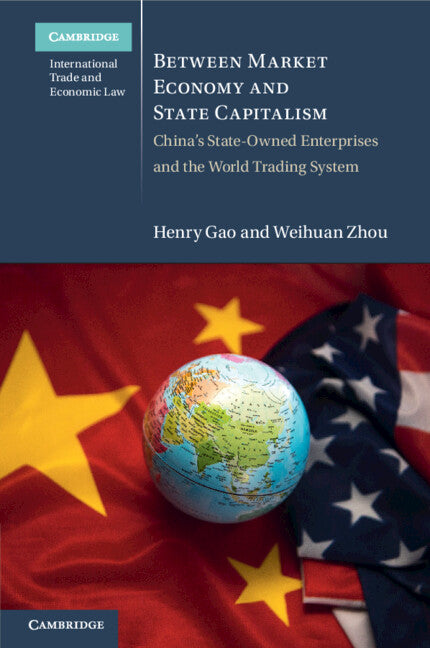
Between Market Economy and State Capitalism
China's State-Owned Enterprises and the World Trading System
The WTO provides tools to address China's state capitalism and should be the preferred forum for negotiations on SOE's and industrial subsidies.
Henry Gao (Author), Weihuan Zhou (Author)
9781108828499, Cambridge University Press
Paperback / softback, published 14 November 2024
224 pages
22.9 x 15.2 x 1.2 cm, 0.331 kg
'Recommended.' R. M. Ramazani, Choice
One major issue facing the world trading system today is how to deal with the challenge of China's state capitalism. Many commentators believe that the existing WTO rules are insufficient and, thus new rules are needed. This book challenges this conventional wisdom. Through meticulous studies and fresh analysis of the commitments in China's WTO accession package, existing rules on state capitalism in WTO agreements and recent attempts to make new rules on these issues at the bilateral, regional and multilateral levels, this book argues that existing WTO rules, especially those on subsidies, coupled with China-specific rules in its accession protocol, do provide feasible tools to counter China's state capitalism. This book also discusses the reasons for the lack of usage of these rules and provides concrete policy suggestions on how the rules may be better utilized, as well as how to conduct constructive negotiations on new rules in the WTO and beyond.
1. China, state capitalism and the World Trading System
2. The evolution of China's reforms of State-Owned Enterprises (1978–2020)
3. State capitalism in China's accession to the WTO: concerns and solutions
4. The limits of general WTO rules
5. The potential of WTO rules on industrial subsidies and China-specific obligations
6. Emerging approaches to regulating State-Owned Enterprises: the comprehensive and progressive agreement for Trans-Pacific Partnership (CPTPP) and Post-CPTPP free trade agreements
7. Tackling China's state capitalism: WTO litigation and trade negotiation
8. Conclusion: the potential of multilateralism.
Subject Areas: International organisations & institutions [LBBU], International economic & trade law [LBBM], Law [L], International economics [KCL], United Nations & UN agencies [JPSN1], International relations [JPS]