Freshly Printed - allow 10 days lead
Couldn't load pickup availability
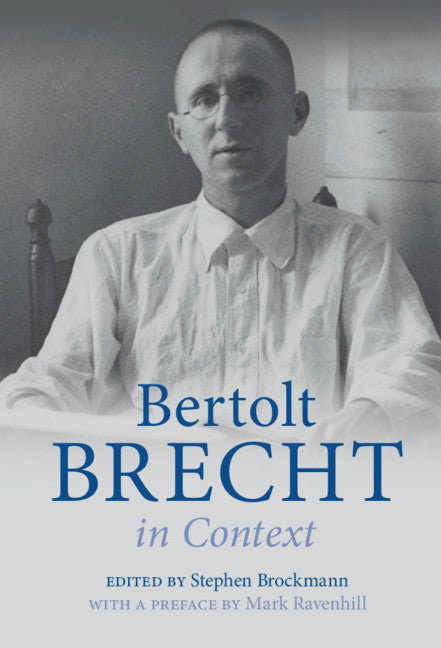
Bertolt Brecht in Context
Bertolt Brecht in Context examines Brecht's significance and contributions as a writer and the most influential playwright of the twentieth century.
Stephen Brockmann (Edited by)
9781108426466, Cambridge University Press
Hardback, published 10 June 2021
372 pages
23.5 x 15.8 x 2.2 cm, 0.69 kg
'Brockmann's Brecht is a forward-looking one. The excellent bibliography and index make this a useful book for readers wanting to find their way round and forge their own connections … The best contributions start to rethink Brecht for the future too … Indeed, the volume as a whole suggests that the new Brecht, indeed the new 'Brechts', will be relevant for English-language scholars, both students and practitioners, for a long time to come.' Karen Leeder, Modern Language Review
Bertolt Brecht in Context examines Brecht's significance and contributions as a writer and the most influential playwright of the twentieth century. It explores the specific context from which he emerged in imperial Germany during the late nineteenth and early twentieth centuries, as well as Brecht's response to the turbulent German history of the twentieth century: World Wars One and Two, the Weimar Republic, the Nazi dictatorship, the experience of exile, and ultimately the division of Germany into two competing political blocs divided by the postwar Iron Curtain. Throughout this turbulence, and in spite of it, Brecht managed to remain extraordinarily productive, revolutionizing the theater of the twentieth century and developing a new approach to language and performance. Because of his unparalleled radicalism and influence, Brecht remains controversial to this day. This book – with a Foreword by Mark Ravenhill – lays out in clear and accessible language the shape of Brecht's contribution and the reasons for his ongoing influence.
Introduction Stephen Brockmann
Part II. Brecht's World: 1. Brecht's Augsburg years Jürgen Hillesheim
2. Models for epic theater from the Munich years: Wedekind and Valentin Meg Mumford
3. Brecht in the Weimar republic Ronald Speirs
4. Brecht's emergence as a young poet Dorothee Ostmeier
5. Brecht and music: the fly in the amber Joachim Lucchesi
6. Brecht and political theater Laura Bradley
7. Brecht and Germany Stephen Brockmann
8. '[She] made suggestions. We took them': Brecht's women collaborators Paula Hanssen
9. Brecht's interviews Noah Willumsen
10. Brecht and exile Johannes Evelein
11. Brecht and the German Democratic Republic Mark Clark
12. The Berliner Ensemble David Barnett
Part II. Brecht's Work: 13. The work of the theater Marc Silberman
14. Brecht and Marxism Anthony Squiers
15. Brecht and photography Tom Kuhn
16. Brecht and film: medium and masses Theodore F. Rippey
17. Brecht and fiction Ernest Schonfield
18. Gestus in context Sabine Hake
19. Brecht's ethics Markus Wessendorf
20. Brecht and dialectics Joseph Dial
21. Brecht and east Asia Antony Tatlow
22. Brecht's work with musical composers Vera Stegmann
Part III. The World's Brecht: 23. Brecht and feminism Helen Fehervary
24. Brecht in southern Africa Loren Kruger
25. Brecht in the creation, production, and analysis of opera today Joy Calico
26. Brecht and his biographers Jost Hermand
27. Brecht editions Erdmut Wizisla
28. Brecht and German studies Hunter Bivens
29. Beginning where Brecht left off: Heiner Müller and Brecht's legacy Janine Ludwig
30. Bertolt Brecht in Brazil Jürgen Pelzer
31. World spirit versus spirit of the age: Brecht's impact and influence on East German literature and culture Kerstin Hensel
32. Brecht in fiction Robert Cohen
33. Brecht and contemporary experimental theater Nikolaus Müller-Schöll
34. Brecht and US actor training Wendy Arons
35. Brecht and transcultural theater Günther Heeg
36. Thinking Brecht in(to) the university Norman Roessler
37. 'Shrunk in translation' or: the (Ir)resistible rise of the old traduttore/traditore tradition…. Michael Morley.
Subject Areas: Literary studies: plays & playwrights [DSG], Literary studies: poetry & poets [DSC], Literary studies: from c 1900 - [DSBH], Theatre studies [AN]