Freshly Printed - allow 10 days lead
Couldn't load pickup availability
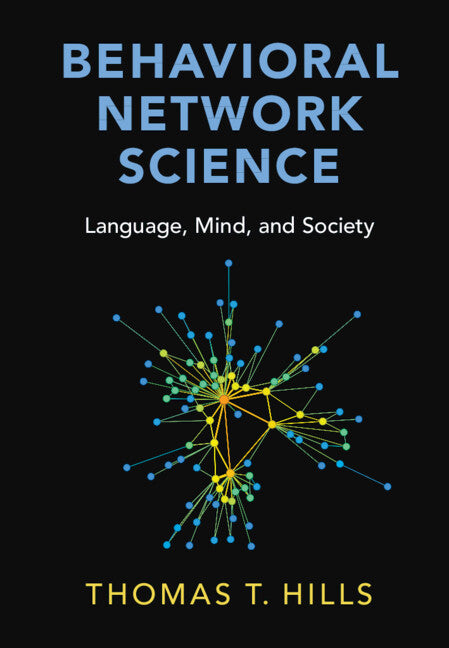
Behavioral Network Science
Language, Mind, and Society
An introduction to network science for social and behavioural researchers, with online R code and simulations.
Thomas T. Hills (Author)
9781108835404, Cambridge University Press
Hardback, published 19 December 2024
428 pages
26.1 x 18.3 x 2.6 cm, 0.89 kg
'Behavioral Network Science takes the reader from the basics of graph theory to advanced topics, all the while linking to studies of behavior. It's network science for cognitive science. Thomas Hills brings the material to life, providing the reader with a valuable perspective on the structure of behavior.' Brad Love, University College London
Behavioral Network Science explains how and why structure matters in the behavioral sciences. Exploring open questions in language evolution, child language learning, memory search, age-related cognitive decline, creativity, group problem solving, opinion dynamics, conspiracies, and conflict, readers will learn essential behavioral science theory alongside novel network science applications. This book also contains an introductory guide to network science, demonstrating how to turn data into networks, quantify network structure across scales, and hone one's intuition for how structure arises and evolves. Online R code allows readers to explore the data and reproduce all the visualizations and simulations for themselves, empowering them to make contributions of their own. For data scientists interested in gaining a professional understanding of how the behavioral sciences inform network science, or behavioral scientists interested in learning how to apply network science from the ground up, this book is an essential guide.
Part I. A Brief Guide to Network Science: 1. Making and recognizing networks
2. Network metrics
3. Generative network models and network evolution
Part II. Language and Learning: 4. Zipf's law of meaning: the degree distribution of the mind
5. Network learning: growing a lexicon by degrees
6. What is distinctive: exploring edge types in multi-layer networks
7. The small-world spectrum: using small worlds to compare networks
8. The birthplace of new words: identifying node origins
9. Agent-Based models of language emergence: structure favors the orangutan
Part III. Mental Processes: 10. False memories: spreading activation in memory networks
11. Cognitive foraging: exploration versus exploitation in memory search
12. Age-related Cognitive Decline: a network enrichment account
13. Creativity: how noisy processes create novel structure
Part IV. Social Dynamics: 14. Network illusions: how structure misleads us
15. Group problem solving: harnessing the wisdom of the crowds
16. The Segregation of belief: how structure facilitates false consensus
17. The conspiracy frame: coherence through self-supporting beliefs
18. The Kennedy paradox: games of conflict and escalation
19. Fund people not projects: a universal basic income for research
References.
Subject Areas: Cognition & cognitive psychology [JMR]